



Agriculture PS Rono Flags Off 2 Million 50-Kilogramme Bags of Fertiliser for Tea Farmers
The flagging off of approximately 99,000 metric tonnes of fertiliser, equivalent to about two million 50kg bags, by Agriculture PS Dr Kipronoh Rono alongside KTDA Holdings National Chairman Enos Njeru at the Port of Mombasa is an important development for Kenya's tea industry. The exercise is intended to ensure that smallholder tea farmers receive fertiliser in time to support soil fertility, tea-bush health and green-leaf production. KTDA has stressed that timely application is essential for maintaining productivity, quality and farmer returns. PS Rono's call for faster distribution and stronger farmer sensitisation highlights the importance of ensuring that the fertiliser does not merely arrive in Kenya but actually reaches farmers within the appropriate agricultural window. The initiative is also part of a wider effort to revitalise Kenya's tea sector through improved production, better marketing, value addition, scientific research, digital payment systems and stronger farmer support. Ultimately, the success of the programme will be measured not by the number of bags flagged off at Mombasa but by what happens on farms: whether farmers receive the fertiliser on time, whether it improves tea productivity and quality, and whether increased production translates into better and more reliable incomes for smallholder tea farmers. The development therefore represents an important moment for Kenya's tea industry, particularly as farmers prepare for the coming rains and the next production cycle.
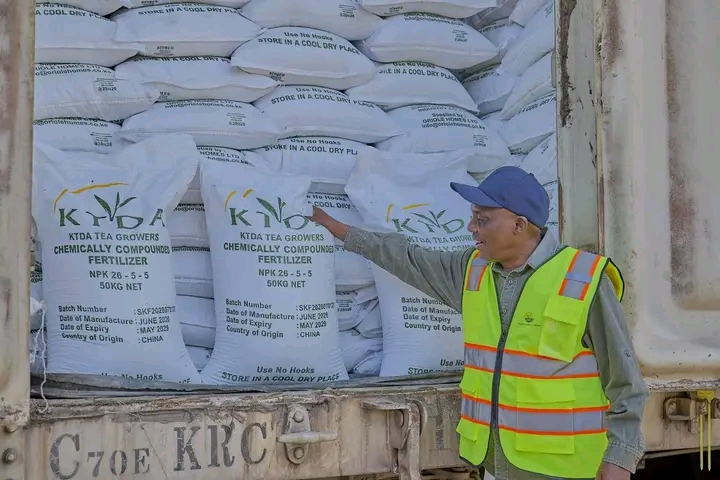
A major development in Kenya’s agricultural sector has taken place today, September 8, 2026, following the flagging off of the first consignment of approximately 99,000 metric tonnes of fertiliser, equivalent to about 2 million 50-kilogramme bags, destined for smallholder tea farmers across the country. The exercise was led by Agriculture Principal Secretary Dr Kipronoh Rono, alongside KTDA Holdings National Chairman Enos Njeru, at the Port of Mombasa.
The development is significant because fertiliser is one of the most important inputs in tea production. The availability of the fertiliser at the right time is expected to help farmers replenish soil nutrients, maintain healthy tea bushes and improve green-leaf production as the country approaches the short-rains season. KTDA has described the initiative as part of its commitment to putting farmers first and ensuring that critical agricultural inputs reach growers when they are needed.
*The flag-off at the Port of Mombasa*
The first consignment was flagged off at the Port of Mombasa, marking the beginning of the movement of the fertiliser from the coastal entry point to tea-growing regions around Kenya.
According to information released by KTDA, the consignment contains about 99,000 metric tonnes of fertiliser, which is approximately equivalent to two million 50kg bags. The fertiliser is intended to support smallholder tea farmers across the country.
Dr Kipronoh Rono, the Principal Secretary in the State Department for Agriculture, participated in the flag-off together with KTDA National Chairman Enos Njeru. The event also brought together senior officials from the tea industry, including Tea Board of Kenya Managing Director Willy Mutai, KTDA management officials and other stakeholders.
The movement of the fertiliser is particularly important because tea farmers depend heavily on proper nutrient management to maintain productivity. Tea is a perennial crop, meaning that farmers harvest from the same bushes for many years. Consequently, nutrients continuously removed from the soil through harvesting need to be replaced.
The availability of fertiliser therefore has a direct relationship with the productivity of tea farms and, ultimately, the earnings of farmers.
Why the two million bags are important
The two million bags represent a substantial agricultural input for Kenya's tea industry. KTDA had earlier announced plans to procure approximately 99,000 metric tonnes of fertiliser for the 2026/27 season. Earlier reports indicated that the consignment was intended for more than 600,000 tea farmers, while KTDA procurement information had also referred to more than 750,000 smallholder growers in connection with the planned fertiliser import.
The difference in the farmer numbers reported in different stages of the programme appears to reflect different descriptions of the intended beneficiary base. The most recent flag-off communication focuses on the fertiliser being distributed to smallholder tea farmers nationally.
The fertiliser is not simply a commodity being moved from the port. It represents an important production input for thousands of rural households whose livelihoods depend on tea.
For many farmers, tea provides regular income throughout the year. When the bushes receive adequate nutrients and weather conditions are favourable, the plants can produce more vigorous shoots, which are harvested as green leaf and delivered to factories.
Consequently, the availability of fertiliser can influence production, factory utilisation, farmer payments and the wider rural economy.
Timing is a major issue
One of the most important messages emerging from the flag-off is the emphasis on timely application.
KTDA National Chairman Enos Njeru said the timing of the fertiliser distribution is critical because farmers have an appropriate window in which to apply the input. According to KTDA, timely fertiliser application helps replenish essential soil nutrients, supports healthy tea-bush growth and promotes vigorous leaf production.
This is especially important because fertiliser applied at the wrong time may not deliver the expected benefits.
Tea requires continuous nutrient management. Nitrogen, phosphorus and potassium, among other nutrients, play different roles in plant development. Nitrogen is particularly important for vegetative growth, while phosphorus contributes to root development and other physiological functions. Potassium helps plants with several processes, including water regulation and overall resilience.
For tea farmers, the objective is therefore not merely to obtain fertiliser but to apply the correct fertiliser at the appropriate time and in accordance with agronomic recommendations.
*The role of KTDA*
The Kenya Tea Development Agency plays a major role in supporting smallholder tea farmers through the tea value chain.
The organisation is involved in supporting tea factories serving smallholder farmers and facilitating services connected with production and processing.
The fertiliser programme demonstrates the importance of coordination between government and farmer institutions. The government, through the Agriculture Ministry, provides policy direction and oversight, while KTDA is responsible for ensuring that the input reaches tea farmers through the tea factory network.
The successful distribution of nearly 99,000 tonnes of fertiliser therefore requires substantial logistical coordination.
The fertiliser has to move from the port to different destinations, where it can eventually reach individual farmers. This means transportation, storage, distribution planning and communication with farmers are all important components of the programme.
Fertiliser and the cost of tea production
Input costs are a major concern for agricultural producers.
Tea farmers have to deal with expenses related to labour, fertiliser, transport, farm maintenance and other activities. If the cost of production rises significantly while tea prices remain under pressure, farmers' profit margins can be squeezed.
The government and KTDA have therefore been paying attention to the affordability and accessibility of fertiliser.
Recent reporting indicated that the government subsidy programme would allow tea farmers to access the fertiliser at a subsidised price. A report published today stated that farmers would access the fertiliser at KSh2,000 per 50kg bag under the government subsidy programme.
However, farmers should rely on official KTDA, government and local factory communication for the exact price applicable to them because fertiliser pricing and distribution arrangements can change depending on the specific programme and implementation stage.
Rono's broader agricultural agenda
Dr Kipronoh Rono's participation in the flag-off comes at a time when the government is placing considerable emphasis on agricultural productivity, affordable inputs and food security.
The government has been implementing fertiliser interventions as part of its wider agricultural transformation agenda. Earlier in 2026, PS Rono also flagged off a separate consignment of two million bags under the National Fertiliser Subsidy Programme for farmers across the country. That earlier programme was intended to serve millions of farmers and involved distribution through NCPB depots, cooperatives and certified KTDA depots.
The latest exercise is particularly focused on tea farmers.
This distinction is important. While general fertiliser subsidy programmes support food-crop farmers, the latest KTDA-linked consignment is designed to address the specific needs of the tea sector.
Supporting tea productivity
The main objective of the fertiliser distribution is to support productivity.
Tea production depends heavily on the health of the tea bush. A healthy tea plant can produce better-quality shoots and sustain harvesting over a longer period.
When soils become depleted, productivity can decline. Fertiliser helps replenish nutrients removed from the soil through repeated harvesting.
This means that the two million bags could have a substantial effect on tea production if they are distributed and applied effectively.
However, fertiliser alone cannot solve all the challenges facing tea farmers.
Farmers also require good-quality planting material, effective extension services, proper soil management, pest and disease control, access to markets and favourable weather conditions.
This is why the government's broader tea-sector reforms will be important alongside the fertiliser programme.
Tea-sector reforms
The flag-off also comes amid wider efforts to reform Kenya's tea industry.
Recent statements by PS Rono have focused on improving the tea value chain and ensuring that farmers obtain better returns from their produce. In Kisii, for example, Rono called for measures to revitalise the tea sector, including stronger marketing arrangements and efforts to prevent tea hawking. The government has also highlighted opportunities for factories to sell tea directly to buyers, with the objective of improving market access and potentially increasing farmer earnings.
This suggests that the fertiliser distribution should be viewed as one part of a broader strategy rather than an isolated government exercise.
Improving production without addressing marketing challenges may not automatically result in better farmer incomes.
Farmers need both productivity and profitable markets.
Importance of the October rains
The timing of the fertiliser distribution is also linked to expected weather conditions.
Tea farmers depend heavily on rainfall, particularly because tea requires adequate moisture for continuous growth and leaf production.
Reports about the fertiliser procurement had indicated that the consignment was being planned for arrival ahead of the October short rains.
This makes September an important period for preparation.
Farmers need to receive their fertiliser early enough to follow recommended application schedules. If distribution is delayed until after the appropriate agronomic window, the benefits may be reduced.
This is why PS Rono has urged KTDA to expedite distribution and strengthen farmer sensitisation ahead of the rains.
Farmer sensitisation
Distribution is only one part of the programme.
Farmers must also know how to use the fertiliser properly.
Improper application can result in wastage, crop damage or limited benefits. Farmers therefore need guidance on application rates, timing, placement and other agronomic practices.
According to today's report, PS Rono urged KTDA to intensify farmer sensitisation as the fertiliser is distributed.
This is particularly important because farmers operate under different soil and climatic conditions. Soil testing and agronomic advice can help farmers understand the nutrient requirements of their farms.
Rono has also directed the Tea Research Institute to strengthen farmer support through measures including soil mapping, improved seedlings and data-driven research aimed at improving tea productivity and quality.
Digital systems and farmer payments
The fertiliser announcement comes alongside other proposed changes in the tea industry.
The government is also working on improving the transparency and efficiency of farmer payments. Today's report says that the Digital Green Leaf Payment System is being rolled out as part of efforts to promote timely and transparent payments to farmers.
This is important because farmers' concerns extend beyond production inputs.
A farmer may increase production but still struggle if payments are delayed or market returns are poor.
Digital payment systems can potentially make transactions more transparent, improve record keeping and reduce some administrative challenges.
Tea quality and value addition
Another issue highlighted by the government is tea quality.
The availability of fertiliser should ultimately contribute to maintaining productive, healthy tea bushes, but quality depends on much more than fertiliser.
Harvesting practices, processing standards, factory efficiency, transportation and marketing all influence the final value of Kenyan tea.
Rono has also indicated that a scientific tea-testing laboratory is ready and is expected to become fully operational within the next three months. Such facilities could support efforts to monitor tea quality and strengthen Kenya's position in international markets.
Value addition is another area that could help the industry.
Instead of relying heavily on bulk tea sales, increasing the amount of tea processed into higher-value products could create additional opportunities for farmers and the wider economy.
*What the flag-off means for farmers*
For tea farmers, the immediate concern is whether the fertiliser will reach them quickly and affordably.
The flag-off is therefore the beginning of a distribution process rather than the end.
The fertiliser must move from Mombasa to tea factories and eventually to individual farmers.
KTDA's network will be crucial in ensuring that the input reaches farmers across the different tea-growing regions.
The organisation has indicated that the fertiliser is destined for smallholder tea farmers nationally, while the government has urged rapid distribution to take advantage of the appropriate agricultural window.
Expected impact on the rural economy
The impact of the programme could extend beyond individual tea farms.
Tea supports millions of livelihoods directly and indirectly.
When farmers produce more green leaf, factories can operate more effectively. Increased factory activity creates demand for transport services, labour and other businesses.
Tea income also supports household expenditure on education, food, healthcare, housing and other needs.
Consequently, an improvement in tea production can have a multiplier effect in rural communities.
The fertiliser programme could therefore contribute not only to agricultural productivity but also to rural economic activity.
Challenges that remain
Despite the positive development, several challenges remain.
First is the need to ensure that the entire consignment is distributed efficiently.
Second is the need to ensure that fertiliser reaches genuine farmers and is not diverted or sold through unauthorised channels.
Third is the need for effective farmer education.
Fourth is the need to address the wider issue of tea prices and farmer earnings.
KTDA National Chairman Enos Njeru recently said the organisation was also working on diversifying markets for Kenyan tea following pressure on tea prices.
This shows that input support must be accompanied by market reforms.

You Might Also Like
-
President William Ruto's signing of the Kenya-Italy-GKSD health partnership on September 8, 2026, marks an important development in Kenya's efforts to expand healthcare infrastructure. The programme will provide for 15 hospitals in 15 counties — 13 Level 5 county referral hospitals and two Level 6
-
President William Ruto’s visit to Kericho County is therefore an important development event for the region. Governor Dr Eric Mutai, local leaders and residents have welcomed the President as he undertakes a tour focused on development and the implementation of government projects. The projects e
-
President William Ruto's visit to Bomet today is one of the county's major development events of 2026. Governor Prof. Hillary Barchok and other leaders have welcomed the President, while residents have been preparing to turn out and participate in the historic tour. The visit begins with an inspect
-
The inspection of Itembe Airstrip by Davis Chirchir, coming just ahead of President William Ruto's arrival in Bomet, places the airstrip at the centre of the President's development tour. The facility is undergoing a major rehabilitation involving a 1,000-metre asphalt runway, taxiways, an apron, d
-
Felix Koskei's speech in Londiani on September 7, 2026, was largely centred on reassuring residents about the future of the proposed Sh8 billion Londiani Referral Hospital. His most important message was clear: the government says the hospital will be constructed in Londiani and has not been moved
-
CS Lee Kinyanjui's clarification on work visas and permits for foreigners has come at a critical moment in Kenya's immigration and trade debate. The government's main position is straightforward: being allowed to enter Kenya without a visa or eTA does not automatically give a foreign national the r