



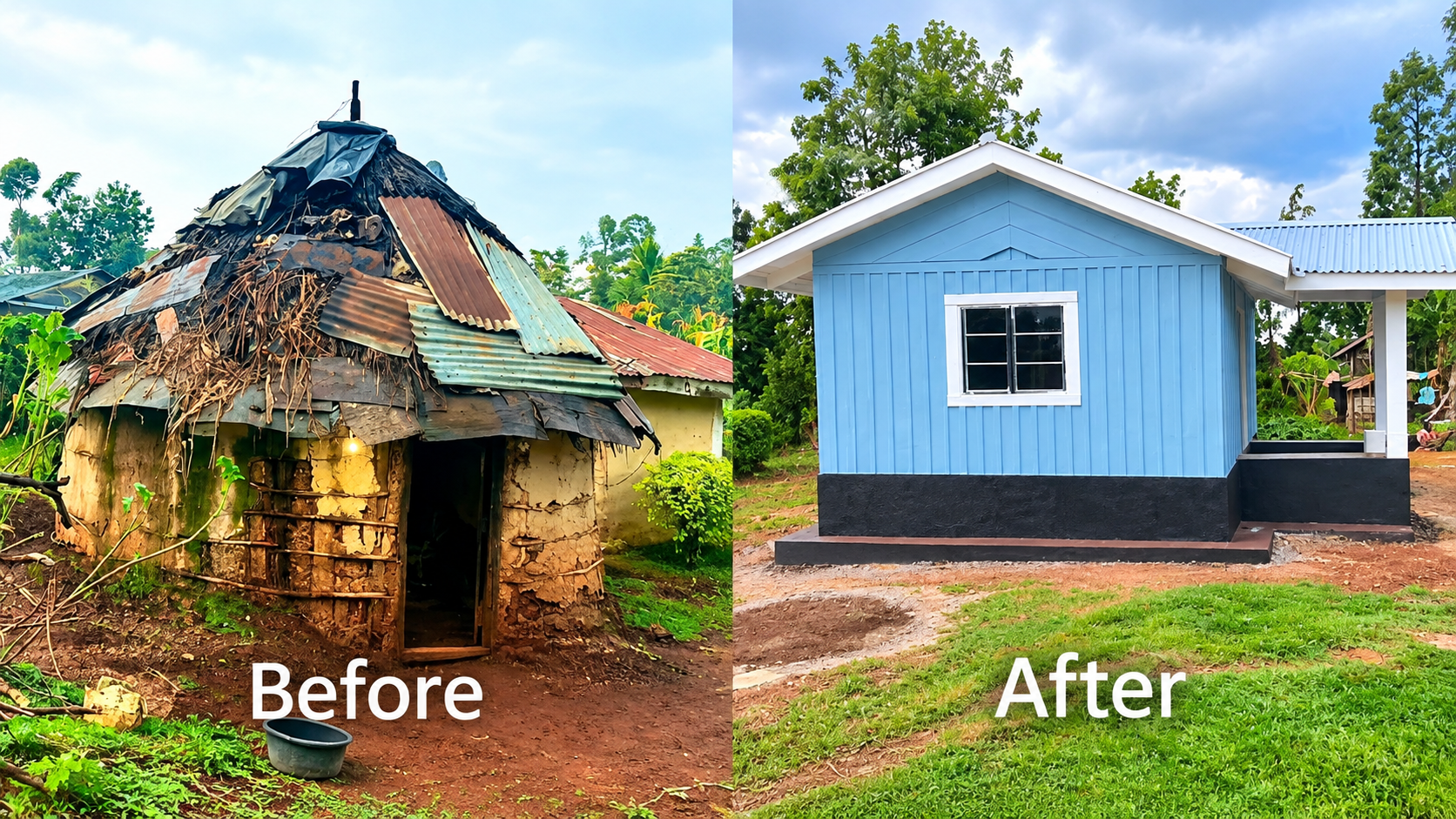
Bureti Residents Unite to Build Joseph Ngeno a New Home in Heartwarming Show of Community Solidarity
Residents of Bureti in Kericho County have come together to support Joseph Ngeno by helping construct a new house for him, demonstrating the power of unity, compassion and community solidarity. Through contributions of building materials, financial assistance and labour, the residents have shared the burden of providing Ngeno with a safer and more dignified place to live. The initiative highlights the traditional spirit of collective support in Kenyan communities, where neighbours come together to assist individuals facing difficult circumstances. Beyond providing shelter, the project offers Ngeno hope and reassurance that he is surrounded by people willing to stand with him during challenging times.
Residents of Bureti in Kericho County have demonstrated the strength of community solidarity after coming together to help build a new house for Joseph Ngeno, turning a difficult personal situation into a powerful example of how neighbours can transform one another’s lives through collective action.
The initiative has highlighted the spirit of togetherness that continues to exist in many communities across Kenya, where residents often come together to support families and individuals facing difficult circumstances. Rather than leaving one of their own to struggle alone, the residents chose to contribute their time, labour and resources towards giving Ngeno a better place to call home.
The construction of the house has attracted attention because it goes beyond the physical structure being put up. For Ngeno, the project represents dignity, security and the reassurance that he is not alone. For the wider community, it demonstrates what can happen when ordinary people unite around a common cause.
Residents Come Together
Building a house can be an expensive undertaking for an individual or family, particularly at a time when the cost of construction materials and labour remains a major challenge for many households.
In such circumstances, community support can make a significant difference. Residents can contribute in different ways, with some providing building materials while others offer labour, transport or financial assistance.
The initiative involving Ngeno illustrates this traditional spirit of harambee, where people come together to address a need affecting one of their own.
Instead of expecting a single person to meet the entire cost of construction, the burden can be shared among many people. A small contribution from one resident may appear insignificant on its own, but when combined with contributions from dozens of neighbours, it can help turn a difficult dream into reality.
The construction project therefore represents more than bricks, timber, iron sheets, cement and other materials. It represents the combined effort of people who believe that their neighbour deserves a safe and dignified home.
A New Chapter for Joseph Ngeno
For Joseph Ngeno, receiving assistance from the community is likely to mark an important new chapter.
A home is one of the most basic needs of every family. It provides shelter from rain, wind and cold while also offering a place where family members can rest, eat, plan their lives and raise children.
A decent house can also restore a person's sense of dignity and confidence.
The decision by residents to assist Ngeno therefore carries significance beyond the construction itself. It sends a message that members of a community should not necessarily face major challenges alone.
The initiative also demonstrates that development does not always have to begin with large institutions or government programmes. Sometimes meaningful change starts at the grassroots level when neighbours identify a problem and decide to act.
The Power of Collective Responsibility
The story from Bureti is an example of collective responsibility.
Communities are often strongest when residents understand that their wellbeing is interconnected. When one household experiences difficulties, neighbours can provide assistance that may help the affected family recover.
Such support can take many forms. People can donate money, provide food, contribute construction materials, volunteer their labour or offer professional services.
In a house-building project, skilled workers can contribute their expertise while other residents can assist with activities that do not require specialised skills.
This approach can reduce the financial pressure associated with construction and, at the same time, create a sense of ownership among those involved.
Every person who contributes becomes part of the story behind the house.
Bureti's Community Spirit
Bureti, located in Kericho County, has continued to witness various development and community initiatives.
Recent development projects in the area have focused on roads, water, markets, sports facilities and other infrastructure. Kenya News Agency reported in September 2026 that several development projects were being pursued in Bureti, including the Panda Pilis–Kampala–Bokoiyot–Mabasi road, Kapkatet Modern Market and Kapkatet Stadium.
The County Government of Kericho has also reported the launch of the Bureti Water Expansion Project, designed to improve water access for households, schools and health facilities in parts of the constituency. The project involves storage tanks and more than 45 kilometres of transmission and distribution pipelines.
While such projects are different from the house-building initiative for Ngeno, they illustrate the broader importance of collective efforts in improving people's living conditions.
At the community level, however, development can also happen through much smaller initiatives.
Helping one person obtain a decent home may not involve millions of shillings, but its impact on that individual and their family can be enormous.
More Than a House
One of the most important aspects of the initiative is the message it sends about dignity.
A house is a physical structure, but a home carries emotional and social meaning.
For someone who has struggled with inadequate housing, moving into a better structure can bring a sense of stability. It can also provide a safer environment for family members and create better conditions for everyday life.
The residents' intervention can therefore be viewed as an investment in the wellbeing of a fellow community member.
The project may also inspire others to consider how they can support vulnerable people within their own neighbourhoods.
Not everyone has the financial capacity to build a complete house for another person. However, community support does not necessarily require one person to carry the entire burden.
A person may donate a bag of cement. Another may provide iron sheets. A skilled mason may volunteer labour. A young person may help transport materials. Another resident may organise fundraising.
When these individual efforts come together, they can create a substantial impact.
A Lesson for Young People
The initiative also carries a lesson for younger members of the community.
In an increasingly individualistic society, community projects can remind young people of the importance of cooperation and compassion.
Young people can participate in community development through volunteer work, fundraising, environmental activities and support for vulnerable households.
The construction of Ngeno's house can therefore be viewed as an example of what is possible when people use their combined abilities for a common purpose.
It also demonstrates that helping another person does not necessarily require extraordinary wealth.
Sometimes the greatest contribution is simply showing up and participating.
Community Support During Difficult Times
Many Kenyan communities continue to rely on informal support systems when families face difficulties.
Funerals, medical emergencies, school-fee challenges, house construction and other major needs have traditionally brought neighbours and relatives together.
Such initiatives can provide immediate assistance while also strengthening relationships within a community.
Recent reporting from Bureti has similarly highlighted cases where community members have benefited from support aimed at improving their living conditions. For example, a 2026 report described a family in Kapchelach, Kisiara Ward, receiving a new shelter after losing its breadwinner.
These examples show how assistance at the community level can have a direct effect on households facing difficult circumstances.
The Importance of Sustaining the Initiative
As the house takes shape, attention will eventually shift towards completing the remaining work and ensuring that the structure becomes a comfortable home.
Construction is only one part of establishing a safe home. Depending on the circumstances, additional needs may include doors and windows, flooring, electricity, water connections, furniture and other basic household requirements.
Community members and well-wishers who wish to support the project can therefore continue looking at the needs that remain after the main construction work is completed.
Transparency can also help maintain public confidence in community fundraising initiatives. Where money or materials are collected from members of the public, clear communication about contributions and expenditure can help ensure that the project remains focused on its intended purpose.
A Story of Hope
The story of Joseph Ngeno and the residents who have joined hands to help him build a house is ultimately a story about hope.
It demonstrates that a difficult situation can become an opportunity for people to come together.
The house will provide physical shelter, but the circumstances surrounding its construction carry an even wider message: communities have the ability to change lives when residents are willing to support one another.
For Ngeno, the completed house will likely stand as a permanent reminder of the people who came together to help him.
For those who contributed, it will serve as evidence that their combined efforts can produce something meaningful.
And for the wider Bureti community, the initiative can become an example of how compassion, cooperation and collective responsibility can help address challenges that individuals may struggle to overcome on their own.
At a time when many families face financial pressures and the cost of living continues to make major household projects difficult, such acts of solidarity remain important.
The story also reminds Kenyans that community development does not only happen through government programmes or large organisations. It can happen at the village level, in neighbourhoods and within families.
A group of ordinary residents can identify a need, organise themselves and make a difference.
The house being built for Joseph Ngeno therefore represents more than a construction project. It represents neighbours standing together, sharing what they have and helping one of their own move towards a more secure future.
The strongest communities are often built not only through roads, schools, markets and other physical infrastructure, but also through relationships between people.
By coming together for Ngeno, the residents of Bureti have demonstrated the enduring value of that principle.

You Might Also Like
-
The High Court's decision on September 28, 2026, has brought an important stage of the contempt proceedings involving Inspector General Douglas Kanja to a close. Kanja was found in contempt over the failure by police to comply with an existing court order concerning timely public advisories before
-
The coming together of political leaders from Emurua Dikirr during a Sunday church service provides an important picture of community interaction at a time when the constituency has experienced significant political changes. The presence and involvement of Aaron Cheruiyot, together with other leade
-
President William Ruto's visit to the Coast today comes as part of an extensive development tour covering all six coastal counties. In Kwale, the issuance of 94,175 title deeds has taken centre stage, giving thousands of beneficiaries formal documentation of their land ownership. Beyond land reform
-
IEBC has expanded diaspora voter registration from 12 to 26 countries ahead of the August 2027 General Election, giving more Kenyans abroad an opportunity to participate in the polls.
-
Murkomen's latest statements present national security as a major government priority. He has maintained that the government will continue confronting banditry, recovering illegal firearms and dismantling criminal networks while strengthening the capacity of security agencies. His remarks about the
-
SHA has directed healthcare providers to renew their service contracts by September 30, 2026, to continue serving beneficiaries under the 2026–2029 contracting cycle.