



Burundi Embassy Chaos in Nairobi: Police Fire Tear Gas as Burundians Demand Services Amid Immigration Fears
The Burundi Embassy chaos in Nairobi on Monday, September 14, 2026, is the latest manifestation of a much larger crisis affecting Burundian nationals in Kenya. Police reportedly used tear gas to disperse crowds demanding services, while the embassy has become a gathering point for people seeking documentation, clarification and, in some cases, assistance to return to Burundi. The roots of the problem lie in Kenya's new push to regulate foreign-owned small businesses and ensure that foreign nationals comply with immigration and licensing requirements. Although the government has announced a 90-day regularisation window and promised protection from xenophobia, fear remains among sections of the Burundian community. The situation requires careful handling because Kenya and Burundi are neighbouring East African countries with strong people-to-people links. The priority should be to enforce the law while protecting human dignity, preventing xenophobic violence and ensuring that foreigners with legitimate rights are not unfairly targeted.
The chaos witnessed around the Burundi Embassy in Nairobi on Monday, September 14, 2026, was the latest and more dramatic episode in a growing dispute surrounding the status, safety and livelihoods of Burundian nationals living and working in Kenya. Reports from Monday indicated that police fired tear gas to disperse crowds of Burundians who had gathered outside the embassy while demanding access to consular services. The incident came against the background of weeks of anxiety among foreign nationals after President William Ruto directed authorities to tighten enforcement against foreigners operating small businesses without the required documentation. The developments have raised questions about immigration enforcement, the treatment of East African nationals, the safety of foreigners in Kenya and the wider relationship between Kenya and Burundi.
KenyaMOJA
*What happened outside the embassy* ?
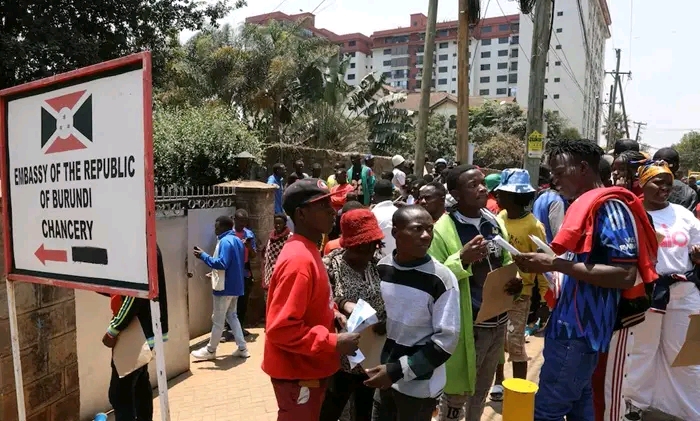
The situation at the Burundi Embassy in Nairobi has developed over several days as large numbers of Burundian nationals sought assistance with documentation and, in some cases, preparations to return to Burundi.
On Monday, September 14, crowds again gathered outside the embassy seeking services. According to reports, the situation became disorderly and police deployed tear gas to disperse people demanding services.
The large crowds were not simply the result of an ordinary busy day at a diplomatic mission. Many Burundians have been seeking clarification about their legal status in Kenya, immigration documentation and travel documents. Others have been concerned about their businesses and personal security following recent government statements concerning foreigners engaged in small-scale trade.
The embassy has therefore become an important focal point for a community facing considerable uncertainty. For many of those gathered, obtaining documentation is not merely an administrative matter. It can determine whether they remain in Kenya, continue working, or return to Burundi.
The background to the crisis
The current situation can be traced to statements by President William Ruto concerning foreign nationals operating small businesses in Kenya.
The government has maintained that foreigners conducting businesses in Kenya must comply with immigration, work-permit, registration and licensing requirements. The administration subsequently announced a 90-day regularisation period for undocumented foreign nationals to put their papers in order. The government also said the exercise was not intended to target foreigners because of their nationality.
However, the initial announcement created significant anxiety among immigrant communities, particularly Burundians and Congolese living in Nairobi. Many people feared that the directive would lead to the closure of their businesses or even force them to leave Kenya.
The fear was particularly strong among people whose livelihoods depend on informal or small-scale businesses.
Burundians began turning to their embassy
The first major scenes of large crowds were reported on Monday, September 7, when hundreds of Burundians went to their embassy in Nairobi seeking travel documents and information.
Reuters reported that many people arrived carrying suitcases and other belongings, while long queues formed outside the embassy. Some said they were considering returning to Burundi because they felt unsafe or unwelcome in Kenya.
The situation demonstrated the level of uncertainty created by the government's announcement.
Some Burundians reportedly said they had received threats from neighbours following the political statements about foreign traders. Importantly, Reuters reported that there were no signs of a government crackdown in Nairobi on that particular Monday, despite the fears among those gathered.
The government subsequently attempted to reassure foreign nationals that enforcement would not mean harassment or xenophobic attacks.
*Why were people demanding services* ?
One of the major issues was documentation.
Some Burundians wanted travel documents so that they could return home. Others needed assistance from their embassy because they lacked valid identification or immigration documents.
For people who have lived in Kenya for several years, returning to Burundi can also be complicated. They may have businesses, families, rented houses and social networks in Kenya. A sudden decision to leave can therefore have major financial and personal consequences.
The government announced that undocumented East African nationals would have an opportunity to regularise their status. During the registration period, authorities said those undergoing the process would be treated as legally present while they regularised their documents.
This was intended to calm fears, but many Burundians remained worried.
Police intervention and tear gas
The latest development on Monday, September 14, was particularly significant because of the reported police use of tear gas.
Reports indicated that police fired tear gas as crowds gathered outside the Burundi Embassy while demanding services.
The deployment of tear gas immediately transformed what had already been a tense administrative situation into a security incident.
For people who had come to the embassy seeking protection, travel documents or other assistance, being confronted by police action could further increase feelings of insecurity.
At the same time, police intervention is often used when authorities believe a crowd has become difficult to control or when there is a risk of disorder. The exact circumstances that led to the police deployment, including what happened immediately before tear gas was fired, should therefore be distinguished from claims that have not yet been independently verified.
Kenya's position
The Kenyan government has repeatedly insisted that the issue is about compliance with Kenyan law rather than nationality.
Government spokespersons have said that foreigners operating businesses in Kenya must have the necessary documentation, including appropriate work permits and business licences. The government has also promised a regularisation period rather than immediate mass deportations.
The administration has additionally stated that Kenya has zero tolerance for xenophobia, harassment, intimidation or violence against foreign nationals.
This distinction is important because Kenya is part of the East African Community, where regional integration, movement of people and trade are important principles. The government therefore faces the challenge of enforcing national immigration and business laws while maintaining its regional obligations and protecting foreign residents.
Government officials had already engaged Burundians
Before Monday's latest confrontation, Kenyan government officials had attempted to calm the situation.
Foreign Ministry official Korir Sing'oei visited Burundian nationals at the embassy after large crowds gathered there. According to AP, he apologised for what he described as a misunderstanding of the president's directive and explained that the government wanted to know who foreign residents were, where they lived and what they did so that their security could also be protected.
The government's message was therefore that registration should not automatically be interpreted as expulsion.
However, the events around the embassy demonstrate that the government's reassurance has not completely eliminated the fear within parts of the Burundian community.
*The economic dimension*
The crisis is also closely connected to Kenya's economy.
Many foreign nationals, including Burundians, earn their livelihoods through small-scale businesses. These can include selling coffee, second-hand clothing and other everyday goods.
Reuters reported that Kenya has around 16,000 Burundian refugees and asylum seekers, with many involved in small-scale economic activities in Nairobi.
For such people, losing a business can mean losing their primary source of income.
The Kenyan government argues that local traders also deserve opportunities and that foreign businesses must comply with the law. Some Kenyan traders have complained that foreigners are competing with them for customers and jobs.
The controversy therefore involves a difficult economic question: how can Kenya protect opportunities for citizens while continuing to respect the rights of lawful foreign residents and traders?
Concerns about xenophobia
Another major issue arising from the Burundi Embassy chaos is the fear of xenophobia.
Some Burundians have said that they experienced threats after the government statements concerning foreign businesses. Burundi's Foreign Affairs Minister Edouard Bizimana also raised concerns about what he described as anti-Burundian sentiment. AP reported that he had shared a video involving threats against Burundians living in Kenya and warned that the Kenyan government would be responsible for their safety.
These developments have the potential to damage relations between ordinary Kenyans and Burundians, who have lived and worked alongside each other for many years.
It is therefore important that individual cases of alleged harassment are investigated rather than allowing rumours or social-media messages to fuel wider hostility.
Why the situation matters to Kenya
The incident is bigger than the events outside one embassy.
Kenya is one of East Africa's major economic centres and attracts workers, traders, students, refugees and investors from across the region. The way the country handles the current situation will influence perceptions of Kenya among other East African nationals.
A disorderly immigration crackdown could discourage people from investing or working in Kenya. On the other hand, failure to enforce immigration and business regulations could create resentment among Kenyan citizens who believe foreign traders are competing unfairly.
The government therefore faces the difficult task of finding a balance between enforcement and protection.
*Why it matters to Burundi*
For Burundi, the situation also presents a diplomatic and humanitarian challenge.
If large numbers of citizens return from Kenya suddenly, Burundi could face pressure to provide transportation, documentation, accommodation and economic opportunities.
Reports have indicated that Burundi has been preparing to help citizens who want to return. One report said the Burundian government was coordinating with its embassy in Nairobi to provide travel documents and facilitate transport for citizens wishing to go home.
That response shows that the issue has moved beyond ordinary consular services into a matter of bilateral relations and citizen protection.
The human side of the crisis
Perhaps the most important aspect of the Burundi Embassy situation is its human dimension.
Behind the large crowds are individuals who have built their lives in Kenya. Some have lived in the country for years. Others have businesses, families and children who depend on their income.
For a trader who has spent years establishing a small business, being told that the business may no longer be allowed can create enormous uncertainty.
For an undocumented migrant, the situation can be even more frightening because the person may not know whether they will be allowed to remain, whether they can regularise their status or whether returning home is the safest option.
The queues outside the embassy therefore represent more than people waiting for paperwork. They represent anxiety about livelihoods, security and the future.
*What happens next?*
The coming days will be important.
Kenyan authorities will need to clearly explain the documentation process and ensure that people know where and how to regularise their status. The government has already announced a 90-day window, and it will be important that this period is accessible to people who need it.
The Burundi Embassy will also have a major role in providing accurate information to its citizens.
Security agencies, meanwhile, will have to ensure that demonstrations and crowds are managed without unnecessary escalation. Any use of force should be proportionate and consistent with Kenyan law.
Most importantly, both governments will need to prevent the dispute from becoming a wider diplomatic confrontation.

You Might Also Like
-
The KUPPET protest and calls for justice in Kericho have brought renewed attention to the death of teacher Martina Chepkemoi Ruto. Her disappearance, followed by the recovery of her body near the Kimugu River and reports of multiple chest stab wounds, has left her family, colleagues and the communit
-
Former Migori Governor Okoth Obado is back in the Milimani High Court on September 16, 2026, for sentencing following his conviction over the 2018 murder of Rongo University student Sharon Otieno. Obado, alongside his former personal assistant Michael Juma Oyamo and former Migori County official Cas
-
The announcement that Nairobi will host the 2029 World Athletics Championships has been met with considerable excitement in Eldoret, particularly among upcoming athletes, coaches and residents who identify strongly with Kenya's athletics tradition. Young athletes see the championships as a potentia
-
 President Ruto's reaction to Nairobi winning the 2029 World Athletics Championships has centred on national pride, Africa's historic opportunity and recognition of Kenya's athletics heritage. He has described the victory as belonging to Kenya, Africa and generations of athletes who have made the cou
 -
The 15th Mara Day celebrations concluded on Tuesday, September 15, 2026, at Bomet Stadium, bringing together Kenyan and Tanzanian leaders, environmental experts, conservation organisations and local communities to discuss the protection of the Mara River ecosystem. Key leaders included EAC Affairs a
-
The story of Mercy Kanini of Juja, Kiambu County, is both extraordinary and heartbreaking. She made headlines after delivering five babies through normal delivery at Thika Level Five Hospital, an event described as extremely rare in Kenya. The babies were subsequently transferred to Kenyatta Nationa