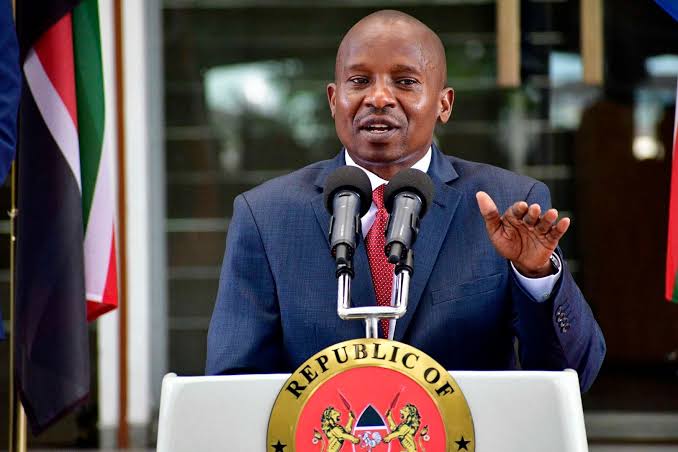
Deputy President Kithure Kindiki has called on the Judiciary to take decisive measures to address delays in the administration of justice
Deputy President Kithure Kindiki has urged the Judiciary to address delays in the delivery of justice, strengthen commercial dispute resolution and improve access to court services across the country. He noted that an efficient, fair and accessible justice system is essential in protecting citizens' rights, boosting investor confidence, supporting businesses and promoting Kenya's economic and social development. His remarks highlight the need for continued judicial reforms, improved service delivery and timely resolution of cases while upholding the independence of the Judiciary and the rule of law.
Deputy President Kithure Kindiki has called on the Judiciary to take decisive measures to address delays in the administration of justice, strengthen the resolution of commercial disputes and improve the delivery of court services to support Kenya's economic and social development.
Kindiki emphasized the importance of an efficient and accessible justice system, noting that the Judiciary plays a critical role in maintaining public confidence, protecting the rights of citizens and creating an environment that supports national development. He observed that the effectiveness of the courts extends beyond resolving disputes, as judicial decisions and the timely delivery of justice also influence investment, business confidence, social stability and the overall functioning of the economy.
The Deputy President's remarks come amid continued calls for improvements in the administration of justice, particularly concerning the time taken to conclude cases. Delays in court proceedings have remained a concern for individuals, businesses and institutions seeking legal redress. For many litigants, prolonged cases can result in additional financial expenses, emotional strain and uncertainty, especially when disputes involve property, employment, family matters or business transactions.
An effective justice system is expected to provide fair hearings and timely decisions while safeguarding the independence of the courts. However, when cases remain unresolved for extended periods, affected parties may experience difficulties moving forward with their personal or professional activities. Such delays can also create uncertainty around legal rights and obligations, making it difficult for individuals and organisations to plan for the future.
Kindiki's call highlights the need for continued reforms aimed at making court processes more efficient, accessible and responsive to the needs of the public. Addressing case backlogs, improving court administration and strengthening the capacity of judicial institutions are among the measures that can contribute to reducing delays and ensuring that disputes are handled within reasonable timelines.
The administration of justice is an important pillar of governance because it provides a framework through which disputes are resolved peacefully and the rule of law is upheld. Citizens rely on courts to protect their constitutional rights, interpret the law and provide remedies when those rights are violated. Businesses and investors also depend on the judicial system to enforce agreements, resolve disagreements and protect legitimate commercial interests.
A justice system that delivers decisions efficiently can strengthen confidence in public institutions and encourage individuals to pursue lawful methods of resolving disputes. It also helps prevent disagreements from escalating into prolonged conflicts that may affect families, communities and commercial relationships.
The Deputy President also placed emphasis on the need to strengthen commercial dispute resolution, recognising the important relationship between the Judiciary and Kenya's economic performance. Commercial disagreements can arise from contractual obligations, financial transactions, property arrangements, partnerships, construction projects and other business activities. When such disputes take too long to resolve, they can affect operations, delay investments and create financial uncertainty for the parties involved.
For businesses, the ability to resolve disputes within reasonable periods is an important consideration when making investment decisions. Entrepreneurs and companies require confidence that commercial agreements will be respected and that legal remedies will be available when disagreements arise. A predictable judicial environment can therefore contribute to a more stable business climate and encourage greater participation in economic activities.
Commercial disputes may involve significant financial resources, employment opportunities and long-term business commitments. When proceedings are delayed, companies may be forced to spend additional money on legal processes while waiting for decisions. In some cases, unresolved disputes can affect the delivery of projects, interrupt supply chains and discourage potential partners from entering into new agreements.
Improving the handling of commercial cases would help reduce these challenges and make Kenya's business environment more attractive. Efficient dispute resolution can also support small and medium-sized enterprises, which may have limited financial capacity to sustain lengthy legal proceedings.
Small businesses are particularly vulnerable when commercial disagreements remain unresolved for extended periods. Unlike large corporations, many small enterprises operate with limited financial reserves and depend on regular cash flow to meet operational expenses, pay employees and maintain their activities. A prolonged dispute involving payments, contracts or ownership can therefore threaten their ability to remain in business.
Strengthening commercial justice would help create an environment in which businesses can operate with greater certainty. It would also demonstrate that the legal system is capable of addressing disputes fairly without imposing unnecessary financial and administrative burdens on those seeking justice.
Kenya's economic development depends on several factors, including infrastructure investment, access to finance, stable institutions, effective regulation and confidence in the rule of law. The Judiciary contributes to these objectives by ensuring that laws are applied fairly and that individuals and organisations can seek legal protection when necessary.
The relationship between justice and economic development is particularly important as the country continues to pursue investments in manufacturing, agriculture, housing, infrastructure, trade and other productive sectors. These activities often involve complex agreements between government institutions, private companies, financial organisations and individuals. A reliable dispute resolution system is therefore necessary to protect the interests of all parties and ensure that contractual obligations are respected.
The Deputy President's remarks also draw attention to the broader social responsibilities of the Judiciary. Beyond commercial matters, courts handle cases involving families, children, workers, communities and individuals seeking protection from unlawful actions. Delays in these proceedings can have serious consequences for people who depend on timely judicial intervention to address urgent personal and social challenges.
For individuals seeking justice, the time taken to conclude a case can determine how quickly they regain stability and move forward with their lives. Cases involving family disputes, inheritance, land ownership, employment and other personal matters may affect access to property, income and essential services. Ensuring that such cases are handled efficiently is therefore important in protecting the dignity and welfare of citizens.
Access to justice also requires that court services remain affordable and accessible to people from different social and economic backgrounds. Individuals living in remote areas may face additional challenges when seeking legal assistance because of transportation costs, limited access to information and the distance between their homes and court facilities.
Improving the accessibility of judicial services would help ensure that justice is not limited to people living in major towns or those with sufficient financial resources. Court users should be able to understand the procedures involved, obtain relevant information and participate in proceedings without facing unnecessary obstacles.
Technology has also become an important part of efforts to improve the delivery of judicial services. Digital platforms can support case management, filing of documents, access to court information and communication between court users and judicial officers. Properly implemented, such systems can reduce administrative delays, improve record management and make certain services more convenient for the public.
However, the use of technology must be accompanied by measures to ensure that people without reliable internet access or digital skills are not excluded. Maintaining appropriate physical services alongside digital platforms remains important in ensuring that all citizens can access the justice system.
The Judiciary also requires adequate resources to carry out its constitutional responsibilities effectively. Court infrastructure, staffing levels, equipment and administrative capacity all influence the speed and quality of service delivery. Additional capacity in areas experiencing heavy caseloads can help improve the handling of matters and reduce pressure on judicial officers.
Investment in court facilities and the recruitment of qualified personnel can also strengthen the ability of judicial institutions to serve growing populations and respond to changing legal needs. Effective management of available resources is equally important in ensuring that cases are scheduled appropriately and that court operations run smoothly.
At the same time, efforts to reduce delays must respect the independence of the Judiciary and the constitutional principles governing the administration of justice. The courts must be allowed to make decisions without improper influence or interference. Efficiency should not come at the expense of fairness, due process or the right of every party to be heard.
A strong justice system must balance timely service delivery with thorough consideration of evidence, legal arguments and the rights of those involved. Speed alone cannot define successful judicial performance. The quality, fairness and consistency of decisions are equally important in maintaining public trust.
Kindiki's appeal therefore places attention on the need for a justice system that is both efficient and dependable. Citizens expect courts to provide impartial decisions, while businesses require predictable processes that allow them to resolve disputes and continue their operations. Meeting these expectations can strengthen confidence in the country's institutions.
Public confidence in the Judiciary is essential because it encourages people to use lawful channels when resolving disagreements. When citizens believe that courts can provide fair and timely decisions, they are more likely to seek legal remedies rather than resorting to self-help or other unlawful methods. This contributes to social stability and reinforces respect for the rule of law.
The Judiciary's contribution to national development also depends on cooperation with other institutions while maintaining its constitutional independence. Government agencies, legal practitioners, businesses and members of the public all have roles to play in supporting an effective justice system. Proper preparation of cases, adherence to court procedures and responsible use of judicial processes can help reduce unnecessary delays.
Legal practitioners and litigants can contribute by ensuring that cases are properly presented and that court procedures are followed. Government institutions can also support the administration of justice by complying with court orders and providing the information required in legal proceedings.
As Kenya continues to pursue economic transformation and improve public service delivery, the efficiency of the justice system remains an important consideration. A country seeking to attract investment, expand commercial activity and improve the welfare of its citizens requires institutions that operate transparently, fairly and effectively.
The Deputy President's remarks reinforce the expectation that judicial services should respond to the needs of a changing society and economy. Tackling case delays, improving commercial dispute resolution and expanding access to justice could help create a more dependable environment for citizens, entrepreneurs and investors.

You Might Also Like
-
German Federal President Frank-Walter Steinmeier is expected to arrive in Kenya on November 25–26, 2026, for a two-day official visit that will include high-level bilateral talks with President William Ruto at State House. The visit is expected to strengthen diplomatic relations between Kenya and
-
President William Ruto has renewed his criticism of opposition leaders who walked out of a consultative meeting with the Independent Electoral and Boundaries Commission (IEBC), accusing them of transferring their frustrations over disagreements on who should lead their presidential campaign to the e
-
Embakasi East MP Babu Owino has reaffirmed his political relationship with Nairobi Senator Edwin Sifuna, describing him as his brother and dismissing speculation that their individual political ambitions could create divisions within the Linda Mwananchi movement. Babu maintained that their political
-
A political party has moved to court seeking to suspend the recruitment of the Independent Electoral and Boundaries Commission (IEBC) Chief Executive Officer, citing alleged integrity concerns surrounding the selection process. The legal challenge comes at a critical time as the electoral commission
-
The Independent Electoral and Boundaries Commission (IEBC) has criticised opposition leaders for walking out of a consultative meeting on electoral preparedness ahead of the 2027 General Election. The commission accused the leaders of missing an important opportunity to raise concerns, discuss propo
-
Police Headquarters has ordered a mandatory nationwide physical headcount of all National Police Service officers following reports that some serving officers are allegedly being illegally recruited by foreign agencies to work as mercenaries abroad. The exercise is expected to establish the whereabo