




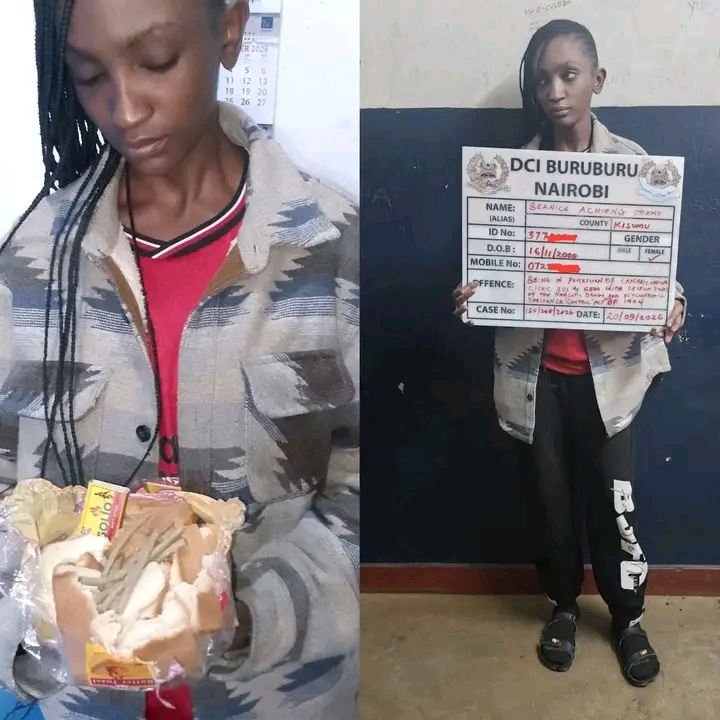
Drama at Buruburu Police Station as Woman Allegedly Hides Bhang Inside Loaf of Bread for Detained Boyfriend
A woman was arrested at Buruburu Police Station in Nairobi after police officers allegedly discovered bhang concealed inside a loaf of bread she had brought for her boyfriend, who was being held at the station. According to police reports, officers inspected the unsealed loaf and allegedly found five rolls of bhang and a matchbox hidden inside it. A further search of the woman reportedly led to the recovery of seven additional rolls of bhang from her jacket, bringing the total to 12 rolls. She was taken into custody and was expected to face charges in court, with the recovered items secured as exhibits. The allegations will be subject to determination through the judicial process.
A 26-year-old woman was arrested at Buruburu Police Station in Nairobi after police officers allegedly discovered bhang concealed inside a loaf of bread that she had brought for her boyfriend, who was being held at the station. The incident, reported on September 21, 2026, has drawn attention to the increasingly unusual methods used to conceal prohibited items when visiting people in police custody.
According to the Directorate of Criminal Investigations (DCI), the woman, identified in media reports as Bernice Achieng, had visited the police station intending to see her detained boyfriend. She reportedly approached officers at the report office and asked them to pass a loaf of bread to him.
What appeared to be an ordinary food item, however, attracted the attention of the officers. The package was reportedly unsealed, prompting them to inspect its contents before allowing it to be taken to the detainee. The subsequent search allegedly led to the discovery of five rolls of bhang and a matchbox hidden inside the loaf.
The discovery did not end with the search of the bread. Police officers reportedly conducted a further search of the woman and allegedly found seven additional rolls of bhang inside a pocket of her jacket. This brought the total number of rolls recovered from the woman and the bread to 12.
The woman was subsequently taken into police custody. The DCI said the recovered items had been secured as exhibits and that she was expected to be arraigned in court. At the time of the reports, there was no indication of the outcome of court proceedings.
It is important to note that the allegations reported by police and media outlets have not, by themselves, established criminal guilt. The woman remains entitled to the presumption of innocence unless and until a court determines otherwise.
How the incident unfolded
The incident began when the woman arrived at Buruburu Police Station to visit her boyfriend, who was already in custody.
Visitors bringing food to people detained in police stations are subject to security procedures. In this case, officers reportedly became suspicious after noticing that the loaf of bread was not sealed. Instead of simply handing it over, they examined it.
The inspection allegedly revealed five rolls of bhang and a matchbox concealed inside the bread.
The discovery prompted officers to conduct another search of the woman herself. Seven more rolls were allegedly found in her jacket pocket.
The combined recovery therefore amounted to 12 rolls.
The DCI subsequently announced the arrest and said the exhibits had been secured while the suspect remained in custody pending court proceedings.
Why the bread attracted attention
Food is commonly brought by relatives and friends to people being held in custody. Because of this, police officers must distinguish between legitimate food deliveries and attempts to introduce prohibited items into detention facilities.
In the Buruburu case, the unsealed nature of the package reportedly raised suspicion. The officers' decision to inspect the loaf resulted in the alleged discovery of the concealed narcotics.
The incident demonstrates why food parcels delivered to detainees may undergo inspection before reaching them. Items concealed within food can potentially evade ordinary visual checks if officers do not examine the contents carefully.
In this particular case, however, the inspection prevented the alleged contraband from reaching the intended recipient.
The significance of the matchbox
Alongside the five rolls of bhang, officers reportedly found a matchbox hidden inside the loaf.
The matchbox was among the items secured by police as part of the exhibits. The available reports do not establish precisely why it was included in the package or whether it was intended for the detained man.
Therefore, any explanation about its intended use would be speculative unless investigators or a court provides further information.
Seven additional rolls allegedly found in her jacket
One of the notable aspects of the case is that the alleged contraband was not limited to what officers found in the bread.
After discovering the five rolls inside the loaf, officers reportedly searched the woman and found another seven rolls in the pocket of her jacket.
This increased the total recovery to 12 rolls of bhang. The discovery also meant that investigators were dealing with alleged possession beyond the food parcel itself.
The exact quantity or weight of the recovered cannabis was not stated in the reports reviewed. The reports instead described the exhibits in terms of the number of rolls.
That distinction can matter in criminal proceedings because the applicable charge and legal consequences depend on the circumstances and evidence presented to court.
Police vigilance at detention facilities
The Buruburu incident comes at a time when Kenyan police have reported other attempts to introduce prohibited items into detention facilities using food.
On September 16, 2026, an 18-year-old woman was reportedly arrested at Ruai Police Station after officers allegedly found metal tools concealed beneath a meal intended for three suspects in custody. According to the DCI account, a pair of pliers and a shear were discovered during an inspection of the food.
The two incidents are not reported as being connected. However, both illustrate the security challenge faced by officers responsible for screening items brought to detainees.
In the Buruburu case, the alleged contraband was narcotics. In the Ruai case, police said they discovered tools that investigators suspected could have been used to facilitate an escape.
These cases highlight the importance of screening visitors and items brought into police stations.
Food as a means of concealing prohibited items
The use of food to conceal prohibited items is not entirely new in Kenya.
The Daily Nation reported that in an earlier case at Gilgil Police Station, a woman allegedly arrived with bread and tea for her husband who was in custody. Police reportedly discovered bhang and cigarettes concealed in the bread.
Another reported case involved a mobile phone allegedly concealed inside bread at Sagana Police Station.
Such incidents demonstrate why seemingly ordinary items can receive close attention when they are being delivered to people in custody.
For police officers, the challenge is to maintain security while still allowing detainees to receive legitimate necessities from family members and friends.
Possible legal consequences
The arrest may lead to criminal proceedings depending on the evidence gathered by investigators and the decision of prosecutors.
Kenya's narcotics laws regulate possession, trafficking, supply and other activities involving controlled drugs, including cannabis. The precise charge in an individual case depends on the evidence and circumstances.
The fact that a person has been arrested does not automatically mean that they will be convicted. Investigators must present evidence, prosecutors must establish the appropriate case, and the court ultimately determines whether the prosecution has proved the allegations beyond the required legal standard.
The woman's expected arraignment will therefore be an important next step in determining the formal charges against her.
Presumption of innocence
The case also highlights the importance of distinguishing between an arrest and a conviction.
Police have alleged that the woman attempted to deliver bhang to her detained boyfriend. The reported recovery of 12 rolls forms part of the evidence that investigators may present.
However, the final determination belongs to the courts.
Until a court makes a finding, the woman is legally presumed innocent. Her arrest and detention should therefore not be presented as proof that she committed the alleged offence.
A broader concern for police stations
The Buruburu case raises broader questions about security at police stations and other detention facilities.
People held in custody may depend on relatives and friends for food and other basic necessities. At the same time, unrestricted deliveries could create opportunities for prohibited substances, communication devices, weapons or other items to reach detainees.
Security officers therefore have to balance access with safety.
The incident demonstrates how an ordinary-looking food parcel can become part of a security concern. In this case, the loaf of bread was reportedly inspected before reaching the intended recipient, leading to the alleged discovery of the drugs.
The role of investigators
Following an arrest, investigators are expected to establish the circumstances surrounding the alleged offence. Among the issues that could become relevant are where the bhang came from, who it was intended for and whether other people were involved.
The available reports do not provide answers to those questions.
They also do not identify the woman's boyfriend or provide details about the offence for which he was being held at Buruburu Police Station.
Those details may become clearer if the matter proceeds to court.
Nairobi's continuing fight against narcotics
The Buruburu arrest comes amid broader police operations targeting suspected narcotics-related offences in different parts of Kenya.
On the same day, reports also emerged of another alleged bhang-related arrest in Thika West. Police reportedly arrested a suspected drug dealer after a motorcycle chase and recovered more than 300 rolls of bhang and an additional three kilogrammes of the drug.
That case is separate from the Buruburu incident and should not be treated as evidence that the two operations were connected.
Nevertheless, the reports illustrate the range of methods through which police are encountering suspected cannabis trafficking, from alleged transportation on motorcycles to alleged concealment inside food.
What happens next
The immediate next step in the Buruburu case is the woman's arraignment, according to police reports.
At the point of arraignment, the charges against her should become clearer, and the court will determine the next stage of the proceedings. Depending on the circumstances, the court may also consider issues surrounding bond or bail in accordance with Kenyan law.
The recovered bhang and matchbox are expected to remain part of the evidence, subject to the appropriate legal procedures.
The case could ultimately provide more information about whether the woman was allegedly acting alone, whether the detained boyfriend was aware of the package, and the circumstances surrounding the alleged possession.
For now, the confirmed reported facts are that a 26-year-old woman was arrested at Buruburu Police Station after officers allegedly discovered five rolls of bhang and a matchbox inside a loaf of bread, followed by the alleged recovery of seven additional rolls from her jacket. She remained in police custody awaiting arraignment.
The incident serves as another reminder that security officers at detention facilities carefully scrutinise items brought to people in custody. What appeared to be a simple loaf of bread reportedly became the means through which police discovered suspected narcotics before they could reach the detainee.
Most importantly, the case remains an allegation at this stage. The courts will ultimately determine whether the evidence supports the charges and whether the accused is criminally liable.

You Might Also Like
-
UDA Secretary General Hassan Omar has criticised former President Uhuru Kenyatta over his claim that Raila Odinga won the 2022 election, insisting that President William Ruto legitimately won the contest.
-
The meeting by Kipkelion elders to appreciate President William Ruto over the proposed Londiani Referral Hospital reflects the deep importance the community attaches to the project. For years, residents have looked forward to a major referral facility that could improve access to specialised health
-
Bomet University students have taken to the streets over unresolved welfare concerns, including water shortages, Chepkosa Dam, delayed bridge works, inadequate security lighting and rising accommodation costs.
-
Deputy Inspector General Eliud Lagat's engagement in Nakuru has placed youth involvement, community safety and professional policing at the centre of the security conversation. His strongest warning was directed at young people whom he urged not to accept money to act as political goons or fight on
-
Former President Uhuru Kenyatta has handed over the leadership of the Jubilee Party to Fred Matiang’i ahead of the party’s National Delegates Convention. Uhuru says he will remain a Jubilee member and serve in a senior advisory role.
-
PS Beatrice Inyangala has drawn attention to a serious concern in Kenya's education sector, citing research that 90 per cent of students have experienced violence either as victims or perpetrators. She said the research showed that women represented 65 per cent of those affected, compared with 35 pe