Felix Koskei Joins Top Leaders at Global Trust Summit 2026 as Kenya Pushes for Accountability, Transparency and Public Confidence
Felix Koskei's participation in the Global Trust Summit 2026 placed Kenya's public service leadership within a major conversation about the relationship between institutions and the people they serve. The summit's first day focused on rebuilding trust from the frontline, examining democracy, public participation, institutional accountability and the responsibilities of those entrusted with public authority. The wider programme extends those discussions to misinformation, digital technology, international cooperation, finance and Africa's position in global decision-making. With President William Ruto, senior Kenyan officials, regional representatives and international figures included in the programme, the gathering offers a platform for exchanging ideas on how trust can be strengthened at both national and global levels.
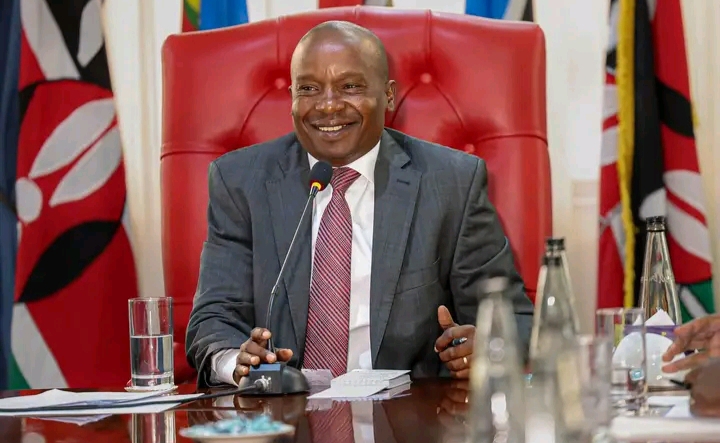
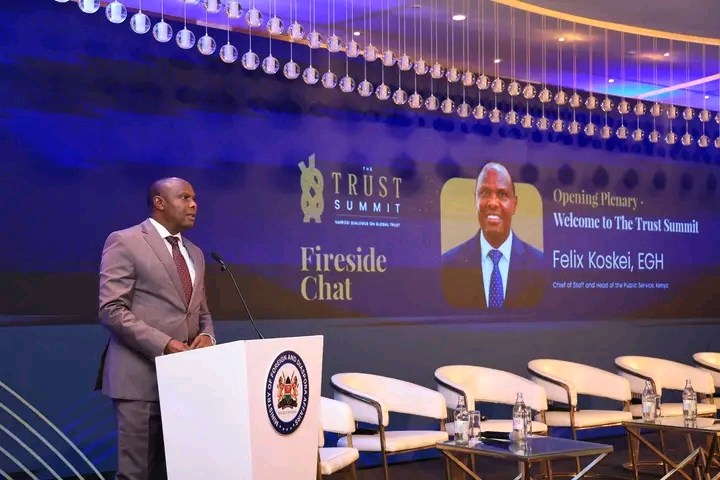
Chief of Staff and Head of Public Service Felix Koskei is among the prominent Kenyan leaders featured in the programme of the inaugural Trust Summit 2026, which opened in Nairobi on Wednesday, October 21, bringing together government officials, international representatives, business leaders, academics, civil society organisations and other stakeholders to discuss how public confidence in institutions can be rebuilt.
The three-day gathering, known as the Trust Summit: Nairobi Dialogues on Global Trust, is scheduled to run from October 21 to October 23, 2026. Its central objective is to find practical ways of strengthening trust in governments, public institutions, the media, businesses, digital platforms and international organisations.Felix Koskei serves as Chief of Staff and Head of Public Service in Kenya, a position connected to the coordination of government operations and public administration. His scheduled participation placed the country's public service leadership at the centre of discussions on restoring confidence in institutions.
The opening plenary, titled Rebuilding Trust from the Frontline: Challenges, Prospects, and Opportunities, was scheduled for 8:55 a.m. to 9:55 a.m. on the first day.
Regulatory authorities have a particular responsibility because they are in many aspects,small government within sectors they oversee.Their decisions affect livelihoods, business and access to essential services,making fairness, transparency and consistency in setting standards and enforcing compliance essential to public confidence.
Sustaining this confidence requires stronger oversight and measurable results,supported by regional and international cooperation.Communities of practice can help institutions learn from one another and apply approaches that improve how they serve citizens.
Ultimately,trust grows when institutions keep their commitments,take responsibility for their decisions and deliver the services citizens depend on.
The session was facilitated by Dr Abraham Korir Sing'Oei, Principal Secretary in the State Department for Foreign Affairs. Monica Brezzi, Deputy Director for Statistics and Data at the Organisation for Economic Co-operation and Development (OECD), was listed for the scene-setting presentation, while Koskei was scheduled for the fireside chat. Muthomi Njuki
The Council of Governors chairperson was listed as a panellist, bringing the perspective of county governments. County administrations play an important role in delivering local services and maintaining public confidence through responsible management and public participation.
Vincent Ogutu
The Strathmore University vice-chancellor was listed to contribute an academic and educational perspective to the discussion.Misinformation and trust in the digital age
Another major concern behind the summit was the effect of misinformation and rapid technological change on public confidence.
Digital platforms have transformed how people receive news, discuss government policies and engage with institutions. They have created opportunities for greater participation and faster access to information, but they have also made it easier for misleading claims and manipulated content to circulate.
When citizens cannot distinguish reliable information from false claims, confidence in public institutions and the media can suffer.The summit's wider agenda therefore included information integrity, responsible digital engagement and the relationship between technology and trust. The third day was scheduled to feature a discussion on Africa's digital futures, covering platforms, artificial intelligence, algorithms, infrastructure and trusted technology providers.
For Kenya, these issues have implications for government communication, online public services, personal data protection and the responsibilities of digital platforms.
Institutions need to communicate accurately and promptly, while citizens need access to trustworthy information. Technology companies, media organisations and public authorities also have roles to play in addressing harmful misinformation without undermining legitimate expression.International cooperation and Africa's position in global affairs
Although the first day focused primarily on trust within countries, the summit was designed to expand the conversation to international relations, global finance and cooperation between nations.
The second day's programme included a high-level panel on The Trust Imperative in a Multipolar Global Landscape, as well as sessions on Africa and global finance, and trust in capital, trade and investment.These discussions are important because international cooperation relies on confidence that countries and institutions will honour agreements, fulfil commitments and apply rules fairly.
For African countries, trust also intersects with access to development financing, international trade, investment and representation in global decision-making.
Ahead of the summit, United Nations Under-Secretary-General and Special Adviser to the Secretary-General on Africa Ahunna Eziakonwa argued that Africa should have a stronger role in shaping international institutions and decisions. She also emphasised that rebuilding trust requires governments to demonstrate accountability through results at home.The published programme describes a process leading towards a Nairobi Call to Action, a Framework for Action, a coalition of actors and a mechanism for following up on commitments. The final day is scheduled to focus on turning discussions into practical action and endorsing the summit's outcome document.
These proposed outcomes are intended to help institutions identify concrete measures, assign responsibility and monitor progress over time.
For example, a government institution could commit to improving public access to information, while an oversight body could establish clearer reporting processes or measures for responding to public complaints. Such examples illustrate the kind of practical action the summit's approach seeks to encourage; they should not be interpreted as specific commitments already announced by Koskei.

You Might Also Like
-
The National Assembly has passed the Sexual Offences (Amendment) Bill No. 78 of 2023, aimed at promoting public awareness, protecting victims’ right to education and aligning existing laws with the Constitution of Kenya. The proposed amendments highlight the importance of safeguarding victims’ r
-
The Kenya Meteorological Department's forecast for October 20–26, 2026, indicates that rainfall is expected in parts of 45 counties across western Kenya, the Rift Valley, Central Kenya, the Coast, the eastern region and the north-eastern counties. Afternoon thunderstorms are particularly relevant
-
The October 21 protest by public health officers in Nairobi has brought renewed attention to the connection between workers' welfare, adequate staffing and Kenya's preparedness for infectious disease outbreaks. As their nationwide strike entered its 92nd day, the officers demanded the signing of a
-
Governor Patrick Ole Ntutu's reported peace message during the Mashujaa Day celebrations at Esoit Naibor Primary School highlights the importance of unity, security and cooperation in Trans Mara South. The gathering came amid concerns about inter-clan disputes and the need to prevent ethnic incitem
-
Deputy President Kithure Kindiki's development agenda in Gatundu North highlights two important areas: modern market infrastructure and improved road connectivity. Kanyoni Market represents the importance of supporting small-scale traders and farmers, while the inspection of the Thika–Magumu Mau M
-
Deputy President Kithure Kindiki's latest meeting in Karen on October 21, 2026, forms part of an intensified national campaign against illicit alcohol and drug cartels. The government reports that multi-agency teams carried out 125 raids over ten days, while new legislative proposals seek to strengt