



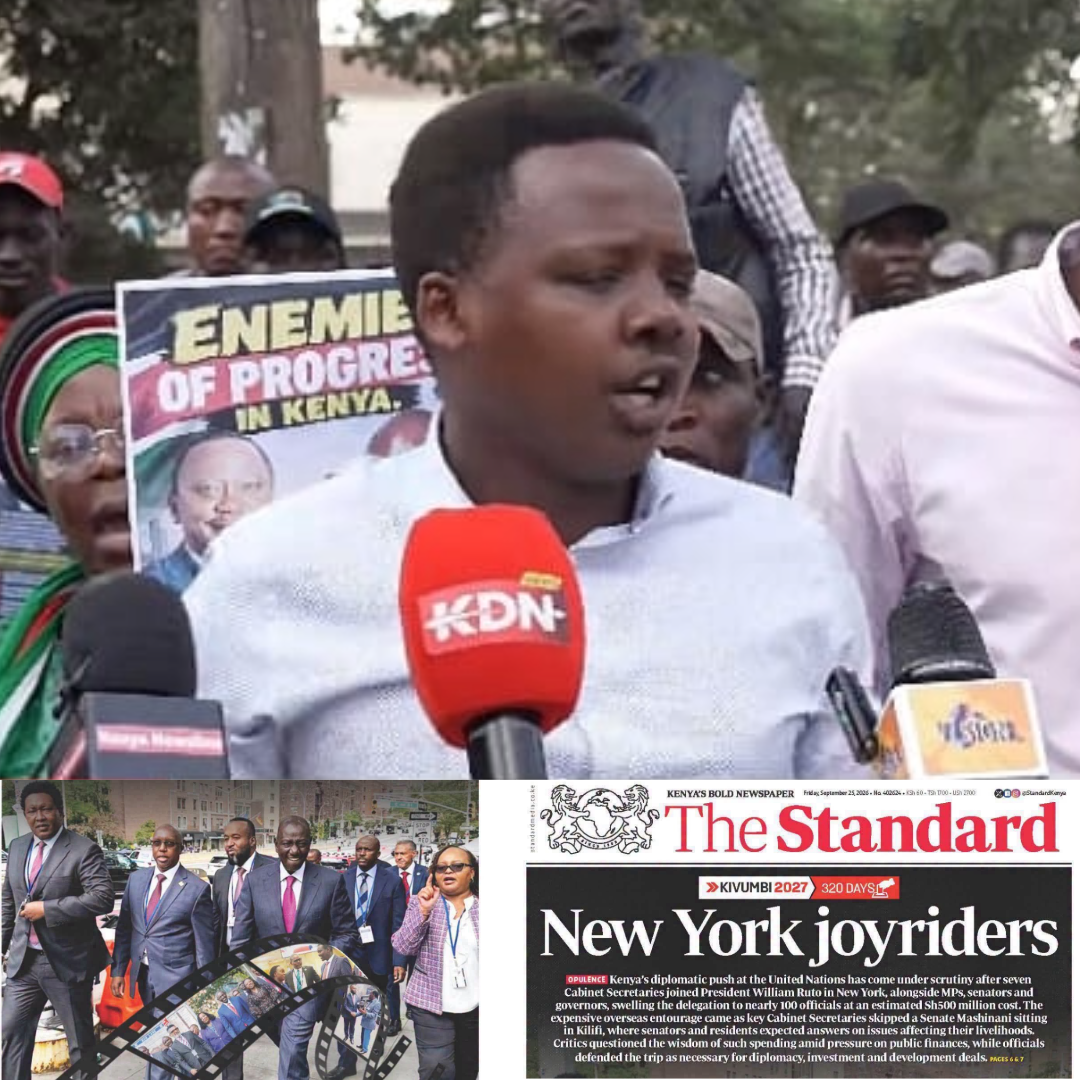
GALGADO VOWS TO PROTEST OVER STANDARD MEDIA HEADLINES, ACCUSES PAPER OF TARGETING GOVERNMENT
Galgado vows to protest against Standard Media, accusing the newspaper of using its headlines to unfairly target the government with propaganda.
Galgado has vowed to stage protests over what he describes as biased headlines published by Standard Media, accusing the media house of using its newspaper coverage to target the government with what he terms propaganda.
Galgado raised concerns over the way some government-related stories are presented, arguing that headlines play an important role in shaping public perception. According to him, the wording and framing of certain stories create a negative impression of the government while giving less attention to what he considers positive developments and achievements.
He said he would not remain silent over what he views as unfair media coverage, announcing plans to mobilise protests against the newspaper if the alleged trend continues.
The remarks come at a time when political debate in Kenya has intensified ahead of the 2027 General Election, with government officials, opposition leaders, activists and members of the public increasingly scrutinising media coverage of political developments.
Standard Media is one of Kenya's major media organisations and publishes The Standard newspaper, alongside operating television and digital news platforms. Its editorial section currently carries a range of political and public-interest commentary, including pieces critical of government policies as well as articles addressing opposition politics and electoral issues.
Galgado's criticism therefore adds to a wider conversation about the role of the media in Kenya's political environment.
At the centre of his complaint is the use of newspaper headlines. Headlines are often the first part of a story that readers see, particularly in print and on social media platforms where headlines can be shared independently from the full article.
Galgado argues that headlines should provide a fair reflection of the information contained in a story rather than creating an impression that, in his view, unfairly damages the reputation of the government.
He has consequently called on Standard Media to reconsider how it presents government-related stories, while warning that he is prepared to take his concerns to the streets through peaceful demonstrations.
The accusation of propaganda, however, remains Galgado's characterisation of the coverage and should not be treated as an established finding without independent evidence.
The Standard has previously published editorials and opinion pieces that scrutinise government actions, but it has also carried stories covering government programmes, development projects and statements by senior government officials. For example, during President William Ruto's development tour of Bomet County earlier this month, The Standard reported his challenge to opposition leaders to explain their alternative plans for running and funding the country.
The debate also comes against a backdrop of growing concern over misinformation and manipulated media content in Kenya's political environment.
Recently, fact-checkers have identified fake newspaper front pages circulating online and falsely attributed to major media organisations. Africa Check, for instance, reported in September 2026 that a fabricated Standard newspaper front page claiming a political development involving Babu Owino was being circulated online. The authentic edition carried a different headline and story.
Another altered Standard front page making claims about former Deputy President Rigathi Gachagua and Wiper leader Kalonzo Musyoka was also found to be fake. Africa Check said the genuine edition carried a completely different lead story.
These incidents highlight the importance of distinguishing between genuine newspaper reporting and material that is digitally manipulated or circulated without verification.
The media has traditionally played a central role in informing citizens, holding public institutions accountable and providing platforms for competing political views. At the same time, politicians and government supporters frequently criticise media houses when they believe coverage does not adequately reflect their position.
The relationship between political leaders and the media can therefore become particularly sensitive during election periods.
With the 2027 General Election approaching, political actors are expected to intensify their communication efforts as they seek to influence public debate. This is likely to increase scrutiny of newspapers, television stations, online publications and social media platforms.
Galgado's proposed protest is consequently likely to add another dimension to the ongoing discussion about media freedom, political communication and the responsibility of news organisations.
For supporters of his position, the planned protest could be viewed as an attempt to demand what they consider fairer coverage of government activities. For critics, however, protests targeting a media organisation could raise questions about the space available for independent journalism and editorial criticism.
The Constitution of Kenya provides protections for freedom of expression and media freedom, while the media also operates within professional and legal standards governing journalism.
The challenge is to maintain a balance between responsible journalism and the public's right to information, while ensuring that political disagreements do not undermine legitimate media scrutiny.
Galgado's comments also raise a broader question about how headlines should be interpreted by members of the public. A headline is designed to summarise the central point of a story and attract the reader's attention, but the full article provides additional context that may not appear in the headline.
Readers are therefore encouraged to examine complete reports, compare multiple credible sources and distinguish verified information from commentary or political claims.
The issue is particularly important in the digital era, where a screenshot of a headline can quickly circulate on WhatsApp, Facebook, X, TikTok and other platforms without the accompanying article.
In such circumstances, a headline can become detached from its original context and be interpreted differently by different audiences.
As political temperatures rise ahead of 2027, similar disagreements between political actors and media organisations are likely to remain part of the national conversation.
For now, Galgado maintains that he will protest against what he considers unfair Standard Media headlines and has accused the publication of targeting the government through propaganda.
The Standard Media has its own editorial processes and has continued publishing political reporting, opinion and editorial content covering both the government and opposition. The organisation has also previously defended the importance of independent journalism and media freedom.
Whether Galgado proceeds with the planned demonstrations, and how Standard Media responds to his accusations, will determine the next phase of the dispute.
The controversy ultimately places renewed attention on the relationship between politics and journalism in Kenya, particularly as the country moves closer to the 2027 General Election.
As political competition increases, the role of the media will remain central to how Kenyans receive information about government performance, opposition activities, public policy and electoral developments.
The immediate issue raised by Galgado is therefore not only about particular newspaper headlines, but also about the wider question of how political news should be reported, interpreted and debated in a democratic society.

You Might Also Like
-
Homa Bay Governor Gladys Wanga and fellow ODM leaders have rallied Kisumu residents to support President William Ruto’s re-election bid, citing ongoing government development projects in the region.
-
The Kilibwoni incident has left Nandi residents demanding answers after 52-year-old Julius Malel was shot during a police operation to arrest a KDF soldier. The latest available report says Malel was injured in the right thigh and hand and was in stable condition after being transferred to a special
-
President William Ruto’s attendance at the Sunday church service in Mwatate on September 27, 2026, provided an opportunity for him to worship with residents while continuing his wider development engagements in Taita Taveta County. The service came after announcements on major infrastructure proj
-
The decision by boda boda riders in Litein, Kericho County, to repair potholes ahead of the expected El Niño-related rainfall has drawn attention to the importance of early preparation. Their intervention is aimed at making roads safer and more passable while highlighting concerns about damaged ro
-
Opposition leaders are increasingly divided over who should lead the challenge against President William Ruto in the 2027 General Election, despite calls for a united front.
-
Linda Mwananchi has named Nairobi Senator Edwin Sifuna as its preferred presidential candidate for the 2027 General Election.