Historic State House Moment as Zimbabwe President Emmerson Mnangagwa Visits Kenya for High-Level Talks with President William Ruto to Strengthen Bilateral Relations and Boost Trade
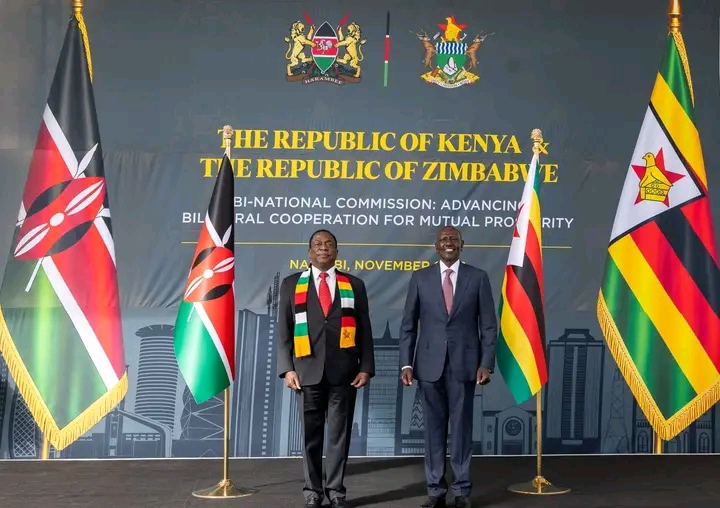
Zimbabwean President Emmerson Mnangagwa is in Kenya for a two-day State Visit on November 26–27, 2026, during which he is engaging President William Ruto at State House, Nairobi. The visit features a ceremonial 21-gun salute, a guard of honour inspection and the inaugural Kenya-Zimbabwe Bi-National Commission, which elevates bilateral relations from the Joint Permanent Commission on Cooperation to a presidential-level partnership. The two leaders are expected to discuss trade and investment, agriculture, manufacturing, mining, renewable energy, healthcare, education, tourism, transport and defence. Kenya and Zimbabwe are targeting an increase in annual bilateral trade from approximately US$57.6 million in 2025 to US$70 million by the end of 2026. The visit seeks to strengthen diplomatic relations, improve business opportunities and promote regional integration while ensuring that cooperation delivers meaningful benefits to citizens of both countries.
Zimbabwean President Dr Emmerson Dambudzo Mnangagwa is in Kenya for a historic two-day State Visit aimed at strengthening diplomatic relations, expanding economic cooperation and creating new opportunities for trade and investment between Kenya and Zimbabwe. The visit, which began on Thursday, November 26, 2026, is expected to mark an important milestone in the longstanding relationship between the two African nations.On Friday, November 27, President Mnangagwa is undertaking high-level engagements with his Kenyan counterpart, President William Samoei Ruto, at State House, Nairobi. The two leaders are expected to co-chair the inaugural session of the Kenya-Zimbabwe Bi-National Commission (BNC), an important diplomatic framework designed to elevate cooperation between the two countries to the highest level of presidential engagement.
The visit comes at a time when African countries are increasingly seeking stronger economic partnerships, regional integration and cooperation that can support industrial development, create employment opportunities and improve the living standards of their citizens.
According to reports from the visit, President Mnangagwa received full military honours at State House, including a ceremonial 21-gun salute and an inspection of the guard of honour before proceeding with the presidential engagements. The reception demonstrated the importance both governments attach to the visit and their commitment to strengthening diplomatic relations.
Following his arrival, President Mnangagwa expressed his enthusiasm about engaging President Ruto and advancing cooperation between the two countries.
He noted that elevating their diplomatic framework from a Joint Permanent Commission on Cooperation to a Bi-National Commission demonstrated the growing strength of their bilateral relationship.
The Zimbabwean leader also expressed optimism that the engagements would produce meaningful outcomes for the people of both countries.Such ceremonies are an important part of diplomatic protocol during state visits because they recognise the status of visiting heads of state and reinforce the friendship between nations.
Following the official reception, the two presidents are expected to engage in bilateral discussions focusing on economic development, regional cooperation, security, trade, investment and other matters of mutual interest.
The meeting also provides an opportunity for both leaders to assess existing agreements and identify additional areas where Kenya and Zimbabwe can work together.
The State House engagement is particularly significant because it marks the inaugural presidential-level session of the newly established Bi-National Commission. Previously, Kenya and Zimbabwe conducted much of their bilateral cooperation through the Joint Permanent Commission on Cooperation, which was established in 1989.
However, following President Ruto's State Visit to Zimbabwe in April 2024, the two countries agreed to elevate their relationship to a higher level.
The decision was intended to provide stronger political direction and improve the implementation of agreements signed between the two governments.
The establishment of the Bi-National Commission therefore represents an important development in the relationship between Nairobi and Harare.
Through the new framework, the two presidents will be able to review progress, identify challenges and provide strategic direction to government institutions responsible for implementing bilateral programmes.For Kenya, Zimbabwe offers opportunities for expanding business activities into Southern Africa.
For Zimbabwe, Kenya provides access to an important East African commercial and financial hub.
The two countries are therefore seeking to create an environment in which businesses can trade more easily, investors can explore new opportunities and entrepreneurs can expand their operations.
The Bi-National Commission is expected to play an important role in coordinating these economic priorities.Previously, Kenya and Zimbabwe conducted much of their bilateral cooperation through the Joint Permanent Commission on Cooperation, which was established in 1989.
However, following President Ruto's State Visit to Zimbabwe in April 2024, the two countries agreed to elevate their relationship to a higher level.
The decision was intended to provide stronger political direction and improve the implementation of agreements signed between the two governments.
The establishment of the Bi-National Commission therefore represents an important development in the relationship between Nairobi and Harare.
Through the new framework, the two presidents will be able to review progress, identify challenges and provide strategic direction to government institutions responsible for implementing bilateral programmes.For Kenya, Zimbabwe offers opportunities for expanding business activities into Southern Africa.
For Zimbabwe, Kenya provides access to an important East African commercial and financial hub.
The two countries are therefore seeking to create an environment in which businesses can trade more easily, investors can explore new opportunities and entrepreneurs can expand their operations.
The Bi-National Commission is expected to play an important role in coordinating these economic priorities. The two countries can benefit from exchanging knowledge on mineral development, investment promotion, environmental protection and value addition.
Renewable energy is another important area.
As African countries seek affordable and sustainable energy solutions, Kenya and Zimbabwe have opportunities to collaborate in developing renewable energy projects.
Kenya has considerable experience in geothermal energy, wind power and other renewable energy sources.
Sharing technical knowledge and encouraging investment in clean energy could support industrial development and improve access to reliable electricity.Cooperation could also include medical research, professional training and the exchange of experiences in public health management.
In education, the two governments have opportunities to strengthen academic partnerships between universities and other institutions.
Student exchange programmes, research partnerships and professional training could help young people acquire skills that are relevant to the changing labour market.
The two countries could also strengthen cooperation in technical and vocational education to support industrialisation.Zimbabwe is known for attractions such as Victoria Falls, one of the world's most recognised natural landmarks, as well as its wildlife reserves and historical sites.
Stronger tourism cooperation could encourage travel between the two countries and promote joint tourism packages.
Improved transport and air connectivity would also make it easier for businesspeople, tourists and investors to travel between Nairobi and Zimbabwe.
Kenya Airways already operates flights connecting Kenya with Zimbabwe, providing an important foundation for further aviation cooperation.The initiative is intended to reduce logistical challenges and improve access to the Kenyan market for Zimbabwean businesses.
An in-market warehouse could help exporters store products closer to their customers, improve distribution and reduce certain transportation costs.
Small-scale farmers and small and medium-sized enterprises could particularly benefit from improved access to regional markets.
The proposal could also strengthen the relationship between businesses in the two countries by encouraging more direct commercial partnerships.Kenya and Zimbabwe are members of important regional and continental organisations, including the African Union and the Common Market for Eastern and Southern Africa (COMESA).
Their cooperation provides opportunities to coordinate positions on regional economic development, peace and security.
The two presidents have also maintained engagement through regional diplomatic platforms.
In October 2026, President Ruto attended the COMESA Summit in Harare, where he handed over the chairmanship of the COMESA Authority to President Mnangagwa.
Their engagement demonstrates the importance of cooperation between African leaders in advancing shared development objectives.The current visit also builds on the diplomatic relationship established during President William Ruto's State Visit to Zimbabwe in April 2024.
During that visit, President Ruto and President Mnangagwa agreed to strengthen bilateral cooperation and elevate the relationship between their countries.
The two leaders recognised the need for a stronger mechanism that would enable them to monitor progress and provide strategic direction to their governments.
The agreement to establish the Bi-National Commission emerged from those discussions.
The November 2026 engagement is therefore an important step towards implementing the commitments made during the earlier presidential visit.What the visit means for ordinary Kenyans and Zimbabweans
The most important question surrounding the State Visit is how the discussions will translate into practical benefits for ordinary citizens.
For Kenyans, stronger relations with Zimbabwe could create opportunities for businesses seeking to expand into Southern African markets.
Farmers, manufacturers, exporters and investors could benefit from improved market access and stronger commercial partnerships.
Young people could also benefit from opportunities in education, professional training and employment if the agreements are effectively implemented.
For Zimbabweans, stronger economic relations with Kenya could provide access to East African markets and new investment opportunities.

You Might Also Like
-
Martha Karua's renewed declaration of her 2027 presidential ambitions marks an important development in Kenya's political preparations ahead of the next General Election. Through her People's Liberation Party and the "Simama na Kenya, Simama na Martha" mobilisation campaign, she is seeking to attrac
-
Bomet East MP Richard Yegon has threatened legal action against individuals and online platforms circulating alleged AI-generated videos and images linking him to the disappearance of nominated MP Sabina Chege's mobile phone. Addressing the National Assembly, Yegon denied any involvement in the inci
-
The Directorate of Criminal Investigations (DCI) and the Anti-Doping Agency of Kenya (ADAK) have signed a Memorandum of Understanding aimed at strengthening the fight against doping-related offences in the country. The partnership will enhance intelligence sharing, coordinated investigations and pro
-
The lawyer representing the family of slain former Rongo University student Sharon Otieno has questioned how former Migori Governor Okoth Obado will continue offering financial assistance to the family while serving his 25-year prison sentence for her murder. The concerns have renewed attention on t
-
President William Ruto is set to resume his Western Kenya development tour on Saturday, November 28, visiting Busia, Bungoma, Kakamega and Vihiga counties in a four-day programme running until December 1, 2026. The tour will feature the launch and commissioning of various development projects target
-
More than 380,000 students enrolled in public universities and colleges across Kenya could face disruptions to their education following a major funding shortfall at the Higher Education Loans Board (HELB). The board has revealed that it requires an additional KSh86.7 billion to meet its financial o