




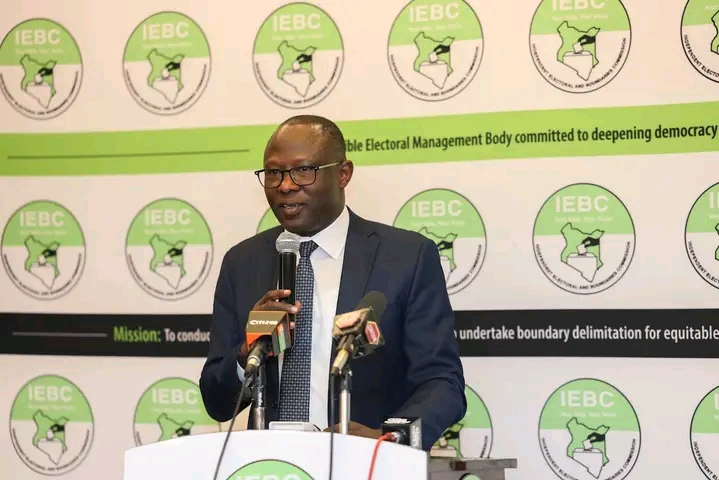
IEBC Rejects Election Rigging Claims as 2027 Poll Preparations Come Under Scrutiny
The current debate over alleged plans to rig Kenya's 2027 General Election has placed the IEBC under renewed public and political scrutiny. The commission has firmly rejected allegations that it intends to manipulate the election, describing previous claims as reckless, misleading and baseless. The latest controversy has particularly focused on election technology procurement and allegations surrounding a proposed new election management system. Former Deputy President Rigathi Gachagua has called for the cancellation of the reported Sh6.5 billion tender and has raised concerns about the possibility of election manipulation. The IEBC has responded that the procurement process is transparent and that no company has been awarded the election technology tender. At this stage, the allegations should be treated as political claims rather than established evidence of a rigging plan. The real test will be whether the IEBC can demonstrate transparency throughout the remaining preparation period. For Kenya, the issue goes beyond one political party or presidential candidate. A credible election requires the confidence of voters, political parties, observers, civil society and the wider public. The IEBC will therefore need to provide clear information about technology, voter registration, procurement, results transmission and safeguards against interference. The road to the 2027 election is likely to remain politically charged. But the most important safeguard against rigging fears will be transparency, verifiable procedures, independent oversight and respect for the law. The IEBC's official website provides information about the commission and its electoral mandate.
Kenya’s Independent Electoral and Boundaries Commission (IEBC) has strongly rejected allegations that there are plans to rig or manipulate the 2027 General Election, warning political leaders against making claims that could undermine public confidence in the electoral process. The issue has become increasingly prominent as Kenya moves closer to the next General Election, with political actors raising concerns over election technology, procurement, voter registration and the independence of the electoral commission.
The latest controversy follows renewed allegations by former Deputy President Rigathi Gachagua, who has questioned the IEBC’s procurement of an election management system and suggested that the process could be connected to a plan to influence the 2027 presidential election. The IEBC, however, has dismissed such allegations and maintained that its procurement processes are being conducted within the law.
IEBC says there is no plan to rig the 2027 election
The IEBC has repeatedly rejected suggestions that the commission is preparing to manipulate the 2027 presidential election. In a statement issued in May 2026, IEBC Chairperson Erastus Ethekon described allegations that political actors could influence the election through unlawful means as reckless, misleading and baseless.
According to the commission, such statements could create unnecessary fear among voters and damage confidence in Kenya’s electoral institutions before the election has even been formally declared.
The commission's position is that it has a constitutional responsibility to conduct elections in a manner that is transparent, credible, accountable and acceptable to Kenyans. It has therefore urged politicians and other stakeholders to avoid statements that suggest the outcome of the election has already been determined.
The IEBC has also pointed out that, at the time of its May statement, the 2027 General Election had not yet been formally declared. It argued that allegations of a predetermined election outcome were therefore premature.
Why rigging allegations have emerged
The debate over possible election rigging is not new in Kenya. Elections have historically generated intense political competition, with losing sides sometimes questioning the credibility of electoral processes.
Ahead of the 2027 election, concerns have increasingly focused on technology and procurement. Former Deputy President Rigathi Gachagua has recently alleged that the IEBC's planned acquisition of a new Integrated Election Management System could be used to compromise the election.
Gachagua has particularly questioned the involvement of South Korean technology company Miru Systems, alleging that the procurement process could result in an election management system that might be manipulated. These are allegations made by a political figure and should not be treated as established facts.
The IEBC has rejected the allegations. In the latest response reported in late August 2026, the commission said that no company had been awarded the election technology tender, directly challenging claims that the procurement had already been predetermined. It maintained that the procurement process was open and transparent.
This clarification is important because much of the current political debate revolves around whether the technology used during the election could determine or influence the final result.
The Sh6.5 billion tender controversy
Another major element of the controversy is the reported Sh6.5 billion election technology tender. Gachagua has called for the cancellation of the tender and argued that Kenya should instead upgrade its existing election technology.
His position is that changing the system close to the 2027 election could create vulnerabilities and potentially compromise public confidence. The former deputy president has urged the IEBC to be more cautious and transparent about the procurement process.
The IEBC, on the other hand, has defended its procurement approach. The commission says it is following the appropriate procedures and that no company has been awarded the tender as alleged.
This disagreement illustrates one of the central challenges facing the IEBC: even when an electoral process is legally compliant, lack of public confidence can become a major political problem.
Technology and the fear of election manipulation
Election technology has become one of the most sensitive issues in Kenya.
The country relies on technology at different stages of the electoral process, including voter identification, results transmission and election management. Because of this, political parties and voters want assurances that the systems are secure and cannot be manipulated.
The IEBC therefore faces pressure to demonstrate that its technology is protected against hacking, unauthorized access and other forms of interference.
The commission's explanation that no company has yet been awarded the disputed election technology tender is significant because it indicates that the procurement process was still being contested rather than being a completed arrangement.
However, allegations about technology can easily spread among voters, particularly through social media. This means the IEBC will have to communicate clearly about every major stage of the procurement and deployment process.
Kenya's history makes the issue particularly sensitive
Election rigging allegations carry considerable weight in Kenya because of the country's history of disputed elections.
The 2017 presidential election provides one of the most important examples. Kenya's Supreme Court annulled the presidential election after finding that the IEBC had failed to conduct the election in accordance with constitutional and legal requirements. A fresh presidential election was subsequently held.
The 2017 experience demonstrated that electoral credibility is not simply about announcing a winner. It also involves the procedures used to identify voters, transmit results, verify forms and announce the final outcome.
This history explains why political parties and voters are paying close attention to the IEBC's preparations for 2027.
IEBC's responsibility as an independent institution
The IEBC is constitutionally responsible for conducting and supervising elections and referendums in Kenya. It also has responsibilities relating to voter registration, voter education, candidate registration, electoral boundaries and other aspects of the electoral process.
Because of this broad mandate, the commission is expected to remain independent from political parties and individual candidates.
The current IEBC leadership under Chairperson Erastus Ethekon has therefore found itself under intense scrutiny. The commission has insisted that it cannot allow political accusations to undermine its constitutional mandate.
At the same time, the commission must understand that public criticism is an unavoidable part of democratic elections. Political parties and candidates have a legitimate interest in questioning procedures that could affect their chances.
The challenge is to distinguish between legitimate scrutiny and unsupported allegations.
IEBC warns against damaging public confidence
One of the strongest arguments made by the IEBC is that unsubstantiated rigging allegations can themselves damage the democratic process.
If voters are repeatedly told that an election has already been rigged, some may lose interest in voting. Others may refuse to accept the eventual results regardless of how the election is conducted.
The commission has therefore warned politicians against statements that portray it as compromised or incapable of conducting a credible election.
This concern is especially important in Kenya, where election-related disagreements have previously contributed to political tension.
For the 2027 election to be peaceful, voters need confidence that their votes will be counted accurately and that disputes will be resolved through established legal mechanisms.
Political leaders also have a role to play
The responsibility for protecting election credibility does not belong to the IEBC alone.
Political leaders have an important role in encouraging their supporters to respect democratic institutions. President William Ruto has also made statements about accepting electoral outcomes, including saying that he would accept defeat if voters choose another leader.
Ruto has emphasized the need for peaceful and free elections as political tensions surrounding the 2027 contest continue to grow.
Meanwhile, National Assembly Speaker Moses Wetang'ula has urged opposition leaders to allow the IEBC space to organize the election rather than attempting to dictate how the commission should operate.
These competing positions demonstrate how politically sensitive the IEBC has become.
Opposition concerns cannot simply be ignored
Although the IEBC has rejected rigging allegations, concerns raised by political parties and other stakeholders cannot simply be dismissed.
An electoral commission gains credibility not only by denying accusations but also by demonstrating transparency.
For example, if the IEBC is acquiring new technology, stakeholders will want to know:
How was the supplier selected?
What security measures will be implemented?
How will political parties inspect the system?
How will independent election observers monitor it?
What safeguards will prevent unauthorized access?
How will election results be verified?
What happens if the electronic system fails?
Will physical election documents remain the primary evidence?
Answering these questions publicly can help reduce suspicion.
The importance of voter verification
Another important part of preventing election manipulation is ensuring that the voters' register is accurate.
The IEBC has previously faced allegations concerning voter registration and possible manipulation of voter records, including during the Ol Kalou parliamentary by-election. The commission rejected claims that the register had been tampered with and assured stakeholders that the electoral process would proceed under established safeguards.
A credible voters' register is essential because every eligible voter should have an equal opportunity to participate, while fraudulent or duplicate registrations should be prevented.
Political parties therefore have a legitimate role in scrutinizing voter registration and raising specific concerns through the appropriate mechanisms.
The role of election observers
Election observers will also be important in building confidence ahead of 2027.
Domestic and international observers can monitor voter registration, campaigns, polling, vote counting and results transmission. Their reports can provide an independent assessment of whether the election meets acceptable democratic standards.
The IEBC will therefore need to work closely with observers and political parties to ensure that the electoral process is open to scrutiny.
Transparency should extend from procurement to voter registration, polling and final tallying.
What Kenyans should watch before 2027
As the election approaches, Kenyans should pay attention to several developments.
First is the procurement and deployment of election technology. The IEBC's clarification that no company had been awarded the disputed technology tender is important because it means stakeholders will continue watching how the procurement eventually develops.
Second is voter registration and verification. Citizens should ensure that their information is correctly captured and that they understand the procedures for participating in the election.
Third is political rhetoric. Leaders have a responsibility to avoid inflammatory statements that could create unnecessary tension.
Fourth is the independence of the IEBC. The commission must demonstrate that it can make administrative and technical decisions without political interference.
Finally, Kenyans should understand that allegations of rigging are not the same as proof of rigging. Claims should be examined against evidence.
Why the IEBC's "no rigging" position matters
The IEBC's rejection of rigging claims is significant because confidence in an election begins long before election day.
If citizens believe that the outcome has already been predetermined, the legitimacy of the eventual government can be questioned regardless of the actual voting process.
Conversely, if the IEBC provides sufficient transparency, political parties are allowed to scrutinize the process, observers are given access, and voters can verify important stages of the election, confidence can increase.
The commission therefore faces a major task: it must not only conduct a technically competent election but also convince millions of Kenyans that the process is fair.

You Might Also Like
-
The death of Martina Chepkemoi Rutto, a Kiswahili teacher at Lalagin Secondary School in Bureti Sub-County, has shocked her family and the wider education community in Kericho. She had been reported missing before her body was discovered in Kericho town. Preliminary reports indicate that she had suf
-
Alex Kiprotich is more than the journalist whose name dominated Kenya's news cycle on September 2, 2026. He is a veteran Standard Group journalist whose career has included investigative reporting, regional newsroom leadership, news editing and senior editorial responsibilities. His reported abduct
-
Kenya Railways' latest land-identification activities mark a significant stage in the development of the Naivasha–Kisumu–Malaba SGR extension. As of September 2, 2026, officials are undertaking field identification and mapping of land along the proposed corridor, following earlier government not
-
Elvis Opiyo died on August 11, 2026, at his rented apartment in Umoja Two, Nairobi, at the age of 37. Police treated his death as a suspected suicide, while a post-mortem reportedly established poisoning as the cause of death. His death occurred while he was facing allegations connected to an acid a
-
The planned Nedbank takeover of NCBA represents a major turning point for the Kenyatta and Ndegwa families and for Kenya's banking industry. The two families have historically been among NCBA's most significant shareholders, with the Ndegwas holding approximately 14.94 percent through First Chartere
-
The government's verification and compensation programme for Mau Forest evictees represents an attempt to resolve a dispute that has lasted for many years. The verification process was crucial because it enabled authorities to identify affected families and create a beneficiary list before releasing