




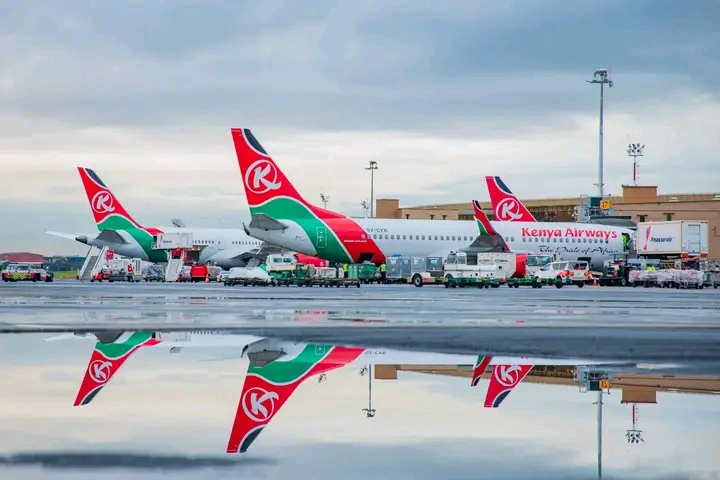
Kenya Airways Loses More Than $7 Million After Three-Day Aviation Strike Disrupts Flights
Kenya Airways has disclosed that it lost more than US$7 million (about KSh905 million) in revenue and additional disruption-related costs following a three-day industrial action that severely disrupted aviation operations in Kenya. The airline cancelled 63 flights, recorded more than 160 delays, with average delays exceeding six hours, and was unable to transport more than 370 tonnes of fresh produce and meat. Although Kenya Airways employees did not participate in the industrial action, the airline was heavily affected because Jomo Kenyatta International Airport (JKIA), its main hub, was among the facilities disrupted. The carrier has since restored its full flight schedule and cleared passenger backlogs after a return-to-work agreement ended the industrial action.
Kenya Airways has revealed the financial consequences of the recent aviation workers' industrial action, saying the disruption cost the national carrier more than US$7 million, equivalent to approximately KSh905 million. The disclosure was made in an update issued by the airline as it moved to restore normal operations following several days of flight cancellations, delays and disruption at Kenya's airports.
The announcement comes at a particularly important time for Kenya Airways, which has been working to strengthen its financial position after years of financial difficulties. The latest loss demonstrates how vulnerable airlines can be to disruptions beyond their direct control. Even when an airline's own employees continue working, interruptions involving airports, air traffic services and other aviation providers can quickly translate into cancelled flights, lost ticket revenue and significant additional expenses.
According to the statement attributed to Kenya Airways Board Chairman Kiprono Kittony, the more than US$7 million figure represents lost revenue as well as additional costs associated with managing the disruption. These costs included accommodation, meals, transportation, passenger rebooking and other travel-related requirements for customers whose journeys were affected.
*What caused the losses?*
The financial losses followed industrial action involving aviation workers in Kenya. The disruption affected operations at Jomo Kenyatta International Airport and other airports, creating difficulties for airlines and thousands of passengers.
The industrial action began around August 30, 2026, and was resolved on September 1, after the relevant parties reached a Return-to-Work Agreement. The agreement involved the Kenya Aviation Workers Union (KAWU), the Central Organisation of Trade Unions (COTU), the Kenya Civil Aviation Authority (KCAA), the government and other aviation stakeholders.
Reuters reported during the disruption that passengers experienced long waits and numerous flight cancellations at JKIA, while the dispute involved longstanding issues concerning collective bargaining, salary reviews, union matters and employment-related grievances.
Because Kenya Airways operates a large portion of its network through Nairobi, disruption at JKIA had an immediate effect on its operations. Aircraft could not operate normally, passengers could not connect to their onward destinations as scheduled, and cargo movements were also affected.
63 flights cancelled
One of the clearest indications of the scale of the disruption was the number of Kenya Airways flights that had to be cancelled.
The airline said 63 flights were cancelled, while more than 160 other flights were delayed. Average delays exceeded six hours.
For an international airline, cancelling dozens of flights over several days can have a major financial impact. A cancelled flight does not only mean the loss of the ticket revenue associated with that particular service. The airline may also have to incur costs associated with rebooking passengers, arranging accommodation, providing meals and transportation, reorganising aircraft and crew schedules and handling customer service operations.
The effects can also continue after airports reopen. Once normal operations resume, an airline has to deal with accumulated passenger and cargo backlogs. Aircraft and crews may need to be repositioned, while passengers who missed connections have to be accommodated on later flights.
This helps explain why Kenya Airways' reported loss included both lost revenue and disruption-related costs rather than simply the value of cancelled tickets.
More than 160 flights delayed
In addition to the cancellations, Kenya Airways recorded more than 160 delays.
Delays of more than six hours on average can create a chain reaction throughout an airline's network. An aircraft that arrives late at one airport may be unable to depart on time for its next destination. Passengers may miss connecting flights, while crews can reach their regulated working limits and require replacement arrangements.
For passengers, the disruption meant missed meetings, delayed holidays, missed connections and additional expenses. Kenya Airways acknowledged that its customers suffered significant inconvenience as a result of the situation.
The airline apologised to affected passengers, saying that although the disruption was outside its control, it recognised the frustration and inconvenience experienced by customers.
Cargo sector also affected
The financial consequences were not limited to passenger flights.
Kenya Airways said more than 370 tonnes of fresh produce and meat could not be uplifted during the disruption.
This is significant because Kenya's aviation industry plays an important role in the export of perishable agricultural products. Fresh flowers, vegetables, fruits, meat and other products depend on reliable air transportation to reach international markets while they are still fresh.
When cargo flights are cancelled or delayed, exporters can face serious consequences. Perishable goods may lose value, buyers may receive products late and exporters can incur additional storage and transportation costs.
The inability to transport hundreds of tonnes of agricultural products therefore represents a wider economic impact beyond Kenya Airways itself. Farmers, exporters, freight handlers and international buyers can all be affected when aviation operations are interrupted.
Kenya Airways employees did not take part
An important clarification from Kenya Airways is that its employees were not participants in the industrial action.
The airline said its operational teams remained on duty and worked to support passengers during the disruption. Nevertheless, because Kenya Airways depends on airports, air traffic services, security, ground-handling systems and other aviation infrastructure, the disruption elsewhere in the system still affected its ability to operate normally.
This highlights how interconnected the aviation sector is.
An airline cannot operate simply because its pilots, cabin crew and other employees are ready to work. Airports must be functioning, air traffic services must be available, aircraft must be handled on the ground and passengers must be processed efficiently.
When one major part of that system experiences a serious disruption, airlines can suffer substantial losses even if their own workforce remains operational.
The cost of taking care of passengers
One of the major components of the reported US$7 million loss was the additional money Kenya Airways had to spend assisting passengers.
Passengers affected by cancelled and delayed flights may require hotel accommodation, meals, transportation and alternative travel arrangements. The airline also has to rebook customers onto later flights or, where necessary, alternative routes.
These services are costly, particularly when thousands of passengers are affected at the same time.
The disruption therefore created a situation in which Kenya Airways faced two financial pressures simultaneously: it lost income from flights that could not operate while also spending additional money to support passengers whose journeys were disrupted.
This is one reason why industrial action in aviation can have such a large financial effect within a relatively short period.
Return to normal operations
The positive development for Kenya Airways is that normal operations have now resumed.
The industrial action was formally resolved on September 1 following the signing of a Return-to-Work Agreement. Kenya Airways subsequently said that its full flight schedule had been restored and passenger backlogs across its network cleared.
The recovery process was nevertheless important because returning to a normal schedule after several days of disruption is not instantaneous. Passengers who missed flights have to be accommodated, aircraft need to return to their planned positions and cargo backlogs have to be addressed.
The airline's operational teams therefore faced the difficult task of rebuilding normal schedules while continuing to assist customers.
Financial situation of Kenya Airways
The latest US$7 million loss comes against the background of a difficult financial environment for Kenya Airways.
In its first-half 2026 results, the airline reported that revenue increased by 9% to KSh81 billion for the six months ended June 30, 2026, despite a 9% reduction in capacity. The airline said stronger aircraft utilisation and commercial performance helped improve its cabin factor.
However, higher costs continued to put pressure on the company.
Kenya Airways said fuel costs increased by 32% compared with the same period the previous year, with fuel accounting for approximately 32% of total operating expenses and 52% of direct operating costs. Total operating costs increased by 14%. The airline consequently recorded a KSh16.1 billion loss after tax in the first half of 2026, compared with KSh12.2 billion in the corresponding period of the previous year.
Against this background, an additional loss of more than KSh900 million from a three-day disruption represents another financial challenge.
Why the $7 million figure matters
The reported loss is significant not only because of its size but also because it occurred within a very short period.
More than US$7 million was lost through a combination of cancelled revenue and additional expenses connected to the disruption. This demonstrates the extremely thin margins under which many airlines operate.
Airlines have substantial fixed costs. Aircraft leases or ownership costs, maintenance, insurance, crew expenses, airport charges, technology systems and other costs continue even when flights are cancelled.
Kenya Airways itself recently explained that airlines operate in a capital-intensive industry where many costs remain even when demand or operations are affected. The carrier reported total operating costs of KSh167.1 billion in FY2025.
Consequently, even a relatively short interruption can cause a disproportionately large financial impact.
Impact on Kenya's economy
The consequences of the disruption extend beyond Kenya Airways.
JKIA is one of the most important aviation hubs in East and Central Africa. It connects Kenya with destinations across Africa, Europe, Asia and the Middle East. Disruptions at the airport therefore affect tourism, trade, business travel, cargo transportation and regional connectivity.
Hotels can lose business when travellers are stranded or cancel trips. Taxi operators and other transport providers can be affected when passenger movements decline. Exporters can lose income when perishable goods cannot reach international markets.
For businesses that rely on just-in-time delivery, aviation disruption can also interfere with supply chains.
The 370 tonnes of fresh produce and meat that Kenya Airways said it could not transport illustrates this wider economic dimension.
Lessons for Kenya's aviation industry
The incident has also highlighted the need for stronger coordination across Kenya's aviation sector.
Kenya Airways emphasised that airlines, airports, regulators and other aviation service providers are interconnected. A problem affecting one part of the system can quickly spread throughout the entire industry.
There is therefore a need for mechanisms that can reduce the impact of future industrial disputes and ensure that essential aviation services continue operating while labour issues are being resolved.
At the same time, workers' grievances need to be addressed through meaningful negotiations. The resolution of the latest dispute through a Return-to-Work Agreement provides an opportunity for the parties involved to continue discussions and address the issues that triggered the industrial action. Reuters reported that the agreement included commitments to continue negotiations on unresolved matters.
What the loss means for passengers
For passengers, the most immediate concern is whether such disruptions will happen again.
Kenya Airways has restored its schedule, but the latest incident serves as a reminder that air travel can be affected by factors beyond an individual airline's control.
Travellers should therefore monitor airline communications and flight status when major disruptions are reported. Passengers with connecting flights may also need to allow sufficient time between flights, particularly during periods of operational uncertainty.
Kenya Airways' restoration of its schedule is a positive development, but rebuilding passenger confidence after widespread delays and cancellations remains important.
Conclusion
Kenya Airways' disclosure that it lost more than US$7 million, or approximately KSh905 million, following the three-day aviation disruption is a major development for the country's aviation industry. The loss resulted from both revenue that the airline could not earn and additional expenses incurred while assisting passengers and managing the disruption.
The airline cancelled 63 flights, recorded more than 160 delays, with average delays exceeding six hours, and reported that more than 370 tonnes of fresh produce and meat could not be transported.
Although Kenya Airways employees did not participate in the industrial action, the carrier was heavily affected because of its dependence on JKIA and the wider aviation infrastructure. The episode demonstrates the interconnected nature of the aviation industry and the enormous financial consequences that can arise when critical airport operations are disrupted.
The return-to-work agreement and restoration of normal flights offer some relief, but the incident also raises broader questions about industrial relations, airport preparedness and the resilience of Kenya's aviation system.
For Kenya Airways, the immediate priority is to maintain stable operations, restore passenger confidence and protect its financial recovery. The company was already facing high fuel costs, aircraft availability challenges and substantial financial pressure before the latest disruption.
The more than US$7 million loss therefore represents more than a headline figure. It is a reminder of how quickly an airline's finances can be affected by operational disruptions and why stable labour relations, effective contingency planning and strong coordination among all aviation stakeholders are essential to protecting Kenya's aviation sector and the wider economy.

You Might Also Like
-
 The death of Nancy Akinyi Koiya, a 26-year-old mother of two and businesswoman from the Kisumu–Nandi border region, has left her family and community devastated. She reportedly disappeared after leaving her hotel and catering business at Kibigori Junction earlier this week. Her husband, Kiplagat K
 -
The latest HELB announcement by Education Cabinet Secretary Julius Ogamba is significant for thousands of Kenyan students preparing to join universities and TVET institutions. The government's decision to extend the 2026/2027 tertiary education funding application deadline to September 21, 2026, aft
-
FUNERALS WITHOUT BODIES: NEPAL FAMILIES MOURN LOVED ONES STILL MISSING AFTER DEVASTATING FLOODS
-
The trailer fire at Kipsitet along the Kericho–Kisumu Highway on September 3, 2026, has drawn attention to the dangers faced by long-distance transport operators and other road users. The trailer, reportedly travelling toward Uganda, caught fire shortly after being parked along the highway near Mo
-
Kenya's current milk shortage is the result of several interconnected problems rather than one single cause. Dry and cold weather has reduced pasture and fodder availability, lowering milk yields in important dairy-producing areas. At the same time, high feed and operating costs have made production
-
The World Meteorological Organization (WMO) has issued a major weather outlook indicating a 100 per cent likelihood of El Niño conditions continuing through February 2027,