



Kenya Meteorological Service Warns of El Niño Onset as Coastal Counties Experience Increasing Rains: Predictions Across the Country
The developing 2026 El Niño is becoming one of the major weather concerns for Kenya as the country approaches the October-December short-rains season. Kenya Meteorological Service forecasts indicate that many parts of the country could receive above-average rainfall, with the possibility of heavy rain, flooding and landslides in vulnerable areas. The Coastal region is already showing signs of increased rainfall, with Mombasa, Kilifi, Kwale and Lamu among counties receiving or expecting showers. Tana River is also an important area to monitor because of the risk of river flooding. At the same time, Nairobi, Central Kenya, the Rift Valley, Western Kenya, the Lake Victoria Basin, Eastern Kenya and parts of northern Kenya are expected to experience varying amounts of rainfall as the season develops. However, the weather situation remains dynamic. Experts have cautioned that the precise onset and distribution of the short rains remain uncertain, and rainfall will not necessarily be uniform across the country. The most important message from Kenya Met's forecasts is therefore preparedness rather than panic. With 46 counties potentially exposed to the impacts and 18 identified as particularly high-risk, communities, county governments and national agencies need to prepare early. For coastal Kenya, residents should be especially alert to flooding, strong winds, high waves and possible disruption of roads and livelihoods. Across the rest of the country, farmers should monitor rainfall forecasts, while residents in flood- and landslide-prone areas should prepare evacuation plans and follow official warnings. The coming weeks will be important because Kenya moves from the current transition period into the main October-December rainfall season. Kenya Met's continuing updates will provide a clearer picture of exactly where the heaviest rains are likely to occur and when the strongest impacts should be expected.
The Kenya Meteorological Service (KMS), commonly referred to as the Kenya Meteorological Department, is closely monitoring the developing 2026 El Niño phenomenon and has warned Kenyans to prepare for an increasingly wet period as the country approaches the October-November-December (OND) short-rains season. Current forecasts indicate that much of Kenya could receive above-average rainfall, although the timing and intensity will vary from county to county. The Coast is already among the areas receiving rainfall, while other parts of the country are expected to experience different patterns ranging from moderate to heavy rain to temporary dry spells.
It is important to clarify that El Niño does not mean that every county will experience continuous heavy rain at the same time. Weather experts have pointed out that the actual distribution and intensity of rainfall will depend on several factors, including the Indian Ocean Dipole (IOD), atmospheric circulation and local conditions. Recent reports have also noted that forecasting models have differed over exactly when the main short rains will begin.
*Kenya Met's prediction for the onset of El Niño rains*
The latest forecasts indicate that enhanced rainfall associated with the developing El Niño could begin becoming more noticeable from late September, with October, November and December expected to be the principal period of concern.
A Kenya Met forecast released in August indicated that the developing El Niño was intensifying and that Kenya should prepare for above-average rainfall. Reports based on the forecast have warned of the potential for heavy rainfall, flooding and landslides in vulnerable areas.
The forecast is particularly significant because Kenya is approaching the country's traditional October-December short-rains season. Under normal circumstances, the short rains are important for agriculture, water resources and livestock. However, when rainfall becomes excessive, it can produce flooding, landslides, destruction of roads and bridges, crop losses and displacement of communities.
Kenya Met has also emphasized that El Niño itself should not be interpreted as a guarantee of extreme rainfall everywhere. The Indian Ocean Dipole is another important factor in determining how much rain East Africa receives.
Coastal Kenya is already experiencing increased rainfall
The Coast is one of the regions that has been receiving rainfall as the country moves toward the main rainy season.
Recent weather forecasts have identified Mombasa, Kilifi, Kwale and Lamu among the coastal counties receiving or expecting showers. A recent five-day forecast covering September 13-17 also included the Coast among regions where rainfall was expected.
This has led to increased attention on coastal communities because rainfall along the Coast can quickly create flooding problems in low-lying areas.
The current situation does not necessarily mean that the peak of the El Niño rains has already arrived. Rather, the Coast is experiencing an earlier increase in rainfall while the country awaits the more widespread October-December rainfall season.
Earlier forecasts had also shown the Coast as one of the regions likely to experience wetter conditions even before the main short-rains season.
Mombasa: flooding and drainage concerns
Mombasa County is particularly vulnerable because of its urban environment, relatively low-lying areas and large population.
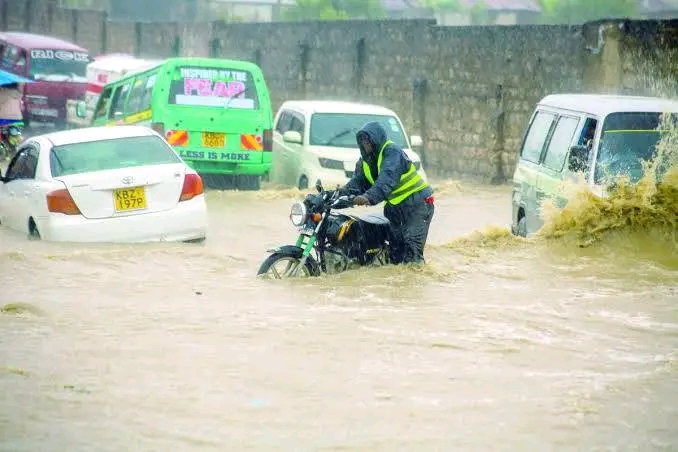
When heavy rainfall occurs over a short period, drainage systems can become overwhelmed. Water can accumulate on roads, in residential areas and around business premises.
For residents, this can mean difficulty travelling, damage to property and disruption of normal economic activities. Businesses located in flood-prone areas may also suffer losses if water enters their premises.
The Coast also faces another weather-related risk: strong winds and large waves. Kenya Met has recently issued marine warnings indicating significant wave heights in parts of Kwale, Mombasa, Kilifi and Lamu.
Consequently, fishermen, boat operators and other people who depend on the Indian Ocean need to follow marine weather warnings closely.
Kilifi County
Kilifi County is also expected to receive increased rainfall during the coming period.
Rain can be beneficial to farmers because it improves soil moisture and replenishes water sources. However, excessive rainfall can cause soil erosion, crop destruction and flooding.
Kilifi also contains areas close to rivers and drainage channels where intense rainfall can produce localized flooding.
The county's coastal communities therefore need to prepare for the possibility of heavy downpours rather than simply relying on the benefits of increased rainfall.
Kwale County
Kwale County is another coastal area that is likely to experience significant rainfall during the October-December season.
Kwale has several rivers and streams flowing toward the Indian Ocean, meaning that heavy rainfall can increase water levels and runoff.
The county also has agricultural communities that depend heavily on rainfall. Moderate and well-distributed rain can improve food production, but excessive rain can wash away crops, damage roads and cause waterlogging.
The possibility of heavy rain therefore presents both an opportunity and a risk for farmers.
Lamu County
Lamu County is also being closely monitored.
The county's geography makes it particularly sensitive to heavy rainfall, flooding and marine conditions. Some communities live on islands or depend heavily on roads and boats for transportation.
Heavy rainfall could make roads difficult to use, while rough seas could create additional challenges for fishermen and boat operators.
Residents should therefore monitor both rainfall forecasts and marine advisories.
Tana River County
Tana River County is one of the most important areas to monitor because of the Tana River and communities living close to its floodplain.
Heavy rainfall upstream can cause river levels to rise even when rainfall in a particular settlement is not exceptionally high.
Flooding along the Tana River can affect farms, homes, livestock, roads and bridges. The county has consequently been included among areas requiring enhanced preparedness for the expected rains.
The combination of rainfall and river flooding means that residents should avoid settling or camping close to riverbanks during periods of heavy rainfall.
Predictions for Nairobi and Central Kenya
The effects of the developing rainy season will not be restricted to the Coast.
Nairobi is also expected to experience rainfall as the season progresses. The current five-day forecast covering September 13-17 indicated showers in Nairobi, with cloudy mornings and afternoon or night showers expected on some days.
Nairobi's major concern is urban flooding.
Heavy rainfall can overwhelm drainage channels and produce flash floods in areas where construction, garbage accumulation or poor drainage obstructs the movement of water.
Central counties including Kiambu, Murang'a, Nyeri, Kirinyaga and Nyandarua are also expected to receive rainfall during different periods.
Farmers in Central Kenya will be watching the forecasts closely because rainfall will be important for crops, particularly in areas dependent on the short rains.
Rift Valley predictions
The Rift Valley is expected to experience variable weather during the transition toward the October-December season.
Some parts of the region could receive enhanced rainfall, while other areas may experience temporary dry spells before the rains become more widespread.
This variability is important for farmers in counties such as Nakuru, Kericho, Bomet, Narok, Uasin Gishu, Nandi, Elgeyo-Marakwet and West Pokot.
In highland areas, heavy rainfall can increase the risk of landslides and mudslides, particularly where the ground becomes saturated.
Roads crossing mountainous and hilly terrain may also be vulnerable to damage or obstruction.
Western Kenya and the Lake Victoria Basin
Western Kenya and the Lake Victoria Basin are also expected to receive rainfall during the coming season.
Counties such as Kisumu, Siaya, Homa Bay, Busia, Kakamega, Bungoma and Vihiga will need to monitor rainfall developments closely.
Rainfall is important for agriculture in this region, but intense storms can cause flooding and damage infrastructure.
The Lake Victoria region also faces risks from strong winds and storms. Fishermen and communities living near the lake should therefore pay attention to weather and marine warnings.
Recent forecasts have shown that rainfall patterns may not be uniform across Western Kenya. Some parts could experience dry spells even while other parts receive rain.
Eastern Kenya
Counties in Eastern Kenya, including Machakos, Kitui, Embu, Tharaka-Nithi and Meru, could also experience rainfall during the OND season.
For farmers in traditionally dry areas, increased rainfall would be welcome because it could improve pasture, replenish water sources and support crop production.
However, heavy rainfall can produce flash floods, especially in areas where rivers and seasonal streams fill rapidly.
Farmers should therefore balance optimism about the rains with preparations for excessive rainfall.
Northern and North-Eastern Kenya
Northern counties such as Garissa, Wajir and Mandera can also receive rainfall during the season, although rainfall amounts may vary considerably from one location to another.
For communities in these areas, rain can have enormous benefits because water availability is often a major challenge.
Improved rainfall can support livestock, pasture and water pans.
At the same time, intense rainfall can cause flooding along rivers and seasonal drainage channels, particularly in vulnerable settlements.
Recent Kenya Met forecasts have included several northeastern counties among areas receiving rainfall during shorter forecast periods.
18 high-risk counties
The government has also identified a group of counties considered particularly vulnerable to the impacts of the expected El Niño rains.
Reports indicate that 18 counties have been prioritized for preparedness because of risks including flooding and other weather-related hazards.
This risk mapping is important because not every county will experience the same impact.
Some counties are more exposed because of their proximity to rivers, while others are vulnerable because of steep terrain, poor drainage, urban congestion or settlements in flood-prone locations.
The government has therefore been working on preparedness measures before the main rains intensify.
Up to 46 counties could be affected
The potential scale of the situation is broader than the list of high-risk counties.
The Kenya Red Cross has warned that 46 counties could be affected by the expected El Niño rains, with more than two million people potentially exposed to the effects.
This does not mean that all 46 counties will necessarily experience disastrous flooding. Rather, it reflects the broad geographical area in which communities could face some form of weather-related impact.
The warning emphasizes the importance of county-level preparedness throughout Kenya.
*Why coastal counties may experience rain earlier*
The Coast's weather is influenced by its proximity to the Indian Ocean. The region can therefore experience rainfall patterns that differ from those in inland Kenya.
The interaction between ocean temperatures, atmospheric circulation and the Indian Ocean Dipole can influence rainfall over the East African region.
This is one reason why the Coast may receive rainfall while some inland areas are experiencing dry or relatively dry conditions.
Recent weather reports have indeed described a contrast in which rainfall was increasing along the Coast while parts of the Rift Valley, Western Kenya and Nyanza were experiencing a dry spell.
Therefore, Kenyans should not expect the El Niño rains to arrive as one nationwide event.
El Niño and the Indian Ocean Dipole
The Indian Ocean Dipole is particularly important in understanding Kenya's rainfall forecast.
The IOD measures differences in sea-surface temperatures between western and eastern parts of the Indian Ocean.
When atmospheric and ocean conditions are favourable, these changes can influence rainfall over East Africa.
Kenya Met has emphasized that even a strong El Niño does not automatically mean that Kenya will experience torrential rain everywhere. The interaction between El Niño and the IOD, together with other atmospheric conditions, determines the eventual rainfall distribution.
This is why meteorologists continue updating their forecasts as new observations become available.
Flooding and landslide risks
The biggest concern associated with the expected rains is flooding.
Urban areas such as Mombasa and Nairobi could experience flash flooding if heavy rain falls faster than drainage systems can handle.
Rural areas face riverine flooding, particularly around major rivers.
Highland counties face an additional danger: landslides and mudslides.
When the soil becomes saturated after prolonged rainfall, slopes can become unstable. This creates danger for communities living near steep hills and mountainous areas.
Roads can also be cut off when bridges are washed away or landslides block major routes.
Impact on agriculture
The expected rains could be good news for Kenyan farmers if they are well distributed.
Farmers could benefit from improved soil moisture, better pasture and increased water availability.
However, excessive rainfall could destroy crops, cause soil erosion and increase the spread of crop diseases.
Farmers should therefore use Kenya Met's seasonal and shorter-term forecasts when deciding when to plant.
The difference between beneficial rain and destructive rain is often determined by intensity, duration and drainage.
What coastal residents should do
Residents in coastal counties should prepare before the heaviest rains arrive.
Households in flood-prone areas should identify safe places where they can move if water levels rise.
Residents should avoid building or staying unnecessarily close to rivers, drainage channels and other areas known to flood.
They should also keep drainage channels around their homes clear of rubbish and other obstructions.
Fishermen and boat operators should follow marine warnings, particularly when Kenya Met issues alerts about strong winds or high waves.
What other counties should do
Preparedness should not be limited to coastal Kenya.
County governments across the country should inspect drainage systems, bridges and roads before the peak of the rainy season.
Schools, hospitals, markets and other public institutions in flood-prone areas should have emergency plans.
Communities should also know where to obtain reliable weather information.
People should avoid depending on social-media rumours when making decisions about dangerous weather.

You Might Also Like
-
EPRA has retained fuel prices for the September–October cycle, with petrol at KSh214.03, diesel at KSh217.86, and kerosene at KSh191.38 per litre.
-
Musalia Mudavadi's speech in Kapsengere, Nandi County, on September 13, 2026, was primarily about the 2027 General Election and President William Ruto's expected re-election campaign. Mudavadi firmly rejected suggestions that Ruto would need to rig the election or use electoral shortcuts. He urged p
-
President William Ruto's second day in Kisumu has been marked by a combination of major infrastructure launches, development announcements and strong political speeches. The biggest project commissioned today is the Sh8.4 billion Lake Victoria Water and Sanitation Project, which is expected to impr
-
Deputy Inspector General of Police Gilbert Masengeli urges Kenyans to work with security agencies, share information responsibly and help safeguard peaceful elections.
-
Rural Electrification and Renewable Energy Corporation (REREC) is targeting the connection of more than 50,000 households in Bomet and Kericho counties to electricity before Christmas, as part of the government’s wider push to expand electricity access in rural Kenya. The initiative is expected to
-
The Public Health Principal Secretary's warning highlights the growing importance of preparing Kenya's health system before the anticipated El Niño rains intensify. Mary Muthoni has called for stronger disease surveillance, safe water, improved sanitation, adequate medicine stocks and greater prepa