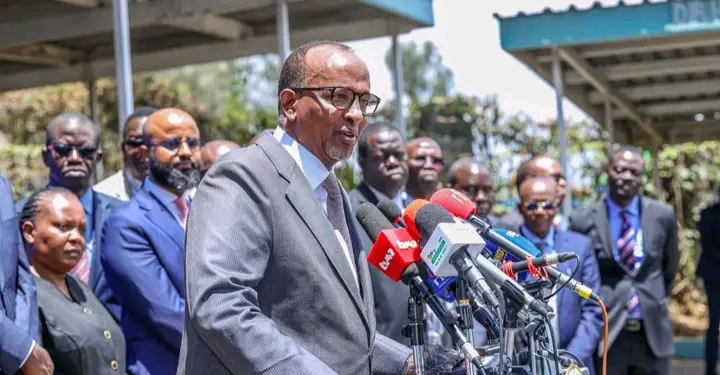





Kindiki Unveils Major Agriculture Gains at Jamhuri Park as Government Pushes for Food Security and Better Farmer Incomes
Deputy President Kithure Kindiki's appearance at Jamhuri Park on October 7 placed agriculture and food security at the centre of the national economic transformation conversation. He outlined government figures on farmer registration, fertiliser prices, livestock vaccination, milk production, meat exports, fisheries and agro-processing while strongly encouraging farmers to adopt technology and precision agriculture. The three-day summit will continue bringing together farmers, government institutions, counties, businesses, researchers, development partners and young innovators as Kenya seeks to strengthen food production, create agricultural jobs, improve farmer incomes and reduce dependence on food imports.
Deputy President Kithure Kindiki on Wednesday, October 7, 2026, presided over the official opening of the Agriculture and Food Security Transformation Summit at the Jamhuri Park ASK Showground in Nairobi, where he outlined the government’s progress in agriculture and called on farmers to embrace technology, innovation and modern farming methods. The three-day summit, running from October 7 to 9, brings together government officials, farmers, county governments, private-sector players, researchers, development partners, youth and other stakeholders to discuss Kenya’s food security and agricultural transformation agenda.
The event at Jamhuri Park brought together senior government officials and agricultural stakeholders as the country assessed what has changed in the agricultural sector over the past four years and considered what more needs to be done to improve food production, farmer incomes, job creation and food security.
Kindiki used the occasion to highlight what he described as significant progress under the government’s agricultural transformation programme. He said agriculture had been placed at the centre of Kenya’s economic transformation agenda and that the government had implemented several measures aimed at lowering production costs and improving productivity.
Kindiki highlights growth in farmer registration
One of the major achievements highlighted by the Deputy President was the expansion of the national farmer registration database.
According to Kindiki, the government had upgraded the farmer register from approximately 300,000 farmers to 7.2 million crop farmers and three million livestock keepers.
He said the database was important because it would enable the government to better understand farmers, target agricultural programmes and deliver support to producers across the country.
Kindiki maintained that farmers remain central to Kenya’s efforts to achieve food security and reduce dependence on imported food.
He described farmers as hardworking and patriotic people whose contribution goes beyond individual livelihoods because they play an important role in ensuring that the country has enough food.
Fertiliser prices reduced
Kindiki also spoke about the government's efforts to reduce the cost of agricultural inputs.
He said the price of a 50-kilogramme bag of fertiliser had fallen from approximately Sh7,000 to Sh2,000 through the government's subsidy programme.
He also said the price of certified maize seed had been reduced by half, from Sh300 to Sh150 per kilogramme.
The Deputy President presented the reduction in input prices as part of efforts to make farming more affordable and encourage farmers to increase production.
The issue of high agricultural production costs has remained a major concern for Kenyan farmers, particularly because the price of fertiliser, seeds, animal feeds, machinery and other inputs directly affects the cost of food.
Kindiki therefore used the summit to emphasise the importance of maintaining measures that reduce the financial burden on farmers.
Government highlights livestock interventions
The Deputy President also discussed developments in the livestock sector.
He said the cost of sexed semen used in artificial insemination of dairy cattle had fallen from approximately Sh8,000 to Sh1,400 per dose.
According to Kindiki, the reduction was intended to make improved breeding technology more accessible to farmers and contribute to better livestock breeds and increased dairy productivity.
He further reported that approximately 8.9 million cattle had been vaccinated under an ongoing livestock vaccination programme.
The programme, he said, is targeting Kenya's estimated population of about 22 million cattle and 50 million small stock.
The government has increasingly emphasised livestock health, breeding and productivity as important components of food security and rural economic development.
Milk production increased.
Kindiki also pointed to growth in Kenya's dairy industry.
He said milk production had increased from about 4.6 billion litres to 5.2 billion litres.
He further said the value of dairy products had risen from approximately Sh4.9 billion to Sh8.9 billion, while meat exports had increased from Sh8.9 billion to Sh12.9 billion.
The Deputy President presented these figures as evidence that interventions in agriculture were beginning to produce results across various value chains.
He said Kenya had also strengthened its position in processed milk exports, while improvements in production, breeding and livestock health were helping farmers and businesses within the sector.
Kindiki urges farmers to embrace technology
A major part of Kindiki's speech focused on technology.
The Deputy President urged farmers to embrace smart agriculture and precision farming, saying technology would play an increasingly important role in the future of Kenyan agriculture.
He cited the use of drones and other technologies that can help farmers apply fertiliser and pesticides more accurately.
According to Kindiki, farmers should avoid applying agricultural inputs unnecessarily across entire farms when technology can identify areas that specifically require treatment.
He explained that precision agriculture allows farmers to apply the right amount of fertiliser or pesticides to the crops that need them.
He described precision farming as one of the next major frontiers for Kenya's agricultural sector.
The Deputy President also said research and innovation had contributed to the development of improved crop varieties, better animal breeds and new agricultural technologies.
County aggregation and industrial parks
Kindiki also highlighted progress in agro-processing.
He said 17 County Aggregation and Industrial Parks had been completed and were being equipped to begin operations.
The facilities are expected to provide opportunities for value addition and agro-processing while helping counties develop industries around agricultural products produced locally.
The government's broader objective is to ensure that farmers do not only sell raw agricultural products but can benefit from processing, packaging, branding and access to better markets.
The development of agro-processing facilities is therefore being linked to both agricultural transformation and employment creation.
Fisheries and blue economy
Kindiki also discussed the fisheries and blue economy sector.
He said the government had invested in fishing infrastructure, including fishing ports at Shimoni and Liwatoni, as well as fish landing sites along the Indian Ocean and Lake Victoria.
He also highlighted support provided to fishing communities through boats, grants to beach management units, fish cages and fingerling production facilities.
According to the Deputy President, the value of the fisheries and blue economy sector had increased from approximately Sh37 billion to Sh59 billion.
The government is seeking to increase the contribution of fisheries to food security, employment and household incomes while supporting communities that depend on fishing and aquaculture.
What took place at Jamhuri Park
The Jamhuri Park event was not simply a political gathering. It was the opening of a major national agricultural summit designed to bring together stakeholders from across Kenya's food system.
The official programme shows that the summit is being held from October 7 to October 9, 2026, at the Jamhuri Park ASK Grounds. The first day focuses on assessing agricultural achievements, while the second day will examine strategic choices and the third day will focus on implementation and commitments.
The summit includes discussions on crops, livestock, dairy, fisheries, coffee, tea, sugar, horticulture, cotton, irrigation, forestry, agricultural finance, cooperatives, mechanisation, soil health and agricultural innovation.
There are also exhibitions and an innovation marketplace where agricultural technologies, machinery, irrigation systems, digital tools and value-added agricultural products are being showcased.
The programme also includes a youth innovation challenge intended to give young entrepreneurs an opportunity to present solutions to challenges such as post-harvest losses, cold storage, irrigation and agricultural advisory services.
Focus on food security and farmer incomes
The larger message from Kindiki's appearance at Jamhuri Park was that Kenya's agricultural transformation must ultimately translate into improved food security and better incomes for farmers.
The government is seeking to increase domestic production while reducing production costs and improving access to markets.
Kindiki's remarks also showed that the government wants agriculture to become increasingly technology-driven, with digital farmer registration, precision farming, improved seeds and livestock breeding forming part of the transformation.
The summit is also expected to address outstanding challenges and establish future priorities for the sector.
Its official theme is “Agriculture & Food Systems Transformation — Advancing Food Sovereignty, Job Creation, and Shared Prosperity under BETA.”

You Might Also Like
-
Former President Uhuru Kenyatta steps down as Azimio council chair, with James Orengo and Rigathi Gachagua emerging in discussions over the coalition’s future leadership.
-
Kenya's Ebola response has entered a critical surveillance and contact-tracing phase following confirmation of the country's first imported Bundibugyo Ebola case. PS Mary Muthoni says 57 contacts have been identified, with 10 already placed under quarantine, while health officers across the country
-
A passenger travelling aboard a Kenya Airways flight from Nairobi to Lagos, Nigeria, has died after suffering a medical emergency shortly before the aircraft landed at Murtala Muhammed International Airport. The passenger reportedly became unresponsive about 20 minutes before landing, prompting cabi
-
NCIC's latest actions against CS Geoffrey Ruku and its handling of nominated MP Joseph Wainaina Iraya underline the commission's growing focus on political language and national cohesion ahead of the 2027 elections. Ruku has been directed to stop repeating remarks that NCIC found divisive, respond w
-
President William Ruto says Raila Odinga’s mausoleum at Kang’o Ka Jaramogi honours his contribution to Kenya’s democratic journey and will help preserve his legacy for future generations.
-
Aden Duale's leadership in checking Kenya's Ebola preparedness comes at a crucial time following the country's first confirmed imported Ebola case and the death of the patient in Nairobi. The development has tested systems that the government had been preparing for months. Authorities are now conce