



KSh60 Million Bhang Plantation Unearthed in Mwingi as Suspected Growers Escape Police Raid
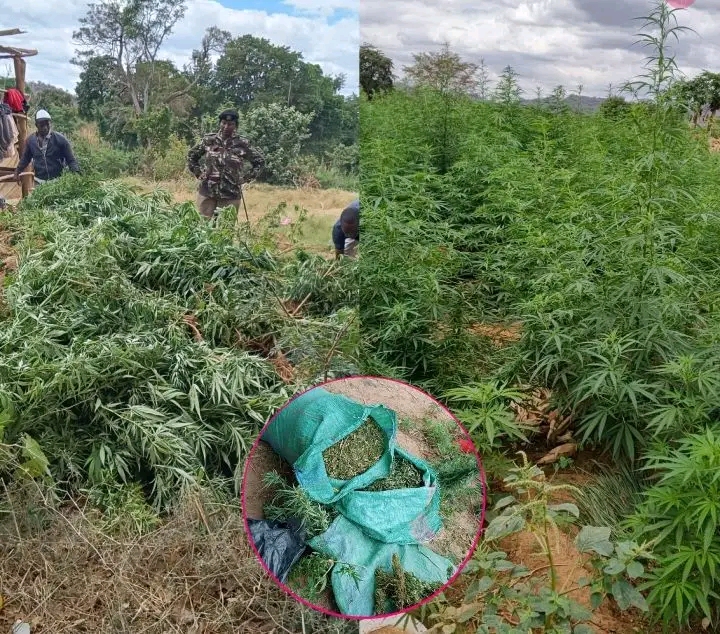
The discovery of the three-acre bhang plantation in Mwingi Central is a significant anti-narcotics operation in Kitui County. Security agencies uncovered approximately 2,000 kilograms of cannabis estimated to have a street value of KSh60 million after acting on intelligence about illegal cultivation along the Tana River. The cannabis had reportedly been concealed among food crops in Kakongo Village, while officers also recovered solar panels, water pumps, farming tools, weighing scales, fertiliser and other equipment. The biggest unresolved issue is the identity of the people behind the plantation. Although the suspected cultivators escaped during the raid, police recovered documents and other evidence that could assist investigators in tracing them. The case is therefore likely to continue developing as NANIB detectives pursue the suspected narcotics network. If investigators establish who owned, financed or operated the plantation, arrests and possible court proceedings could follow.
A major anti-narcotics operation in Mwingi Central, Kitui County, has resulted in the discovery and destruction of a large bhang plantation estimated to have a street value of KSh60 million. The operation, reported on September 14, 2026, uncovered approximately three acres of cannabis plants growing along the Tana River. Police said the illegal crop had been deliberately mixed with ordinary food crops, apparently to conceal the plantation from authorities and the surrounding community.
The discovery has attracted attention because of the amount of cannabis recovered, the agricultural equipment found at the site and the fact that the suspected cultivators managed to escape before they could be arrested. Investigations are now being conducted by anti-narcotics detectives as authorities seek to identify the people behind what appears to have been a sizeable cultivation operation.
Where the KSh60 million bhang was discovered
The plantation was discovered in Kakongo Village, Kairungu Location, Kiomo Kyethani Ward, Mwingi Central, in Kitui County. The farm was located along the Tana River, in a river delta that provided a relatively secluded environment for agricultural activities.
According to information attributed to the Directorate of Criminal Investigations (DCI), security agencies received intelligence concerning suspected large-scale cultivation of bhang in the area. Officers from the National Police Service (NPS) and National Government Administration Officers (NGAO) subsequently conducted an operation targeting the suspected plantation.
The location appears to have been significant because the river provided access to water, while the remote nature of the area may have made it easier for those operating the plantation to keep the illegal activity away from immediate public scrutiny.
Bhang was hidden among food crops
One of the most notable details of the operation was the manner in which the cannabis had allegedly been cultivated.
Police said the bhang had been interspersed with assorted food crops. Rather than establishing a plantation consisting exclusively of cannabis, the cultivators allegedly mixed the illegal crop with other agricultural plants.
This arrangement could make aerial or casual observation more difficult because the plantation would appear to be an ordinary agricultural farm. It also demonstrates why intelligence from local sources can be important in detecting concealed narcotics cultivation.
The plantation covered approximately three acres, making it a substantial cultivation site rather than a small garden intended for personal use.
Approximately 2,000 kilograms recovered
After arriving at the plantation, security officers, with assistance from members of the public, uprooted the cannabis plants.
The plants were then transported to Mwingi Police Station, where they were weighed. Authorities reported that the recovered bhang weighed approximately 2,000 kilograms.
The cannabis was subsequently estimated to have a street value of about KSh60 million.
It is important to understand that the KSh60 million figure refers to an estimated street value. It does not mean that police recovered KSh60 million in cash. The property seized was the cannabis crop and other items found at the plantation.
Based on the reported figures, the estimated valuation works out to roughly KSh30,000 per kilogram, although actual prices in illegal markets can vary considerably.
Equipment found at the plantation
The discovery was not limited to the cannabis plants. Officers also recovered numerous items believed to have been used to cultivate and maintain the plantation.
Among the items reportedly recovered were:
Seven solar panels
Six jembes
Four pangas
Two weighing scales
Two fork jembes
Two hacksaws
A solar control unit
Assorted solar accessories
Five petrol-operated water-pump generators
Approximately 30 kilograms of CAN fertiliser
Other farming tools
The equipment provides investigators with additional evidence as they attempt to establish how the plantation was being operated.
The presence of water pumps is particularly notable because the plantation was located near the Tana River. The pumps may have assisted in moving water from the river to agricultural areas.
The solar equipment could also have provided electricity or supported equipment used at the site.
However, investigators will need to establish the precise role of each item and who purchased or controlled it before drawing conclusions about the organisation behind the plantation.
Suspected cultivators escaped
Despite the successful seizure, police did not arrest the people suspected of operating the plantation during the raid.
Reports indicate that the cultivators escaped before officers could apprehend them. They apparently became aware of the security operation and fled the area.
This means that the investigation remains open.
Authorities reportedly recovered personal documents suspected to belong to some of the cultivators. These documents could provide important leads as detectives attempt to establish the identities of the people who were involved.
The fact that suspects escaped does not mean the investigation has ended. Instead, investigators can use the evidence recovered at the plantation to trace individuals who may have been responsible for leasing, managing, financing or cultivating the land.
NANIB takes over investigations
The investigation is being pursued by detectives attached to the National Anti-Narcotics Investigations Bureau (NANIB) in Mwingi Central.
Their task is expected to go beyond identifying the people who were physically cultivating the cannabis. Detectives may also seek to determine whether the plantation was connected to a wider narcotics network.
The DCI's anti-narcotics work covers activities such as the cultivation, production, distribution, storage, transportation and trafficking of prohibited drugs. Cannabis sativa, commonly referred to as bhang, is listed by the DCI among commonly abused drugs.
Investigators could therefore examine whether the plantation was intended to supply a local market or whether the cannabis was being cultivated for distribution to other parts of Kenya.
Why the discovery is significant
The Mwingi operation is significant for several reasons.
First, the scale of the plantation indicates that authorities were dealing with a sizeable agricultural operation. Three acres is considerably larger than a small personal-use garden.
Second, the reported 2,000-kilogram quantity represents a substantial amount of cannabis.
Third, the equipment recovered suggests that the plantation had resources dedicated to farming and irrigation. The five water-pump generators, solar equipment, fertiliser and agricultural tools indicate that the operation had access to infrastructure that could support cultivation.
Fourth, the concealment of the bhang among food crops indicates an apparent effort to make the illegal activity less visible.
Finally, the operation demonstrates the importance of intelligence-led policing and cooperation between security agencies and members of the public.
Role of local residents
Members of the public assisted security officers in uprooting the cannabis after the plantation was discovered.
Community involvement can be particularly important in combating narcotics cultivation because residents are often in a position to notice unusual activities, unfamiliar individuals, unexplained movement of equipment or agricultural operations that do not appear consistent with normal farming.
However, accusations against individuals must be based on evidence. The fact that somebody lives near a plantation, owns nearby land or knows people associated with the farm would not by itself establish involvement in drug cultivation.
The investigation will therefore have to establish the actual ownership, control and operation of the plantation.
What investigators may focus on next
With the suspects having escaped, several questions remain unanswered.
One major question is who owned or controlled the three-acre farm.
Another is how long the plantation had been operating and whether previous harvests had already taken place.
Investigators may also want to know where the harvested cannabis was intended to go.
The recovered personal documents could help establish identities. Equipment may also provide leads through purchase records, ownership information or witnesses who supplied the machinery.
Investigators could further examine financial transactions, communications and relationships between people associated with the plantation, subject to the appropriate investigative and legal procedures.
The ultimate objective will be to determine whether this was an isolated operation or part of a larger narcotics network.
Possible legal consequences for suspects
If the people behind the plantation are identified and arrested, they could face criminal charges relating to the cultivation, possession, handling or trafficking of narcotic drugs, depending on the evidence gathered and the specific offences established by investigators.
The seized cannabis, photographs of the plantation, equipment, documents and other evidence could become important in any subsequent prosecution.
However, it is important to distinguish between being suspected and being found guilty. Until a court determines otherwise, anyone arrested in connection with the plantation remains entitled to due process and the presumption of innocence.
The broader fight against narcotics
The Mwingi discovery forms part of the wider struggle by Kenyan security agencies against illegal drug cultivation and trafficking.
The DCI describes drug trafficking as involving activities including cultivation, production, distribution, sale, buying, supplying, storing and transportation of prohibited substances.
Operations such as the one in Mwingi therefore target the supply side of the illegal drug market.
Destroying a plantation can prevent a large amount of cannabis from entering the market. At the same time, investigators need to identify the people financing and organising cultivation if authorities want to disrupt the networks behind the supply.
The importance of the Tana River area
The location along the Tana River is another important aspect of the case.
Water availability is critical for farming, especially in areas where rainfall may be unreliable. The use of water pumps at the plantation suggests that irrigation may have been an important part of maintaining the crops.
The riverine environment may also have offered some degree of privacy and made the plantation less visible than farmland located close to densely populated settlements.
Authorities are likely to examine whether similar cultivation exists elsewhere along the river or in neighbouring areas.
*What happens next*
The immediate priority is to identify and arrest the suspected cultivators and anyone else involved in the operation.
NANIB detectives are pursuing leads from the scene, including the personal documents and other evidence recovered during the raid. Investigators will also need to establish the ownership or control of the land and determine whether other people were involved in financing or distributing the cannabis.
The investigation could result in arrests if sufficient evidence is obtained.
Meanwhile, the seized cannabis remains evidence in the case, while the recovered equipment could help investigators reconstruct how the plantation was operated.

You Might Also Like
-
The KUPPET protest and calls for justice in Kericho have brought renewed attention to the death of teacher Martina Chepkemoi Ruto. Her disappearance, followed by the recovery of her body near the Kimugu River and reports of multiple chest stab wounds, has left her family, colleagues and the communit
-
Former Migori Governor Okoth Obado is back in the Milimani High Court on September 16, 2026, for sentencing following his conviction over the 2018 murder of Rongo University student Sharon Otieno. Obado, alongside his former personal assistant Michael Juma Oyamo and former Migori County official Cas
-
The announcement that Nairobi will host the 2029 World Athletics Championships has been met with considerable excitement in Eldoret, particularly among upcoming athletes, coaches and residents who identify strongly with Kenya's athletics tradition. Young athletes see the championships as a potentia
-
 President Ruto's reaction to Nairobi winning the 2029 World Athletics Championships has centred on national pride, Africa's historic opportunity and recognition of Kenya's athletics heritage. He has described the victory as belonging to Kenya, Africa and generations of athletes who have made the cou
 -
The 15th Mara Day celebrations concluded on Tuesday, September 15, 2026, at Bomet Stadium, bringing together Kenyan and Tanzanian leaders, environmental experts, conservation organisations and local communities to discuss the protection of the Mara River ecosystem. Key leaders included EAC Affairs a
-
The story of Mercy Kanini of Juja, Kiambu County, is both extraordinary and heartbreaking. She made headlines after delivering five babies through normal delivery at Thika Level Five Hospital, an event described as extremely rare in Kenya. The babies were subsequently transferred to Kenyatta Nationa