



Mudavadi in Nandi: Ruto Will Win 2027 Through Valid Votes, Not Election Rigging
Musalia Mudavadi's speech in Kapsengere, Nandi County, on September 13, 2026, was primarily about the 2027 General Election and President William Ruto's expected re-election campaign. Mudavadi firmly rejected suggestions that Ruto would need to rig the election or use electoral shortcuts. He urged politicians across the political divide to stop spreading claims about dead people voting and warned against rhetoric that could undermine confidence in Kenya's democratic institutions. Mudavadi also expressed strong confidence in Ruto's chances of winning, saying the government's grassroots mobilisation was gaining momentum. He defended the UDA-ODM broad-based government, urged its supporters to continue popularising the coalition and insisted that President Ruto's political position should not be weakened. At the same time, he criticised opposition leaders for what he described as inadequate political structures and warned against emotional politics that could create hostility and unrest. Overall, the speech was both a defence of Ruto's 2027 re-election prospects and an appeal for a peaceful, credible and constitutionally conducted election. Mudavadi's insistence that Ruto should win through genuine votes was particularly notable given the controversy surrounding recent comments about deceased voters. His address therefore placed election integrity, political stability and the government's development record at the centre of the emerging 2027 political debate.
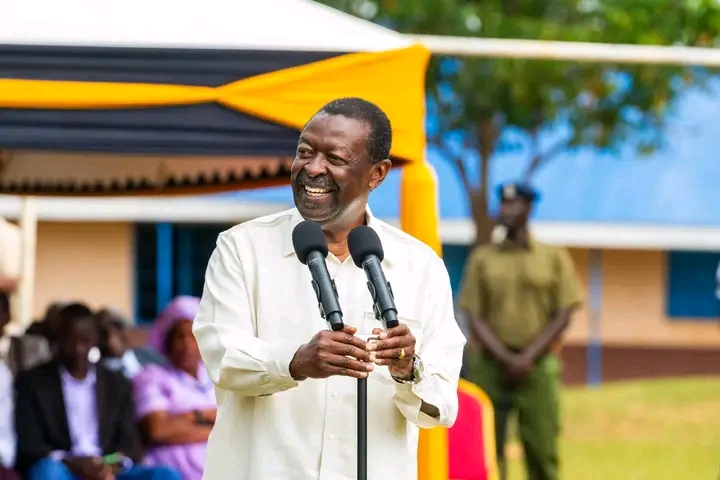
Prime Cabinet Secretary and Foreign and Diaspora Affairs Cabinet Secretary Musalia Mudavadi delivered a strongly political speech in Kapsengere, Nandi County, on Sunday, September 13, 2026, during a church service. His address came at a sensitive period when political activity is increasing ahead of the 2027 General Election. The central theme of his speech was the need for a credible election and his insistence that President William Ruto should seek a second term through legitimate votes rather than any form of electoral manipulation.
Mudavadi's remarks attracted attention because they came shortly after controversial comments by UDA Secretary-General Hassan Omar concerning deceased people and biometric voter registration. Mudavadi sought to distance President Ruto and the ruling coalition from such suggestions, saying politicians should stop creating narratives that could damage public confidence in the electoral process.
*Mudavadi's main message on Ruto's 2027 victory*
One of the strongest points in Mudavadi's speech was his declaration that President William Ruto would not need electoral shortcuts to secure a second term.
Mudavadi told those attending the church service that Ruto's victory, if achieved, should come from the will of Kenyan voters. He argued that the President should be judged by his administration's record, policies and development agenda rather than through manipulation of the electoral process.
The Prime Cabinet Secretary warned politicians against suggesting that Ruto would interfere with the election. He said such statements were dangerous because they could create unnecessary suspicion among Kenyans before voting takes place.
His position was particularly significant because the 2027 election is already becoming a major political subject across the country. Political parties are beginning to position themselves, potential presidential candidates are emerging and the ruling coalition is working to consolidate its support.
Mudavadi therefore wanted supporters and opponents alike to understand that the government intends to seek another mandate through the ballot.
Rejection of election-rigging claims
Mudavadi's speech was largely a response to growing political discussion about whether the 2027 election could be manipulated.
He strongly rejected suggestions that Ruto would win through rigging. He called on politicians from UDA, ODM, Kenya Kwanza and the opposition to stop spreading what he described as propaganda concerning dead people voting.
According to Mudavadi, Kenya needs an election whose credibility cannot be questioned. He linked electoral integrity to the country's security, stability and economic wellbeing.
This was an important aspect of his speech because disputes surrounding elections have historically generated significant political tension in Kenya. By calling for a credible process, Mudavadi was presenting electoral legitimacy as an issue that affects the entire country, rather than simply the political interests of President Ruto or his supporters.
He argued that politicians should allow Kenyans to determine the country's leadership through constitutional and democratic means.
The Hassan Omar controversy
Mudavadi's remarks came after comments made by UDA Secretary-General Hassan Omar in Mombasa.
Omar had reportedly suggested that supporters could use the fingerprints of deceased relatives to register them biometrically and have them participate in the election. The remarks caused a political uproar and generated concerns about the integrity of the voters' register.
Mudavadi's response was therefore significant because he appeared to draw a clear line between such controversial remarks and the official position of the government.
Rather than defending the idea, he rejected the suggestion that deceased people could be used to manipulate an election. He insisted that Ruto's re-election must be based on genuine votes.
This allowed Mudavadi to reassure Kenyans who may have been concerned that remarks by individual political leaders represented government policy.
Call for a peaceful election
Another major issue in Mudavadi's address was peace.
He warned that political leaders should avoid statements capable of raising emotions and creating hostility among Kenyans. He said politicians should not use inflammatory rhetoric to generate political support.
Mudavadi argued that Kenya's democracy should not be defined by what he called "cheap politics." He cautioned against attempts to provoke Kenyans over issues that are not based on facts.
His warning is important because political competition is expected to become more intense as the 2027 election approaches.
The Prime Cabinet Secretary's argument was that political disagreements are normal in a democracy, but they should not become a reason for violence or instability.
Mudavadi's confidence in Ruto
Although Mudavadi emphasized the importance of a credible election, he was also highly confident about President Ruto's chances of winning.
He told supporters that Ruto's political camp was already making progress at the grassroots level. He suggested that the President's support base was growing and predicted a significant victory.
Mudavadi reportedly said Ruto was starting the race with a very large number of supporters and suggested that the eventual results would surprise those already planning to challenge them in court.
This was more than simply a defence of electoral integrity. It was also a political mobilisation message directed at supporters of the administration.
Mudavadi wanted government supporters to remain confident and continue building support for Ruto rather than becoming distracted by allegations of possible electoral manipulation.
UDA and ODM broad-based government
Mudavadi also defended the broad-based government arrangement involving UDA and ODM.
The arrangement has changed Kenya's political landscape considerably because leaders who were previously on opposing sides of the political divide are now cooperating within the government framework.
Mudavadi called on supporters of both UDA and ODM to continue promoting the broad-based arrangement.
He emphasized that President Ruto remains the leader of the coalition and argued that UDA should not be weakened in the process.
His comments indicate that the broad-based arrangement is becoming an important component of the government's political strategy as the country moves toward 2027.
The government appears keen to present the cooperation as a means of promoting stability and development while also creating a broader political base for the President.
Mudavadi attacks opposition strategy
The Prime Cabinet Secretary also criticised opposition politicians.
He questioned the preparedness of some opposition leaders, arguing that they lacked strong political structures and, in some cases, did not have properly established parties through which they could pursue presidential ambitions.
Mudavadi suggested that some opposition politicians were becoming anxious because they lacked the structures needed to mount a nationwide campaign.
He argued that running for the presidency requires organisation across the country, including functioning political parties and grassroots networks.
This was clearly a political challenge to emerging opposition formations that are attempting to position themselves ahead of 2027.
Mudavadi's message was essentially that political ambition alone is not enough to win a national election. Candidates need functioning parties, supporters and structures across Kenya.
The broad-based government's development record
Mudavadi also defended the government's development agenda.
He argued that the administration should focus on continuity rather than reversing projects and programmes that have already been initiated.
He said the government was working to protect what he described as gains made under President Ruto.
This reflects one of the central arguments likely to feature in the 2027 campaign: whether voters should maintain the current administration or choose a different political direction.
For Mudavadi and other government leaders, the election is likely to be presented as a referendum on the administration's development record.
The opposition, on the other hand, is expected to focus on issues such as the cost of living, taxation, unemployment and government accountability.
His message about Kenya's economy and security
Mudavadi also connected the quality of the electoral process to Kenya's broader national interests.
He argued that the democracy Kenya experiences will have consequences for the economy, security and welfare of citizens.
This is significant because political uncertainty can affect investment, business confidence and economic activity.
A disputed presidential election can create uncertainty, while a peaceful and credible election can strengthen confidence in the country's institutions.
Mudavadi therefore presented electoral credibility as more than a political issue. In his view, it is also an economic and security issue.
*Why the speech in Nandi was politically important*
The location of Mudavadi's speech was also significant.
Nandi County is in the Rift Valley, a region that has traditionally been an important political base for President Ruto. Speaking there allowed Mudavadi to address an audience in one of the areas where the administration has strong political support.
The speech also came while President Ruto was beginning a major development tour of the broader western and Nyanza regions. The President's four-day tour was scheduled to cover Kisumu, Siaya, Homa Bay and Migori, making the political messaging from senior government officials particularly relevant at this time.
Mudavadi's appearance in Nandi therefore formed part of a wider period of intensified political activity.
The significance of his prediction about 2027
Mudavadi's confidence in Ruto's re-election is likely to generate debate among opposition parties.
He is effectively challenging President Ruto's opponents to prepare themselves for a competitive election rather than relying on allegations of rigging.
At the same time, his emphasis on valid votes provides the government with an opportunity to respond to accusations that it may attempt to manipulate the election.
His message can therefore be understood on two levels: political mobilisation for Ruto and reassurance about the integrity of the election.

You Might Also Like
-
EPRA has retained fuel prices for the September–October cycle, with petrol at KSh214.03, diesel at KSh217.86, and kerosene at KSh191.38 per litre.
-
President William Ruto's second day in Kisumu has been marked by a combination of major infrastructure launches, development announcements and strong political speeches. The biggest project commissioned today is the Sh8.4 billion Lake Victoria Water and Sanitation Project, which is expected to impr
-
Deputy Inspector General of Police Gilbert Masengeli urges Kenyans to work with security agencies, share information responsibly and help safeguard peaceful elections.
-
Rural Electrification and Renewable Energy Corporation (REREC) is targeting the connection of more than 50,000 households in Bomet and Kericho counties to electricity before Christmas, as part of the government’s wider push to expand electricity access in rural Kenya. The initiative is expected to
-
The Public Health Principal Secretary's warning highlights the growing importance of preparing Kenya's health system before the anticipated El Niño rains intensify. Mary Muthoni has called for stronger disease surveillance, safe water, improved sanitation, adequate medicine stocks and greater prepa
-
The arrest of two suspects marks the latest development in the investigation into the Nembure chaos in Embu County, where a UDA meeting attended by Deputy President Kithure Kindiki was violently disrupted on September 12, 2026. The incident resulted in one confirmed death, several injuries and six