



Ogamba and Mbadi in Crucial Talks Over University Funding as Government Moves to Tackle Higher Education Financing Crisis
The meeting between Education CS Julius Ogamba and Treasury CS John Mbadi has placed higher education financing firmly back on the national agenda. The government is seeking a sustainable model capable of supporting universities while protecting students from financial barriers. Although no new financing formula or additional university allocation was announced, the discussions are an important indication that the government recognises the financial pressures facing Kenya's higher education sector. For students, parents and universities, the next stage will be particularly important. They will want clarity on government funding, student contributions, scholarships, loans and the future of the Student-Centred Funding Model. For now, the message from the talks is that the government is working toward a longer-term financing framework rather than announcing an immediate change. The eventual decisions by the Ministry of Education and the National Treasury could have a major impact on the affordability, accessibility and quality of university education across Kenya.
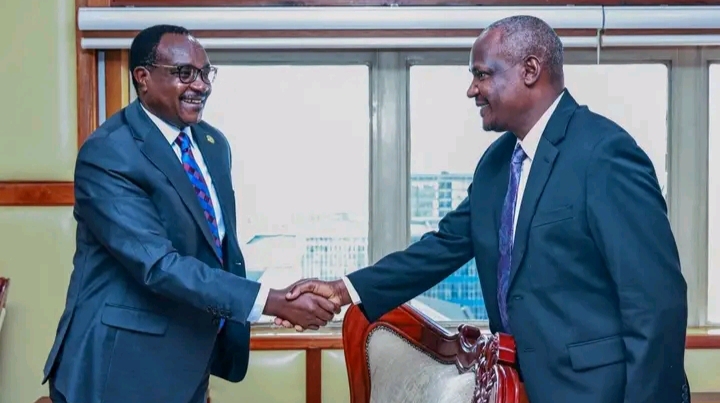
Education Cabinet Secretary Julius Migos Ogamba has held discussions with National Treasury Cabinet Secretary John Mbadi on the future financing of higher education in Kenya, as the government seeks a sustainable way of supporting universities while maintaining access, equity and quality.
The talks, reported on October 6, 2026, come at a critical moment for Kenya's university sector, which has continued to face financial pressures arising from rising enrolment, operational costs, staff expenses and the need to provide quality academic services. The meeting brought together senior officials from the Ministry of Education, the National Treasury and the Presidential Council of Economic Advisors. Among those present were Higher Education Principal Secretary Dr Beatrice Muganda Inyangala, as well as Dr David Ndii and Mohammed Hassan from the Presidential Council of Economic Advisors.
The discussions are significant because the government is now looking beyond short-term funding challenges and examining how universities can be financed sustainably over the long term. However, no final new financing formula was announced after the meeting, meaning students, parents and university administrations are still waiting for details on what the government's eventual decisions will mean for them.
Focus on sustainable university financing
The main issue before Ogamba and Mbadi was how Kenya can continue financing universities in a manner that is financially sustainable while ensuring that students are not locked out of higher education because of their financial circumstances.
According to reports on the meeting, the government is considering several questions, including the amount of direct government funding that universities should receive, the contribution expected from students and how vulnerable students can continue receiving financial assistance.
The government has also acknowledged that universities need predictable funding to meet their responsibilities. Institutions require money to pay staff, operate laboratories and libraries, maintain buildings and other infrastructure, support research and provide essential services to students.
The current discussions therefore have implications beyond university accounts. The financing decisions will affect the quality of education, staff welfare, research activities and the ability of institutions to provide adequate services to growing numbers of students.
No new funding formula announced yet
One of the most important points emerging from the meeting is that the government has not yet announced a new university financing formula.
The discussions are still at the policy stage, with officials examining different options before making a final decision. The government has also not disclosed the amount of additional money that universities will receive as a result of the talks.
This means that students should not interpret the meeting as an immediate announcement of either increased fees or increased government funding.
Instead, the talks are part of a broader process aimed at determining how higher education should be financed in the coming years.
The government will have to balance two competing priorities. On one side is the need to provide universities with enough resources to operate effectively. On the other is the need to protect students and families from excessive education costs.
Student-centred financing remains important
The discussions also come against the background of Kenya's reforms to higher education financing.
The government has been moving toward a system in which financial support is targeted according to students' financial needs rather than providing the same level of support to everyone. Under the Student-Centred Funding Model, government support has included scholarships and loans administered through institutions such as the Higher Education Loans Board and the Universities Fund.
The Kenya Yearbook explains that the new higher education funding approach prioritises students according to financial need, representing a shift from the previous system of uniform block funding.
This approach has been presented as a way of ensuring that students from disadvantaged backgrounds can continue accessing universities and other institutions of higher learning.
However, the financing model has also generated debate over how much students should eventually pay and how much responsibility should remain with the government.
HELB funding and student support
The meeting between Ogamba and Mbadi also has to be viewed alongside earlier government efforts to increase support for higher education students.
In February 2026, Mbadi announced plans to increase funding for the Higher Education Loans Board from Sh41 billion to Sh58 billion in the 2026/27 financial year. He said the proposals were influenced partly by feedback received from students during public engagements.
The proposed increase was intended to strengthen student financing and make higher education more affordable.
The government had already increased HELB funding from Sh36 billion to Sh41 billion for the 2025/26 financial year. Education CS Ogamba said the increase was intended to ensure that students were not left behind because of financial challenges.
These developments demonstrate that the government has been trying to strengthen student financing while simultaneously examining the broader question of how universities themselves should be funded.
Pressure facing universities
Kenyan universities have faced increasing financial pressure in recent years.
The institutions must cater for growing student populations while dealing with rising costs of salaries, utilities, infrastructure maintenance, teaching materials and other services.
Universities also require funding to support research and innovation, which are important for Kenya's economic development.
The financing problem has therefore become a national issue because universities are responsible for producing professionals in fields such as medicine, engineering, education, law, information technology, agriculture and business.
If institutions do not receive predictable funding, they may experience difficulties maintaining their programmes and services.
The latest talks therefore provide an opportunity for the Ministry of Education and the National Treasury to examine the sector's needs and determine how funding can be made more reliable.
Government balancing access and affordability
For students and parents, perhaps the biggest concern is whether future financing reforms could increase the amount families are expected to contribute.
The government has repeatedly stated that it wants to expand access to higher education. At the same time, Treasury officials have emphasised the limitations imposed by the country's fiscal position.
The latest meeting did not reveal whether student contributions will be increased, reduced or maintained. It also did not provide details of whether universities will receive larger direct allocations. Those questions remain under consideration.
This uncertainty means that students currently enrolled in universities and those preparing to join higher education will be watching the government's next steps closely.
Connection to the free university education debate
The talks also come at a time when the government has been discussing reforms aimed at making university education more accessible.
In July 2026, questions emerged over the legal framework for the government's free university education promise. President William Ruto had referred to the Higher Education Loans Board (Amendment) Bill, 2026, while the Ministry of Education referred to the Tertiary Education Placement and Funding Bill, 2026.
The difference highlighted the complexity surrounding the government's plans for higher education financing.
Any new financing system will need to clarify how scholarships, loans, government funding and student contributions will work together.
The current talks between Ogamba and Mbadi could therefore become an important step in determining the direction of these reforms.
What happens next
The October 6 meeting did not produce a final financing package. Instead, it demonstrated that the government is continuing to examine the challenges facing higher education and is involving both education and economic policymakers in finding a solution.
The participation of the Presidential Council of Economic Advisors shows that the government is looking at university financing not only as an education issue but also as an economic and fiscal question.
Officials will need to determine how much money the government can sustainably commit to universities, how students in financial difficulty can be protected and how institutions can meet their growing operational needs.
Any final decision will also have to take into account students already enrolled under the existing financing arrangements so that reforms do not unexpectedly disrupt their studies.

You Might Also Like
-
Former President Uhuru Kenyatta steps down as Azimio council chair, with James Orengo and Rigathi Gachagua emerging in discussions over the coalition’s future leadership.
-
Kenya's Ebola response has entered a critical surveillance and contact-tracing phase following confirmation of the country's first imported Bundibugyo Ebola case. PS Mary Muthoni says 57 contacts have been identified, with 10 already placed under quarantine, while health officers across the country
-
Deputy President Kithure Kindiki's appearance at Jamhuri Park on October 7 placed agriculture and food security at the centre of the national economic transformation conversation. He outlined government figures on farmer registration, fertiliser prices, livestock vaccination, milk production, meat e
-
A passenger travelling aboard a Kenya Airways flight from Nairobi to Lagos, Nigeria, has died after suffering a medical emergency shortly before the aircraft landed at Murtala Muhammed International Airport. The passenger reportedly became unresponsive about 20 minutes before landing, prompting cabi
-
NCIC's latest actions against CS Geoffrey Ruku and its handling of nominated MP Joseph Wainaina Iraya underline the commission's growing focus on political language and national cohesion ahead of the 2027 elections. Ruku has been directed to stop repeating remarks that NCIC found divisive, respond w
-
President William Ruto says Raila Odinga’s mausoleum at Kang’o Ka Jaramogi honours his contribution to Kenya’s democratic journey and will help preserve his legacy for future generations.