



President Ruto’s Second-Day Kisumu Visit: Projects Launched, Development Agenda and Key Speeches
President William Ruto's second day in Kisumu has been marked by a combination of major infrastructure launches, development announcements and strong political speeches. The biggest project commissioned today is the Sh8.4 billion Lake Victoria Water and Sanitation Project, which is expected to improve clean-water access and expand sewerage capacity in Kisumu. The President also launched the upgrading of the 12-kilometre Rabuor-Chiga Road to bitumen standards, with construction expected to take about 18 months. He announced that approximately Sh23 billion has been allocated to road projects in Kisumu County, with nine roads already under construction. His speeches have gone beyond individual projects. Ruto has spoken about affordable housing, employment, water, roads, national unity and the need to end marginalisation. He has also challenged his political opponents to present alternative policies ahead of the 2027 elections, arguing that Kenyans should judge leaders according to their performance and development plans. The Kisumu visit is therefore both a development tour and a significant political engagement. For residents, the most important question will now be whether the projects launched today are completed on schedule and deliver the promised improvements in water, sanitation, transport, housing and economic opportunities. For the President, the visit provides an opportunity to demonstrate his administration's development record in a region that remains politically important ahead of the 2027 General Election.
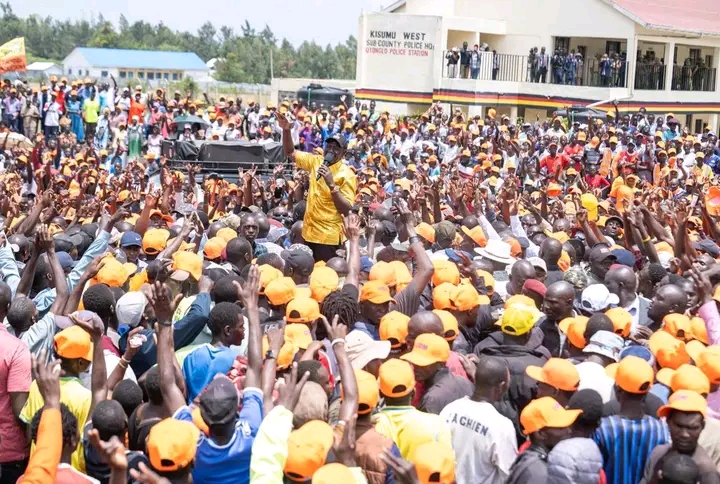
President William Ruto is in Kisumu today, Monday, September 14, 2026, for the second day of his four-day development tour of the Nyanza region. The Kisumu leg of the tour has combined the commissioning of major infrastructure projects with public meetings in which the President has spoken extensively about development, roads, water, sanitation, affordable housing, employment, national unity and the 2027 General Election. The tour will subsequently proceed to other parts of Nyanza, including Siaya, Homa Bay and Migori.
The second day of the tour has been particularly significant because Ruto has used his engagements in Kisumu to demonstrate what his administration describes as its development agenda for the region. Among the most prominent projects commissioned today is the Sh8.4 billion Lake Victoria Water and Sanitation Project, while another major event was the launch of construction works for the 12-kilometre Rabuor-Chiga Road, which is being upgraded to bitumen standards. The President has also outlined a broader road programme worth billions of shillings in Kisumu County.
Sh8.4 billion Lake Victoria Water and Sanitation Project
One of the biggest highlights of President Ruto's second day in Kisumu was the commissioning of the Lake Victoria Water and Sanitation Project, valued at approximately Sh8.4 billion. The project is designed to improve access to clean water and expand sewerage services in Kisumu City.
Ruto said the investment would help address longstanding challenges surrounding sewerage and wastewater management in the rapidly growing lakeside city. The project is particularly important because Kisumu's population and urban settlements have expanded considerably, increasing demand for reliable water supplies and proper sanitation infrastructure.
The President's message was that urban development cannot depend on housing and roads alone. As Kisumu expands, residents require water, sewerage systems and other essential services. The water project is therefore being presented as part of a broader strategy to transform Kisumu into a better-serviced urban and economic centre.
Ruto linked the water and sanitation investment to the government's affordable housing programme. His argument is that new housing developments must be supported by adequate infrastructure so that residents have access to essential services.
The Lake Victoria project is consequently expected to have implications beyond household water supply. Improved wastewater management can help reduce environmental pollution, protect water resources and improve public health. For Kisumu, whose economy and identity are closely connected to Lake Victoria, better management of wastewater is particularly important.
Launch of the Rabuor-Chiga Road
The second major project launched by President Ruto today was the upgrading of the Rabuor-Chiga Road to bitumen standards.
The road covers approximately 12 kilometres, and Ruto flagged off construction machinery during his engagement with residents in the Nyando area. The works are expected to take about 18 months.
The road project is significant to residents who have depended on the route for transportation and access to markets, schools, hospitals and other services. Upgrading the road to bitumen standards is expected to make movement easier throughout the year and reduce some of the difficulties associated with poor roads.
For farmers in the surrounding areas, improved roads could also make it easier to transport agricultural produce to markets. Poor rural roads can increase transportation costs and cause delays, especially during rainy periods. A modern road network can therefore contribute to agricultural and commercial activity.
The President used the occasion to announce that the national government has allocated approximately Sh23 billion for road projects in Kisumu County. According to Ruto, nine new roads are already under construction. He also mentioned the Kibos-Nyamongo Road, which is among the roads targeted for upgrading.
Ruto presented the road programme as evidence that his government is investing in areas that have historically complained about inadequate infrastructure.
A wider development programme for Kisumu and Nyanza
The projects being launched in Kisumu are part of a much larger government development programme across Nyanza. Reports ahead of the presidential tour indicated that projects worth more than Sh220 billion were being rolled out across Kisumu, Siaya, Homa Bay and Migori counties.
These investments cover roads, housing, markets, health facilities, water infrastructure and other development programmes. In Kisumu, flagship projects include the Sh15.9 billion Kisumu-Chemelil-Muhoroni-Kipsitet road and the Lumumba affordable housing project.
The President has therefore used his Kisumu visit to put emphasis on the government's intention to increase infrastructure investment in the region.
This has both economic and political significance. Kisumu is one of the major commercial centres in western Kenya and is strategically located along Lake Victoria. Improvements in roads, water, housing and other infrastructure could strengthen the city's position as an economic hub.
*Ruto’s speech on development*
A major theme in Ruto's speeches today has been development without political discrimination.
The President has argued that government development should benefit all Kenyans regardless of their political affiliation or voting patterns. His message in Kisumu was that residents should focus on what government is delivering rather than whether their region traditionally supports a particular political party.
This message is particularly important in Nyanza, a region that has historically been associated with opposition politics. Ruto has increasingly sought to establish a stronger political and development relationship with the region, particularly under the broad-based government arrangement involving leaders from different political backgrounds.
During his Kisumu engagements, the President has therefore presented the projects as evidence that his administration is willing to invest in areas irrespective of previous political loyalties.
Ruto’s message on marginalisation
Another major theme of the President's speech was the need to move Kenya away from marginalisation and ethnic politics.
Ruto said the country can only make progress if different communities and counties work together. He argued that development should not be distributed according to political calculations or ethnic considerations.
He also connected this message to the 2027 General Election. The President said the next election should provide an opportunity for Kenyans to reject marginalisation and focus on unity and development.
His message was essentially that Kenyans should judge leaders according to what they have done and what they plan to do, rather than their ethnic backgrounds or political affiliations.
This is a significant message in Nyanza because the region has for decades been a major political centre for opposition politics. Ruto's development-focused approach is also part of his effort to strengthen his relationship with voters in the region ahead of 2027.
Ruto challenges his political opponents
President Ruto also used his Kisumu visit to address his political opponents.
He challenged opposition leaders to present their own policies and development programmes rather than concentrating on criticism of his administration. He said the 2027 election should be a contest of ideas and policies.
The President argued that Kenyans should have the opportunity to compare different political programmes and determine which leadership approach can best address the country's challenges.
Ruto's remarks come at a time when political activity is intensifying ahead of the 2027 General Election. His Nyanza tour has therefore combined government development activities with political messaging.
The President's argument is that voters should evaluate leaders based on performance. He has repeatedly asked Kenyans to examine government projects and determine whether they are improving people's lives.
Affordable housing and jobs
Affordable housing was another important issue in Ruto's wider message.
The President has defended his government's affordable housing programme, arguing that it is intended to address several challenges simultaneously. According to the administration's position, the programme is not simply about providing homes but also about creating employment and supporting economic activity.
Construction creates jobs for masons, electricians, plumbers, engineers, suppliers, transporters and other workers. The development of housing estates can also create opportunities for businesses such as shops, transport services and other small enterprises.
In Kisumu, the affordable housing programme has been connected with the city's wider urban development. The government has argued that housing should be accompanied by water, sanitation, roads and other infrastructure.
This is why today's commissioning of the Lake Victoria Water and Sanitation Project is significant. The government is presenting housing and infrastructure as complementary projects rather than separate programmes.
*Political significance of the Kisumu visit*
President Ruto's second day in Kisumu also carries considerable political significance.
The visit is taking place less than a year before the 2027 election campaign is expected to intensify. Nyanza remains an important political region, and the President's decision to spend several days touring the area demonstrates its importance to his administration.
The tour also follows the emergence of closer cooperation between leaders associated with Ruto's United Democratic Alliance and leaders associated with ODM under the broad-based government arrangement. Reports on the tour have described it as both a development tour and an important political engagement.
At the same time, some opposition and regional leaders continue to express their own political positions. For example, Kisii Governor Simba Arati spoke in Muhoroni on Monday about ODM's political interests ahead of 2027, showing that political competition remains active even as government development projects are being launched.
This makes Ruto's speeches particularly important because he is attempting to frame the coming political contest around development, policy and national unity.
The President’s message to Kisumu residents
The overall message from President Ruto today has been that Kisumu and Nyanza should expect greater government investment.
He has pointed to the water and sanitation project, road construction, affordable housing and other infrastructure as examples of the government's commitment.
The President has also sought to reassure residents that development should not be tied to political affiliation. His argument is that every Kenyan has a right to benefit from government programmes.
Another major message has been that the 2027 election should be about development and competing ideas. Ruto has challenged his opponents to provide alternative plans and allow voters to make their decisions based on performance.
The President's speeches have therefore contained two closely connected messages: first, that his government is delivering development projects; and second, that Kenyans should use those projects and government performance when evaluating political leaders.
Importance of the projects to ordinary residents
For ordinary residents of Kisumu, the practical impact of today's announcements will ultimately depend on implementation.
The Sh8.4 billion water and sanitation project could improve access to clean water and sewerage services, particularly as the city continues to grow.
The Rabuor-Chiga Road upgrade could improve transport and stimulate economic activities in the Nyando area. Farmers could benefit from better access to markets, while students, patients and workers could experience easier movement.
The wider Sh23 billion road programme could improve connectivity between different parts of Kisumu County and contribute to economic development.
However, residents will also be watching the implementation of these projects closely. The success of major infrastructure programmes depends on timely construction, proper financing, quality workmanship and maintenance after completion.

You Might Also Like
-
EPRA has retained fuel prices for the September–October cycle, with petrol at KSh214.03, diesel at KSh217.86, and kerosene at KSh191.38 per litre.
-
Musalia Mudavadi's speech in Kapsengere, Nandi County, on September 13, 2026, was primarily about the 2027 General Election and President William Ruto's expected re-election campaign. Mudavadi firmly rejected suggestions that Ruto would need to rig the election or use electoral shortcuts. He urged p
-
Deputy Inspector General of Police Gilbert Masengeli urges Kenyans to work with security agencies, share information responsibly and help safeguard peaceful elections.
-
Rural Electrification and Renewable Energy Corporation (REREC) is targeting the connection of more than 50,000 households in Bomet and Kericho counties to electricity before Christmas, as part of the government’s wider push to expand electricity access in rural Kenya. The initiative is expected to
-
The Public Health Principal Secretary's warning highlights the growing importance of preparing Kenya's health system before the anticipated El Niño rains intensify. Mary Muthoni has called for stronger disease surveillance, safe water, improved sanitation, adequate medicine stocks and greater prepa
-
The arrest of two suspects marks the latest development in the investigation into the Nembure chaos in Embu County, where a UDA meeting attended by Deputy President Kithure Kindiki was violently disrupted on September 12, 2026. The incident resulted in one confirmed death, several injuries and six