



RUTO ADDRESSES KENYANS IN MOMBASA: President’s Strong Response to Gachagua and Key Issues He Discussed
President William Ruto's media engagement at State House Mombasa on October 1, 2026, covered a broad range of national issues, from the Lamu refinery and mineral resources to sugar production, investment, education and youth employment. However, the exchange over Rigathi Gachagua attracted particular attention. Gachagua had alleged that negotiations involving Kenya's niobium resources at Mrima Hills were taking place with an American company and had warned that Kenyans could lose out on the economic benefits. When asked about those claims, Ruto rejected the question and used strongly worded descriptions of his former deputy. Ruto then shifted attention to the importance of properly managing Kenya's mineral resources, saying the country needed systems that would enable it to know what minerals are extracted, where they go and how Kenyans benefit. His wider message during the Mombasa engagement focused on attracting investment, developing infrastructure, creating employment and increasing local value from Kenya's natural resources. The meeting therefore became significant both for the economic issues discussed and for the renewed public exchange between Ruto and Gachagua over Kenya's mineral wealth.
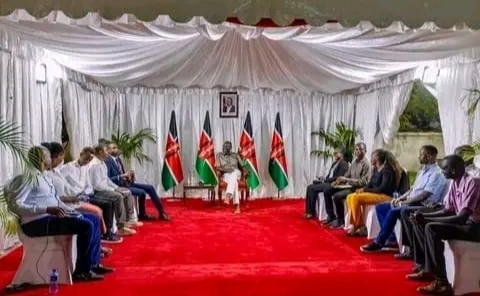
President William Ruto on Thursday, October 1, 2026, held a media engagement at State House Mombasa where journalists questioned him on a wide range of issues affecting Kenya, including the Lamu refinery project, mineral resources, investment, agriculture, employment, education and development at the Coast.
The media engagement attracted significant attention because of the President's response to a question concerning former Deputy President Rigathi Gachagua and allegations surrounding the proposed exploitation of niobium and other minerals at Mrima Hills in Kwale County. Ruto gave a particularly strong response when a journalist asked him to address Gachagua's claims.
Ruto's response to the question about Gachagua
One of the most widely reported moments of the interview came when a journalist asked President Ruto about remarks made by Gachagua concerning Kenya's mineral wealth.
Gachagua had raised concerns over the proposed exploitation of niobium deposits at Mrima Hills. While speaking to Kenyans in Kansas City in the United States in September, Gachagua alleged that Ruto's trip to the United States during the United Nations General Assembly was partly connected to negotiations involving the mineral deposits.
Gachagua claimed that an American company was interested in exploiting the deposits and argued that Kenyans risked failing to receive adequate benefits from the country's mineral wealth. He also said that he was prepared to pursue legal action if necessary. These were Gachagua's allegations and were not established as facts in the reports.
When the journalist asked Ruto to respond, the President dismissed the question and used very strong language about his former deputy.
Ruto said:
“Usiniletee maneno ya mtu mjinga kama huyo tafadhali. Tuongee maneno mengine, yule ni mpuuzi sana yule.”
In English, the remarks were reported as Ruto telling the journalist not to bring him the claims of what he described as a foolish person and suggesting that the interview should move to another subject. In another reported version, Ruto questioned why, as President, he was being asked about what he described as the matters of a “madman.”
The exchange immediately became one of the major talking points from the Mombasa media engagement.
Ruto turns discussion to Kenya's minerals
Although Ruto dismissed the question about Gachagua, he went on to discuss the wider issue of Kenya's mineral resources.
The President said minerals were important to the country's economy and explained that his administration was working to reform the mining sector.
Ruto argued that Kenya needed better systems for recording, monitoring and accounting for mineral resources. He gave an example from his own experience with mining activities in the Mount Kenya region, saying minerals had previously been extracted but that the country lacked sufficient information about what happened to those resources.
He questioned what future generations would say if they discovered that Kenya had valuable minerals but could not establish where the resources had gone.
According to the President, this demonstrated the need for stronger management of the mining industry so that the country could benefit from its natural resources instead of simply extracting and exporting them.
The Mrima Hills controversy
The disagreement between Ruto and Gachagua comes amid growing attention to the mineral potential of Mrima Hills in Kwale County.
Gachagua has publicly questioned the proposed exploitation of the deposits and has argued that Kenyans should receive significant economic benefits from the resources.
He has also claimed that the deposits could be worth trillions of shillings and said he would consider going to court over any agreement that he believes does not protect the interests of Kenyans.
It is important to distinguish these statements from established facts. The reports describe Gachagua's position as allegations and claims, while Ruto rejected the concerns when questioned about them.
The controversy has nevertheless placed critical minerals at the centre of public discussion, particularly as Kenya seeks foreign investment in mining and mineral processing.
Lamu refinery was another major topic
A large part of the Mombasa engagement focused on the planned Dangote East Africa Petroleum Refinery in Lamu.
The President defended the project and discussed questions concerning land, investment and the potential economic benefits of the refinery.
Ruto said the main land being used for the refinery is government land and maintained that residents would not simply be removed from the project site.
He said the government had secured approximately 10,000 acres and was seeking additional land for the refinery and a proposed special economic zone. He further stated that where government processes require the use of privately occupied land, the government would be responsible for compensation rather than leaving that responsibility to investor Aliko Dangote.
The land issue has been contested, however. Residents have raised concerns about possible displacement and compensation, and legal proceedings have been initiated concerning land associated with the wider project. The existence of those legal proceedings is an important part of the background to Ruto's comments.
Ruto defends Dangote investment
The President also addressed criticism surrounding the refinery's investment agreement.
Ruto told those seeking answers about the agreement to use Parliament and the courts rather than pressure the investor.
He said questions concerning the agreement could be pursued through parliamentary procedures, while disputes involving Dangote could be taken to court.
The President argued that investors should be protected from intimidation and that Kenya should provide an environment capable of attracting major investments.
His comments came shortly after the groundbreaking of the refinery in Lamu, which the government has presented as a major industrial project for Kenya and the wider East African region.
Kenya, Uganda and Tanzania refinery projects
Ruto was also asked about refinery projects being pursued by other East African countries.
He said Kenya had no problem with Uganda or Tanzania developing their own refineries.
According to Ruto, the East African market was large enough to accommodate multiple petroleum-processing facilities. He said Kenya's refinery would help reduce exposure to international fuel-price fluctuations and some costs associated with importing refined petroleum products.
The President also argued that the wider economic value of the Lamu project would extend beyond refining crude oil. He said industries could develop around the refinery, including petrochemical, chemical and plastics manufacturing, as well as fertiliser and bitumen production.
Sugar production at the Coast
Agriculture and irrigation were also discussed during the media engagement.
Ruto announced plans to expand sugar production at Galana-Kulalu in Tana River and Kilifi counties.
He said irrigation would be central to the plan because the Coast has conditions that could allow sugarcane to mature relatively quickly.
The President said the first dam at Galana-Kulalu had already been contracted at an estimated cost of about KSh30 billion. He said the National Infrastructure Fund would play an important role in financing water infrastructure required for agricultural production.
Ruto also pointed to sugarcane trials in Bura, where he said 45,000 acres had been allocated to two companies for production.
A new KSh33 billion Kitui investment
Another announcement made during the media engagement concerned a proposed KSh33 billion investment in Kitui.
Ruto said a new investor had been identified for the project and that he intended to visit Kitui in November 2026 to launch construction.
The President recalled that Nigerian businessman Aliko Dangote had previously been lined up to undertake the project several years ago, but the investment did not proceed.
Ruto used the example to argue that Kenya needs to create a business environment that encourages investors to establish companies and create employment.
Education and university students
The President also spoke about higher education financing and students being sent home because of unpaid fees.
Ruto said he wanted changes to education laws to ensure students entering universities, TVET institutions and KMTC would not be sent home because of difficulties in paying fees.
He linked the proposed changes to the government's higher education funding reforms and indicated that he wanted the changes implemented from January 2027.
The issue is particularly important because higher education financing has been undergoing significant changes, with the government seeking to link support to students' financial circumstances.
Youth employment and digital jobs
Employment for young Kenyans was another issue raised.
Ruto pointed to online work, ICT hubs, Jitume laboratories and Business Process Outsourcing as areas that were creating employment opportunities.
He said hundreds of thousands of young Kenyans had obtained opportunities through digital platforms and overseas employment.
The President's comments reflected the government's wider emphasis on the digital economy and services as sources of employment for young people.
What the Mombasa meeting means for the Ruto-Gachagua relationship
The exchange concerning Gachagua provided another public indication of the continuing political disagreement between the two former allies.
Gachagua has continued to criticize various government policies and projects while building his own political platform ahead of the 2027 elections. Ruto, meanwhile, has rejected several of Gachagua's allegations.
In Mombasa, however, Ruto did not give a detailed response to every aspect of Gachagua's Mrima Hills allegations. Instead, he dismissed the claims and redirected the discussion toward his administration's broader approach to mineral resources.
The strongest part of Ruto's response was therefore not a detailed debate over the alleged mineral agreement, but his language toward Gachagua. His description of Gachagua as a “mjinga” and “mpuizi,” as reported from the interview, became a major headline from the engagement.

You Might Also Like
-
Public Service Cabinet Secretary Geoffrey Ruku represented President William Ruto at the NYS passing-out parade at the Paramilitary Academy in Gilgil on October 2, 2026, where 15,363 recruits from the 01/2026 cohort graduated after six months of intensive training. The class included 11,527 men, 3,8
-
Rigathi Gachagua has arrived in Boston, Massachusetts, as he enters the final phase of his extensive United States tour, where he is engaging Kenyans in the diaspora on matters of national development, investment, leadership and Kenya’s political future. Accompanied by his wife, Pastor Dorcas Riga
-
Deputy President Kithure Kindiki's announcement in Kiambu on October 2, 2026, signals a renewed phase in the government's campaign against illicit and harmful alcoholic drinks. The fresh inspections will target alcohol manufacturing premises to determine whether they comply with health, safety, qual
-
Kenya has begun preparations to host the 2029 World Athletics Championships, with World Athletics official Pierce O’Callaghan inspecting Kasarani, Nyayo and Ulinzi Sports Complex to guide infrastructure upgrades ahead of the global event.
-
President William Ruto on October 2, 2026, presided over the issuance of about 5,000 title deeds to residents of Mombasa County at the Mama Ngina Drive Grounds, as part of a wider government programme aimed at resolving longstanding land ownership and squatter problems at the Coast. The Mombasa issu
-
Nairobi Governor Johnson Sakaja has given contractors 14 days to complete flood-control projects, as the county steps up efforts to improve drainage and tackle flooding across the city.