



RUTO MAINTAINS DANGOTE LAMU REFINERY PROJECT WILL PROCEED AMID PROTESTS AND LAND DISPUTE
President William Ruto has reaffirmed his commitment to the proposed Dangote oil refinery in Lamu despite protests and a land dispute, insisting that the project remains on course as affected residents demand compensation.
President William Ruto has reaffirmed his administration’s commitment to the proposed Dangote oil refinery project in Lamu, maintaining that the multibillion-shilling investment will move forward despite protests by local residents and an ongoing court dispute over land linked to the project.
The proposed refinery, associated with Nigerian businessman Aliko Dangote, is expected to be one of the largest industrial investments in Kenya. The project has, however, encountered opposition from residents who are demanding compensation and a clear resettlement plan before construction activities proceed.
The disagreement has intensified just days before the planned groundbreaking ceremony, scheduled for Wednesday, September 30, with President Ruto expected to attend.
The project has also become the subject of proceedings before the Malindi Environment and Land Court after 133 residents from Chandavai challenged activities on a parcel of land they say their families have occupied, cultivated and developed for generations.
The residents argue that their land rights and livelihoods should be addressed before the refinery project advances.
COURT DISPUTE OVER LAND
The court case centres on Land Reference Number 13061 in the Hindi/Manda Magogoni area of Lamu County.
The residents have told the court that the disputed area contains homes, farms, grazing areas, mosques, shrines and family graves. They argue that the development could affect families that have relied on the land for generations.
The applicants sought orders stopping the planned groundbreaking and further development of the refinery pending the determination of their concerns.
However, Justice Jane Onyango of the Malindi Environment and Land Court did not grant an order stopping the planned groundbreaking.
Instead, the court directed the parties to maintain the status quo on the disputed parcel until October 14, 2026, when the matter is scheduled to be heard inter partes. The respondents were also given time to file their responses.
This means the legal dispute remains active and has not been finally determined.
The court's position is therefore different from an outright cancellation or suspension of the entire refinery project.
RESIDENTS DEMAND COMPENSATION
The legal challenge has been accompanied by protests in Lamu, with affected residents demanding compensation before the refinery project proceeds.
Some residents have said they are not opposed to development or investment but want their land rights recognised and their concerns addressed.
They are calling for compensation and, where necessary, a clear resettlement arrangement for families that could be affected by the project.
Reports from Lamu indicate that residents demonstrated over the land issue as preparations for the refinery groundbreaking continued.
The residents' concerns are particularly focused on what they describe as the occupation and use of ancestral land without adequate compensation or resettlement.
In their court papers, the residents argue that they have historical connections to the disputed property and that their livelihoods are tied to the land.
They have therefore asked the court to intervene and protect what they describe as their constitutional and community interests.
GOVERNMENT REMAINS COMMITTED
Despite the dispute, the government has continued to signal its commitment to the refinery.
Energy and Petroleum Cabinet Secretary Opiyo Wandayi said on Tuesday that the groundbreaking ceremony would proceed as planned on September 30 despite the ongoing court proceedings.
The position reflects the government's view that the court order does not amount to a blanket prohibition against the refinery project.
The legal proceedings will nevertheless continue, with the court expected to hear the residents' application on October 14.
President Ruto's administration has presented the refinery as an important investment that could significantly expand Kenya's energy and industrial capacity.
The proposed facility is expected to process up to 700,000 barrels of crude oil per day once fully operational. Reports have described the project as potentially the largest refinery in East and Central Africa.
DANGOTE DEFENDS THE PROJECT
Aliko Dangote has also indicated that the legal challenge will not deter his plans for the Lamu refinery.
Speaking in Nairobi on September 29, Dangote said he was prepared to deal with the legal challenge and described such disputes as part of doing business in Africa. He maintained that the court matter would not stop the planned launch.
Reuters also reported that Dangote said the court ruling would not prevent the official groundbreaking ceremony, although it could affect some activities on the disputed site.
The businessman has been working with the Kenyan government on the proposed investment, which is projected to cost about KSh2.2 trillion, or roughly US$17 billion, according to reports.
The scale of the proposed investment has made the project a major component of Kenya's industrialisation and energy ambitions.
EXPECTED ECONOMIC IMPACT
Supporters of the refinery project have pointed to its potential economic benefits.
A refinery of the proposed scale could create direct and indirect employment opportunities while supporting industries linked to petroleum, logistics, construction, transport and manufacturing.
The project could also create demand for local suppliers and service providers.
The government has increasingly sought large private-sector investments as part of efforts to expand Kenya's industrial base and attract international capital.
The proposed refinery could also give Kenya a larger role in the regional petroleum value chain.
The plans reportedly include sourcing crude from Kenya's Lokichar oilfields in Turkana as well as other sources in East and Southern Africa.
If implemented as planned, the refinery could process crude locally rather than Kenya relying entirely on imported refined petroleum products.
That could have implications for the country's energy security, although the eventual impact would depend on the refinery's construction, operations, financing, crude supply arrangements and market conditions.
LAND RIGHTS REMAIN A KEY ISSUE
While the government and investors emphasise the economic potential of the refinery, the residents' concerns have placed land rights at the centre of the debate.
For the affected communities, the issue is not simply about whether Kenya should attract investment.
Their argument is that major development projects should also protect the rights and livelihoods of people who occupy or have historical claims to the land being developed.
The residents have accused authorities of failing to adequately address their concerns before activities linked to the project began.
According to court papers reported by local media, the residents claim that previous infrastructure-related activities in the area resulted in destruction of crops, trees and other property. They also allege that they have not received a satisfactory resettlement arrangement.
Those allegations remain part of the legal dispute and have not been finally determined by the court.
MACHINERY ALREADY AT LAMU PORT
The preparations for the refinery have continued despite the legal challenge.
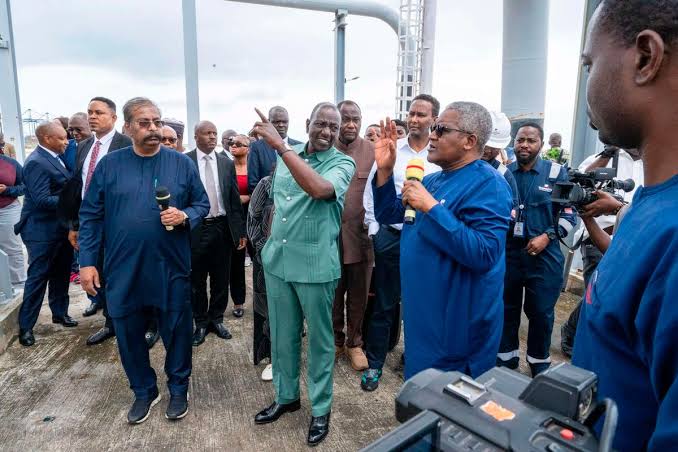
A vessel carrying approximately 2,930 metric tonnes of heavy machinery reportedly arrived at the Port of Lamu on September 26. The equipment is expected to support activities associated with the project.
The arrival of the equipment came shortly before the scheduled groundbreaking ceremony and added to expectations that the project would move into a new phase.
The planned investment has therefore generated significant interest not only in Lamu but across Kenya.
A BALANCE BETWEEN INVESTMENT AND COMMUNITY RIGHTS
The dispute presents a broader question about how Kenya can pursue large-scale investments while addressing the rights of communities affected by development projects.
Major infrastructure and industrial projects can generate employment, improve infrastructure and attract investment, but they can also create disputes where land ownership, compensation and resettlement issues remain unresolved.
The Lamu refinery case has brought those competing concerns into sharp focus.
On one side, the government and investors see the refinery as an important economic and industrial opportunity.
On the other, residents are demanding that their land and property concerns be addressed before the project advances on disputed areas.
The ongoing court process provides the legal avenue through which those competing claims can be examined.
The October 14 hearing is therefore expected to be significant for the residents and other parties involved in the case.
GOVERNMENT EXPECTED TO PROCEED
For now, the government maintains that the planned groundbreaking will go ahead.
The Energy and Petroleum Ministry has confirmed that the ceremony remains scheduled for September 30, while Dangote has also indicated that the court dispute will not stop the launch.
President Ruto's administration has continued to emphasise the importance of the investment and its potential contribution to Kenya's economy.
The President's support for the project comes as his government seeks to attract major investments in manufacturing, energy, infrastructure and other productive sectors.
The refinery is part of a broader strategy aimed at increasing industrial activity and expanding Kenya's position as a regional economic hub.
However, the government will still have to contend with the legal proceedings and the concerns raised by the affected residents.
WHAT HAPPENS NEXT?
The immediate focus will be on Wednesday's planned groundbreaking ceremony and the October 14 court hearing.
The groundbreaking can proceed under the current court position because the court did not grant the residents' request to stop the ceremony. However, the order requiring the status quo to be maintained on LR No. 13061 remains in place until the matter is heard.
The court will eventually consider the residents' arguments and responses from the government, agencies and other parties named in the proceedings.
Until then, the land dispute remains unresolved.
The refinery itself remains a major proposed investment, with a projected processing capacity of 700,000 barrels of crude oil per day and an estimated cost of around KSh2.2 trillion.
For the government, the project represents an opportunity to expand Kenya's industrial and energy capacity.
For the affected residents, the priority remains securing recognition of their land interests, compensation and protection of their livelihoods.
As the two sides await further legal proceedings, President Ruto and the government continue to support the refinery's development.
The current situation therefore involves two parallel processes: the government's push to advance a major industrial investment and the residents' legal effort to address their land and compensation concerns.
With the groundbreaking scheduled for September 30 and the court set to hear the dispute on October 14, the coming weeks are likely to provide greater clarity on how the project will proceed and how the outstanding land issues will be addressed.
For now, the government maintains that the Dangote refinery project remains on course, while the residents continue to seek legal protection and compensation over the disputed land.
The final outcome will depend on the ongoing legal process and any agreements or decisions reached between the affected communities, government agencies and the project developers.

You Might Also Like
-
Ameliah Cherotich from Keringet, Kuresoi South, is battling a serious heart condition and urgently needs specialised treatment in India. Her family is seeking KSh 2.5 million and is appealing to leaders, well-wishers and the community for support.
-
The government is targeting the issuance of at least 500,000 more title deeds in the Coastal region, building on an ongoing programme aimed at strengthening land ownership, resolving historical disputes and improving security of tenure.
-
The latest NTSA developments show that Kenya's matatu sector is entering another phase of regulatory and professional reforms. The authority is currently emphasizing qualified drivers and crew, roadworthy vehicles, proper licensing, maintenance records, authorised routes and responsible management o
-
Kenyan TikTok personality Patrick Mbacio, popularly known as “Patrick The Truth,” has died after being found dead inside his home in Nakuru, bringing to an abrupt end the life of a social-media figure who rose to fame through viral videos about his relationships, lifestyle and interactions with
-
Aliko Dangote's journey has moved from commodity trading to one of Africa's largest industrial empires. His businesses now span cement, fertiliser, sugar, food products, petrochemicals, oil refining, logistics and related industries. Forbes currently estimates his wealth at approximately $31.4 billi
-
Lang’ata MP Jalang’o has announced a candle-lighting ceremony at Uhuru Park this Friday to commemorate the life and legacy of the late Raila Odinga.