



Ruto Takes Kenya’s Infrastructure Agenda to Lagos as Africa Finance Corporation Expands Footprint in Nairobi
President William Ruto's engagement with the Africa Finance Corporation and the establishment of AFC's Nairobi regional office represent an important development in Kenya's relationship with one of Africa's major infrastructure finance institutions. While AFC remains headquartered in Lagos, the opening of its first regional office outside Nigeria in Nairobi in 2026 gives Kenya and the wider East African region closer access to AFC's infrastructure financing, project development and advisory capabilities. The partnership also fits into Ruto's wider call for stronger African-led financing of development. Kenya's additional investment in AFC, the Host Country Agreement for the Nairobi office and the Africa We Build Summit all point to efforts to strengthen the role of African institutions in financing the continent's infrastructure and industrialisation. For East Africa, the Nairobi office could become an important platform for identifying and structuring regional investments in transport, energy, industry, telecommunications and other strategic sectors. The long-term significance will depend on the projects that are ultimately developed, financed and implemented through the strengthened relationship between Kenya, AFC and other regional partners.
President William Ruto’s engagement with the Africa Finance Corporation (AFC) and its headquarters in Lagos, Nigeria, comes against the backdrop of Kenya’s growing effort to strengthen African-led financing for infrastructure, trade and industrial development. The development is particularly significant because, in April 2026, AFC and the Government of Kenya signed an agreement establishing the corporation’s first regional office in Nairobi, expanding AFC’s presence beyond its headquarters in Lagos.
Ruto’s engagement with AFC
President Ruto has increasingly emphasized the importance of African countries developing stronger mechanisms for financing their own infrastructure and economic transformation. AFC is central to this discussion because it is an African multilateral development finance institution focused on infrastructure and industrial projects.
AFC was established in 2007 and has developed its operations around infrastructure investment, project development, financial and technical advisory services, project structuring and risk capital. Its major areas include energy, transport, natural resources, heavy industry and telecommunications. By May 2026, AFC said it had 48 member countries and had invested more than US$19 billion across 36 African countries since its establishment.
The corporation's headquarters are located on Osborne Road in Ikoyi, Lagos, Nigeria.
Ruto's engagement with AFC therefore represents more than a meeting between a Kenyan president and a financial institution. It is part of a broader conversation about how African capital can be mobilised to finance African priorities.
Why AFC is important to Kenya
Kenya has major infrastructure financing requirements involving roads, energy, ports, railways, manufacturing, housing, water infrastructure and digital connectivity. These projects require substantial amounts of capital, while governments across the continent face competing demands on their national budgets.
AFC provides one avenue through which large infrastructure projects can be structured and financed. Its model involves working with governments, private investors, financial institutions and other development partners to bring projects from planning to implementation.
For Kenya, closer cooperation with AFC could therefore provide opportunities to mobilise financing for projects that have regional as well as national importance.
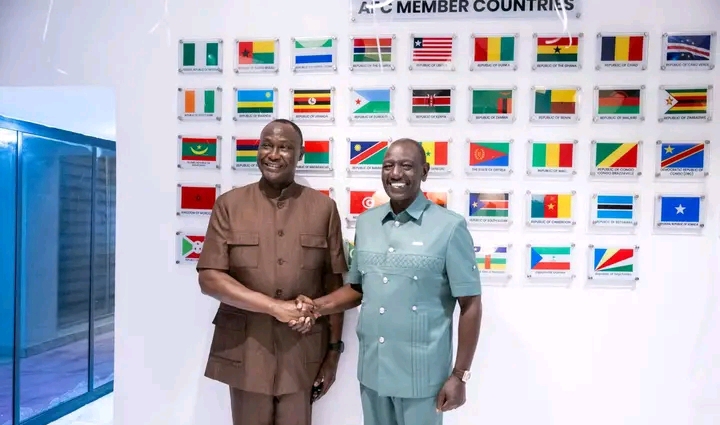
The significance of this relationship became clearer in April 2026, when Kenya and AFC formalised an agreement to establish AFC's first regional office outside Nigeria in Nairobi. The corporation said the office would help it expand infrastructure investment and financial solutions in East Africa.
Kenya opens AFC’s first regional office
One of the most important developments involving Kenya and AFC this year was the establishment of the Nairobi regional office.
On April 23, 2026, AFC and the Government of Kenya signed a Host Country Agreement establishing the office. The agreement was signed by Prime Cabinet Secretary Musalia Mudavadi and AFC President and CEO Samaila Zubairu, in an event witnessed by President Ruto during the Africa We Build Summit in Nairobi.
The Nairobi office is significant because it represents AFC's first regional office outside its Nigerian headquarters.
According to AFC, the new office is intended to strengthen the corporation's ability to identify and support investment opportunities in East Africa. AFC announced a target of mobilising an additional US$2 billion in regional investments and financial services solutions through the Nairobi presence.
This means Nairobi is increasingly being positioned as an important centre for regional infrastructure financing.
What the Nairobi office means for East Africa
The new office can bring AFC's expertise closer to governments, businesses and investors in East Africa.
Rather than requiring all regional engagements to be coordinated from Lagos, the Nairobi office gives AFC a base within the East African market. This could make it easier to identify projects, engage local stakeholders and develop financing structures for infrastructure and industrial investments.
The office could also strengthen Kenya's role as a regional financial and business centre.
AFC's presence in Nairobi may help bring together governments, development finance institutions, private investors and project developers around infrastructure opportunities across East Africa.
The potential areas of cooperation include transport corridors, energy generation and transmission, industrialisation, telecommunications and natural-resource-related investments.
Ruto’s call for African-led financing
Ruto's engagement with AFC has also been linked to his broader argument that African countries need to mobilise more of their own financial resources.
Speaking at the Africa We Build Summit in Nairobi in April 2026, the President argued that Africa should make greater use of its own financial capital to finance infrastructure.
He pointed to roads, ports, airports and oil refineries as examples of projects requiring significant investment. He also warned against excessive dependence on external capital for Africa's development priorities.
Ruto cited Kenya's proposed National Infrastructure Fund and Sovereign Wealth Fund as mechanisms that could help mobilise capital.
According to the President, Kenya is seeking to mobilise public and private, domestic and foreign capital for priority projects worth approximately KSh5 trillion over the next decade.
His message fits closely with AFC's broader role as an African institution focused on infrastructure and industrial development.
The Africa We Build Summit
The Nairobi regional office agreement was announced during the inaugural Africa We Build Summit 2026, which brought together African political leaders, financiers and business leaders.
The summit was co-hosted by Kenya and AFC and focused on infrastructure as a driver of industrialisation. President Ruto was among the leaders participating, alongside Ugandan President Yoweri Museveni, AFC President and CEO Samaila Zubairu and Nigerian businessman Aliko Dangote.
The summit focused on the challenge of financing infrastructure and creating stronger connections between African economies.
The discussions also highlighted the importance of regional infrastructure. Roads, railways, ports, electricity networks and other systems can connect producers to markets and enable countries to benefit from each other's resources.
For East Africa, such infrastructure has particular importance because trade and economic activity increasingly cross national borders.
Kenya’s additional investment in AFC
Another important part of the relationship is Kenya's financial participation in AFC.
In April 2026, Kenya announced plans to acquire an additional US$25 million stake in AFC, equivalent at the time to about KSh3.23 billion. Kenya has been an AFC shareholder since 2017.
The additional investment demonstrates Kenya's interest in strengthening its relationship with the continental development finance institution.
It also comes at a time when Kenya is seeking to attract more financing for infrastructure and development projects.
AFC’s wider financial capacity
AFC's financial position also helps explain why Kenya is seeking deeper cooperation with the institution.
The corporation reported that its 2025 total assets increased to US$19.23 billion, while total equity reached US$5.07 billion. Its total comprehensive income rose to US$513.8 million, while net profit reached US$444.8 million.
AFC also reported that it raised US$330.6 million in new capital during 2025 and completed several major infrastructure-related financing transactions.
These figures illustrate the scale of the institution's operations and its potential role in mobilising financing for major African projects.
Possible impact on infrastructure development
The Nairobi office could make it easier for East African countries to engage AFC when seeking financial and technical support.
Infrastructure projects often require more than money. They require feasibility studies, legal arrangements, risk assessments, financial structuring, environmental considerations and negotiations among governments and investors.
AFC's role includes these technical and financial functions.
Consequently, the Nairobi office could serve as a platform for developing projects that are commercially viable and capable of attracting investment.
For Kenya, this could support efforts to expand infrastructure while bringing in private-sector participation.
Regional integration
The relationship between Kenya and AFC also has a regional dimension.
Ruto has repeatedly linked infrastructure development with regional integration. At the Africa We Build Summit, he argued that African countries should improve connectivity through roads, railways, ports and electricity grids so that raw materials and intermediate goods can move more freely across borders.
This approach means infrastructure is viewed not simply as individual national projects but as interconnected systems.
For example, an efficient road or railway linking several countries can support trade across a wider region. Similarly, interconnected electricity systems can help countries share energy resources and improve reliability.
The presence of AFC in Nairobi could therefore give East African governments and investors another platform for developing cross-border projects.
Energy and industrialisation
Energy is another major area in which AFC's expertise could be relevant.
Africa continues to face significant challenges in expanding electricity generation and transmission while also seeking to industrialise.
During the 2026 summit, Ruto highlighted Africa's position as a major producer of crude oil while still relying heavily on imported petroleum products. He also discussed regional efforts to explore a joint refinery at Tanzania's Tanga Port involving East African countries.
Such projects illustrate why African development finance institutions are important. Large energy and industrial projects require significant amounts of long-term financing and coordination.
AFC's mandate covers energy, heavy industry and natural resources, making these sectors relevant to its cooperation with Kenya and other East African states.
What the development could mean for investors
The establishment of AFC's Nairobi office could also be important to investors.
A regional presence can provide investors with greater access to information about infrastructure opportunities and facilitate engagement with project developers and governments.
For private investors, the participation of a development finance institution can also be relevant when assessing the financial structure and risks of major projects.
AFC's involvement does not automatically guarantee that every proposed project will receive funding. Projects still need appropriate structures, feasibility, financial viability and other requirements before financing can be concluded.
Nevertheless, the Nairobi office creates an additional institutional platform through which potential investments can be explored.
Kenya’s growing role in African finance
The establishment of AFC's Nairobi office adds to Kenya's role as a regional financial and diplomatic centre.
Nairobi already hosts numerous international organisations, financial institutions and regional bodies. Having AFC establish its first regional office outside Nigeria adds another major continental financial institution to the city's economic ecosystem.
It also reflects Kenya's strategy of attracting institutions capable of supporting infrastructure, trade and investment.
For AFC, meanwhile, Nairobi provides proximity to East Africa's economies and access to a region with significant infrastructure and investment requirements.
AFC’s continental reach
AFC's expansion comes as its continental membership continues to grow.
The corporation reported that four additional countries—Comoros, Somalia, the Central African Republic and Equatorial Guinea—joined in 2025, bringing membership to 48 countries and extending its coverage to 89 percent of the African continent.
This expanding membership gives AFC a broad continental footprint.
Kenya's new regional office therefore comes at a time when AFC is increasing its geographical reach and financial capacity.

You Might Also Like
-
Dr Joyce Kithure's call for young people to use digital media for climate action places Kenya's youth at an important intersection between technology, environmental conservation and public advocacy. Speaking during the launch of the Youth Climate Policy and Advocacy Training programme at KISE, she
-
President William Ruto responds to Kalonzo Musyoka, saying the Tsiekuru road is among many infrastructure projects his administration is pursuing across the country.
-
Former Deputy President Rigathi Gachagua has pledged to intensify the fight against drug trafficking, promising tougher border controls to prevent heroin, cocaine and cannabis from entering Kenya within the first year of his administration.
-
President William Ruto's September 26, 2026 visit to Taita Taveta County focused on development, with particular attention to technical education, land ownership and infrastructure. The President laid the foundation stone for Wumingu Technical and Vocational College, participated in the Coast-wide t
-
Mike Bloomberg's discussions with President William Samoei Ruto bring attention to three important dimensions of Kenya's development agenda: healthier food choices, the clean-energy transition and ocean conservation. The front-of-package warning-label debate is focused on giving Kenyan consumers cl
-
The Koitaleel Samoei University College main campus in Nandi Hills is now approaching a major milestone after years of delays. The latest September 2026 reports place construction at about 85 per cent, with an administration block and 14 lecture halls forming key components of the development. Finis