



Taita Taveta Road Fire Incident: What Happened Along the Voi–Taveta Road
The fire along the Voi–Taveta Road in Taita Taveta County on September 6, 2026, was initially reported as a possible tanker-related fire but was later confirmed by the Kenya Red Cross as a bush fire. The correction came after ground teams assessed the situation. The response brought together the Kenya Red Cross, Kenya Wildlife Service and the Taita Taveta County fire brigade, with teams working to contain the blaze, protect nearby residents and ensure the safety of road users. The incident highlights several important issues: the dangers posed by roadside fires, the importance of rapid emergency response, the need to protect wildlife and natural vegetation, and the importance of accurate information during developing emergencies. It also comes at a time when Taita Taveta has been experiencing wider concerns about fires affecting natural habitats. For residents and motorists, the key message is to remain vigilant, report fires immediately, avoid approaching active flames and cooperate with emergency responders. As investigations and assessments continue, authorities will need to establish the cause and full extent of the latest blaze. The incident ultimately serves as another reminder that effective fire prevention, rapid response and cooperation between county authorities, national agencies and local communities are essential to protecting lives, property, roads and the environment in Taita Taveta.
A fire incident reported along the Voi–Taveta Road in Taita Taveta County has attracted attention after flames were seen spreading across vegetation near the busy road on the night of Sunday, September 6, 2026. The incident initially generated reports suggesting that a fuel tanker had overturned and caught fire, raising fears of a potentially serious hazardous-materials accident. However, the Kenya Red Cross later clarified that the incident was a bush fire and not a tanker fire.
The incident comes at a time when parts of Taita Taveta have experienced dry conditions and several fire incidents, making the latest blaze an important concern for residents, motorists, wildlife authorities and emergency-response agencies.
*What happened?*
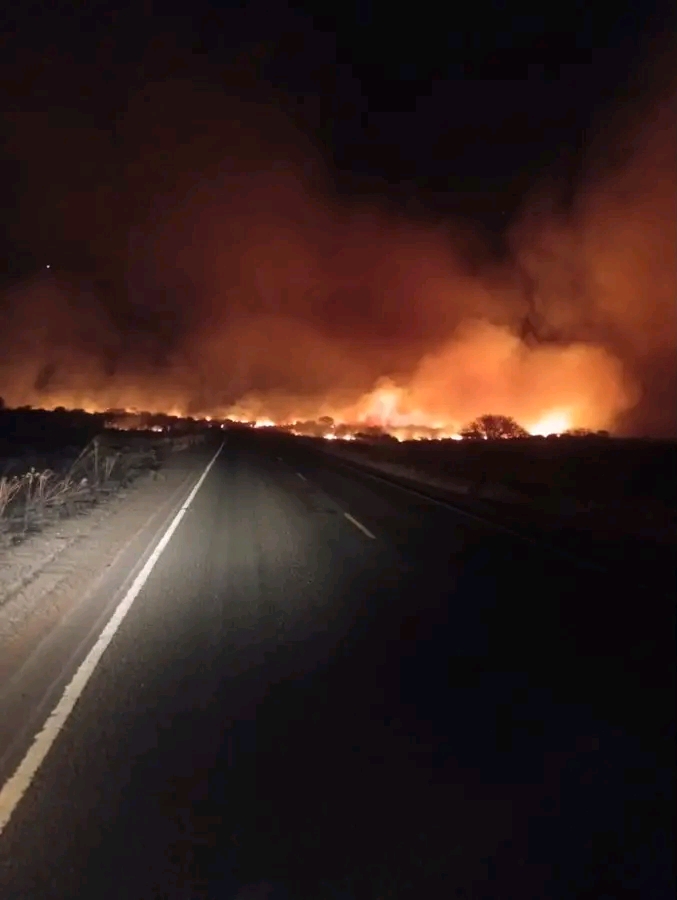
According to reports from the scene, the fire broke out along the Voi–Taveta Road at approximately 9:50 p.m. on Sunday, September 6. A large area of vegetation was reportedly affected as the flames spread along the roadside. Images and reports from the area showed a significant blaze, prompting emergency teams to respond.
The first reports caused considerable concern because they described the incident as involving a fuel tanker. A report circulated that a tanker had lost control, overturned and spilled fuel, with the fuel subsequently igniting and causing flames to spread into surrounding vegetation.
Such a scenario would have posed a major danger because fuel fires can spread rapidly and create serious risks for motorists, pedestrians, nearby residents and emergency responders.
However, after teams reached the area and assessed the situation on the ground, the Kenya Red Cross clarified that the incident was a bush fire rather than a tanker fire. The clarification was important because it corrected the initial description of what had happened.
Emergency teams respond
Several agencies moved in to respond to the fire. The Kenya Red Cross, Kenya Wildlife Service (KWS) and the Taita Taveta County fire brigade were reported to be working together to contain the blaze.
Citizen Digital reported that the multi-agency response was aimed at controlling the fire and preventing it from spreading to nearby areas. Teams were also working to protect residents and road users who could have been affected by the flames or smoke.
The involvement of KWS is particularly significant because Taita Taveta contains important wildlife habitats and conservation areas. A bush fire in the region can therefore pose a threat not only to people and property but also to wildlife and vegetation.
Firefighters face additional challenges when dealing with vegetation fires because flames can move quickly depending on wind, dryness and the availability of combustible vegetation. Unlike a small building fire, a bush fire can spread over a large area and become difficult to control if it reaches thicker vegetation or dry grasslands.
Why the incident caused concern
The Voi–Taveta corridor is an important transport route connecting communities and facilitating movement between different parts of Taita Taveta. A fire close to such a road can create several risks.
One of the immediate concerns is visibility. Thick smoke can reduce visibility for motorists, particularly at night. Drivers approaching an area affected by smoke or flames may have difficulty seeing other vehicles, pedestrians or obstacles.
There is also the danger of motorists stopping too close to the fire. People may be tempted to leave their vehicles to watch or record an incident, but this can expose them to smoke, heat and unexpected changes in the direction of the flames.
Emergency responders also require sufficient space to operate. When crowds gather around an incident, firefighters and other emergency teams can experience difficulties accessing the affected area.
For this reason, motorists and members of the public are generally advised to keep a safe distance from active fires and allow emergency personnel to work without obstruction.
Clarification about the alleged tanker fire
One of the most important aspects of this incident is the correction issued by the Kenya Red Cross.
Initial information indicated that a fuel tanker had overturned and that spilled fuel had ignited. The Red Cross subsequently stated that ground teams had established that the fire was actually a bush fire.
This highlights the importance of relying on verified information during emergencies.
Reports of fires and accidents can spread extremely quickly through social media and messaging platforms. When an incident is still developing, early reports can sometimes contain incomplete or inaccurate information. In this case, the tanker-fire description was later corrected following confirmation from teams at the scene.
The distinction matters because the emergency response to a tanker carrying fuel would involve specific hazardous-material precautions. A bush fire, while still dangerous, presents a different set of risks and requires a different response strategy.
Environmental concerns
The Taita Taveta region is environmentally important, with forests, wildlife habitats, farms and other natural resources. Bush fires can cause significant environmental damage if they spread over large areas.
A fire can destroy grass, shrubs, trees and crops while also affecting animals that depend on the vegetation for food and shelter. Smaller animals may be particularly vulnerable because they may not be able to escape rapidly from advancing flames.
The region has already faced concerns about fires affecting natural habitats. A report published earlier in September 2026 highlighted concerns over fires and their impact on biodiversity in Taita Taveta, including threats to endangered species such as the Taita apalis.
This means the latest Voi–Taveta Road fire should not be viewed solely as a roadside incident. If bush fires become frequent or spread into forests and wildlife habitats, their cumulative environmental impact can be considerable.
Taita Taveta's history of fire emergencies
Fire incidents are not entirely new to the county. The Taita Taveta County government's development planning documents indicate that its fire department has responded to different types of emergencies, including house fires, road accidents, water rescues, highway fires, highway oil spillages and bush fires.
The county has also undertaken training and capacity-building initiatives for its fire officers. The county document notes that fire officers received training in firefighting and rescue techniques, including support and training involving European partners.
Such preparedness is important because Taita Taveta has major highways, wildlife areas, settlements and agricultural zones. Emergencies can therefore take different forms and require different response capabilities.
Another vehicle fire near Voi
The latest bush fire occurred only days after another significant fire incident involving a passenger bus in the Voi area.
On Friday, September 4, 2026, a 50-seater Tahmeed passenger bus reportedly caught fire in Voi, Taita Taveta County. Preliminary reports indicated that two rear tyres had burst before the vehicle caught fire. Passengers reportedly managed to evacuate the bus safely.
Although the two incidents are different and there is no indication that they are connected, their occurrence within a short period has drawn attention to safety along roads in the county.
The bus incident also demonstrates why passengers should remain alert during emergencies. Quick evacuation can make an important difference when a vehicle develops a serious mechanical or fire-related problem.
Safety lessons for motorists
The Voi–Taveta fire provides several important lessons for motorists.
First, drivers should remain alert when approaching areas where smoke is visible. Speed should be reduced where visibility is affected.
Second, motorists should avoid stopping unnecessarily near an active fire. A vehicle parked close to flames can obstruct emergency responders and expose occupants to danger.
Third, drivers should follow instructions from police, firefighters and other emergency personnel. If authorities advise motorists to use an alternative route, such directions should be followed.
Fourth, people should avoid spreading unverified information. The initial description of the Taita Taveta fire as a tanker incident demonstrates how quickly incorrect information can circulate during an emergency.
Importance of accurate emergency information
The Kenya Red Cross clarification is an important reminder of the role played by emergency agencies in providing reliable information.
During a major incident, people often depend on social media for updates. While social media can provide information quickly, early posts may not always provide the complete picture.
Official statements from emergency responders can help establish what actually happened, whether there are casualties, what areas are affected and what members of the public should do.
In this particular case, the clarification that the incident was a bush fire helped prevent continued circulation of the tanker-fire account.
What remains unclear
Despite the clarification about the nature of the fire, some details remained unclear in the reports available by September 7.
The precise cause of the bush fire had not been established in the reports reviewed. It was also not immediately clear how much vegetation had been destroyed or whether any homes, farms, wildlife or other property had suffered significant damage.
The response operation was still ongoing, meaning that authorities could provide additional information after assessing the affected area.
It is therefore important not to attribute the fire to a particular individual, organisation or cause without an official investigation.
A wider warning about dry conditions
The incident also raises broader concerns about fire preparedness in Taita Taveta.
Dry vegetation can become highly flammable, allowing fires that begin in small areas to spread quickly. Human activities, accidental ignition, burning of vegetation and other factors can contribute to bush fires, although the specific cause of this particular incident had not been established at the time of reporting.
Residents living near forests, farms and roads therefore have an important role to play in preventing fires. Communities can help by reporting fires early, avoiding careless burning and ensuring that emergency responders are alerted as soon as flames are detected.

You Might Also Like
-
Jaswinder Bedi's decision to speak publicly has provided more information about the company behind Kenya's new police uniforms and the process through which it obtained the contract. Bedi Investments Limited, according to both the company and the National Police Service, is the manufacturer respons
-
The death of Martina Chepkemoi Rutto has left her family facing profound grief while also demanding answers about what happened to their loved one. She had been reported missing on August 26 before her body was reportedly recovered from Kimugu River with multiple stab wounds. Police have opened inve
-
Content creator Eric Omondi has proposed major changes to Kenya's governance structure, including reducing the number of counties, scrapping the Senate and cutting the number of elected and nominated leaders. His proposal has sparked debate about the cost of governance, representation and the future
-
Caleb Amisi's Renaissance plan represents one of the emerging political projects ahead of Kenya's 2027 General Election. Through the People’s Renaissance Movement, he is presenting a vision centred on economic liberation, justice, youth empowerment, constitutionalism, anti-corruption measures, wom
-
United Opposition leaders are urging unity and selflessness as they prepare to choose a single flagbearer to challenge President William Ruto. The leaders say the selection process must identify the strongest candidate with national appeal, strong leadership qualities and the ability to unite the op
-
The planned Kenya Power interruptions for Monday, September 7, 2026, affect selected areas in six counties: Nairobi, Bomet, Siaya, Migori, Nyeri and Meru. The longest interruption periods generally run from morning into late afternoon, although the exact schedule varies by location. The affected c