



Trailer Bursts Into Flames Along Kericho–Kisumu Highway as Residents Rush to Contain Fire
The trailer fire at Kipsitet along the Kericho–Kisumu Highway on September 3, 2026, has drawn attention to the dangers faced by long-distance transport operators and other road users. The trailer, reportedly travelling toward Uganda, caught fire shortly after being parked along the highway near Moi Girls Kipsitet. The driver escaped after noticing the flames, while residents, traffic police and a water truck helped contain the fire. The front section of the vehicle suffered extensive damage, although the cargo container was reported to have remained largely intact. The exact cause remains subject to investigation, and it is important that authorities establish the facts before attributing responsibility. The incident nevertheless provides an opportunity for transport companies, drivers, emergency agencies and road authorities to reassess vehicle maintenance, emergency response and highway safety. For motorists, the main lesson is clear: when a heavy vehicle catches fire, safety must come first. Drivers should maintain distance, avoid unnecessary stopping near the scene and follow instructions from police and emergency personnel. For authorities, the incident highlights the importance of timely emergency response along busy highways. For transport operators, it is a reminder that regular inspection and preventive maintenance can help identify dangerous faults before they result in fires or other emergencies. The Kipsitet trailer fire may have ended without reported loss of life, but the extensive damage to the vehicle demonstrates how quickly a roadside emergency can escalate. The findings of the ongoing investigation will be important in explaining what caused the fire and in identifying measures that could help prevent similar incidents on the Kericho–Kisumu corridor and other major highways in Kenya.
A long-distance trailer burst into flames on the morning of Thursday, September 3, 2026, along the busy Kericho–Kisumu Highway, raising concern among motorists and residents in the Kipsitet area of Kericho County. The incident occurred near Moi Girls Kipsitet, where the trailer, reportedly travelling toward Uganda, caught fire shortly after being parked beside the highway. Preliminary reports indicate that the exact cause of the fire had not been established by the time of reporting.
The incident at Kipsitet
According to reports from the scene, the trailer was a long-distance truck involved in transporting cargo toward Uganda. It had been travelling along the Kericho–Kisumu route before being parked along the road in the Kipsitet area. Moments later, the vehicle caught fire.
The incident reportedly happened at around 8am, a time when the Kericho–Kisumu Highway was already carrying motorists, public service vehicles, trucks and other road users. The sudden outbreak of fire therefore attracted the attention of residents and motorists in the area.
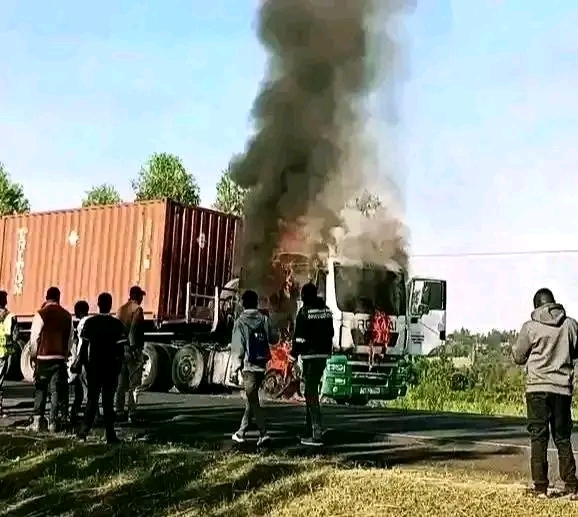
Witnesses reported seeing thick black smoke rising from the vehicle, particularly from the front section. The smoke created an alarming scene along the highway as residents moved closer to establish what was happening.
The driver was reportedly inside the vehicle when the fire started and initially did not realise that the trailer had caught fire. He noticed the danger moments later and managed to get out of the vehicle and move to safety. This was particularly important because fires involving heavy commercial vehicles can spread rapidly, especially when mechanical, electrical or fuel-related components are involved.
Fortunately, initial reports did not indicate deaths or serious injuries arising from the incident.
Residents intervene
One of the notable aspects of the Kipsitet incident was the response by residents who witnessed the fire. People near the scene reportedly intervened as they waited for more specialised emergency assistance.
The fire was eventually brought under control after a water truck and traffic police officers arrived. By then, however, the flames had caused extensive damage to the front section of the trailer. Reports indicate that the container carrying the cargo was largely intact, while the cabin and other parts at the front were severely damaged.
Photographs circulating from the scene showed the extent of the damage. The front part of the trailer was left badly affected by the flames, illustrating how quickly a vehicle fire can destroy a heavy commercial vehicle.
Residents also expressed concern about the speed of emergency response. Some witnesses reportedly felt that firefighting assistance took longer than expected, allowing the fire to cause considerable damage before it was fully contained.
Cause of the fire remains unknown
At the time of the initial reports, authorities had not announced a confirmed cause of the fire.
This is an important distinction because it would be premature to blame a particular mechanical or electrical component before investigators complete their assessment. Police and other relevant authorities are expected to examine the vehicle and establish what triggered the flames.
Possible causes of heavy-vehicle fires can include mechanical failures, electrical faults, overheating components, brake problems, fuel leaks and other issues. However, these possibilities should not be treated as the confirmed cause of the Kipsitet incident until authorities release their findings.
Investigators may examine the engine compartment, electrical wiring, fuel system, tyres, brakes and other components as part of determining how the fire started.
The condition of the vehicle before the journey may also become relevant. Long-distance trailers cover substantial distances and operate under demanding conditions. Proper inspection and maintenance are therefore essential in reducing the possibility of mechanical problems developing while on the road.
Importance of the Kericho–Kisumu Highway
The incident occurred on an important transport corridor connecting Kericho with Kisumu and other parts of western Kenya. The County Government of Kericho describes the B1 road as linking Mau Summit, Kericho, Kisumu and Busia, making it an important connection for passenger and commercial transport.
The route is used by private motorists, public transport operators, agricultural producers and long-distance trucks. Commercial vehicles frequently use the corridor to transport goods between different parts of Kenya and toward neighbouring countries.
The presence of a long-distance trailer travelling toward Uganda highlights the regional importance of the road. Trucks using this corridor form part of a wider supply chain connecting Kenyan ports, industrial centres, towns and neighbouring countries.
Consequently, an accident or fire involving a large truck can have effects beyond the immediate vehicle. It can slow traffic, create safety risks and potentially disrupt the movement of goods.
Potential traffic disruption
Vehicle fires along busy highways can quickly create traffic problems. Motorists approaching a burning truck have to slow down, stop or find a safe way around the affected section of road.
There is also the danger posed by smoke. Thick smoke can reduce visibility for approaching drivers, increasing the possibility of secondary collisions. Drivers who become distracted while watching a burning vehicle may also expose themselves and other road users to danger.
The situation can become even more complicated if motorists stop unnecessarily near the scene. Curious onlookers can obstruct emergency vehicles and make it more difficult for firefighters, police officers and rescue teams to reach the affected vehicle.
For this reason, motorists are normally expected to follow instructions from traffic officers and keep a safe distance from a burning vehicle.
Lessons from previous incidents
The Kipsitet fire is not the first truck fire reported along the Kericho–Kisumu Highway. A similar incident occurred in November 2017, when a truck carrying cement-manufacturing materials caught fire near Moi Kipsitet Girls High School. The driver at the time reportedly escaped after the vehicle caught fire, while the incident caused significant traffic disruption.
The earlier incident demonstrates that vehicle fires have previously occurred in the same general area. While the circumstances of the 2017 incident and the 2026 incident are different, both highlight the importance of preparedness along major transport corridors.
It is therefore important for transport companies and vehicle owners to ensure that heavy commercial vehicles undergo regular inspections and maintenance.
Safety concerns surrounding heavy trucks
Heavy trucks and trailers require particular attention because of their size, weight and mechanical complexity. A small problem that might be manageable in a passenger car can become much more dangerous in a large commercial vehicle.
Brake systems, tyres, electrical wiring, engines and fuel systems need to be maintained properly. Long-distance journeys can put significant strain on these components.
Drivers also need to remain alert to unusual smells, smoke, warning lights, overheating or changes in vehicle performance. Identifying a problem early can allow a driver to stop in a safe location before a minor mechanical issue develops into a major fire.
Transport companies also have a responsibility to ensure their vehicles are properly maintained and that drivers have appropriate emergency procedures.
The role of emergency preparedness
The Kipsitet incident has also raised questions about emergency preparedness along major highways.
Having firefighting and rescue equipment available within reasonable reach of busy transport corridors can make a significant difference during emergencies. A vehicle fire can grow rapidly, meaning that early intervention is often critical.
Local residents sometimes become the first people to respond to emergencies because they are already near the scene. However, members of the public must also avoid exposing themselves to unnecessary danger.
In particular, people should not approach a burning truck simply to take photographs or videos. A fire may involve fuel, pressurised systems, batteries or other hazardous materials. The safest approach is to keep a safe distance and allow trained personnel to handle the situation.
Importance of police investigations
Traffic police are expected to investigate the circumstances surrounding the Kipsitet trailer fire. Their findings may help determine whether the incident resulted from a mechanical problem, electrical fault, human error or another factor.
An investigation can also establish whether the vehicle had been properly maintained and whether any safety regulations were violated.
Such investigations are important not only for determining what happened but also for preventing similar incidents in the future.
If investigators identify a mechanical defect or maintenance problem, the findings could serve as a warning to other truck operators using the same routes.
No confirmed casualties reported
One of the most significant aspects of the incident is that preliminary reports did not indicate fatalities or serious injuries. The driver reportedly managed to escape after noticing the fire, while residents and authorities worked to contain the flames.
Nevertheless, the absence of reported casualties should not diminish the seriousness of the incident. A burning heavy truck on a major highway can potentially result in injuries, fatalities, property damage and secondary accidents.
The situation could have been considerably worse if the fire had spread to the cargo or other nearby vehicles.
Broader concern about road safety
The trailer fire comes at a time when road safety remains a major concern in Kenya. Kericho and surrounding areas have experienced several serious road incidents involving trucks and other vehicles.
For example, recent reports documented a deadly crash involving a lorry and a pick-up truck at Fort Ternan in Kericho County, where three people were killed.
Another recent incident along the Kericho–Kisumu Highway involved former Roads Minister Franklin Bett, who sustained injuries after the vehicle he was travelling in collided with a tractor carrying sugar cane.
These incidents underline the need for greater attention to road safety, particularly on routes used by heavy commercial vehicles.
What motorists should do during a truck fire
When approaching a burning truck, motorists should avoid driving too close to the vehicle. They should slow down, follow traffic officers' directions and maintain a safe distance.
If traffic is stopped, drivers should remain patient instead of attempting dangerous overtaking manoeuvres. Sudden U-turns or driving onto the wrong side of the highway can create additional accidents.
Members of the public should also avoid crowding around the burning vehicle. Although people may want to assist, approaching without appropriate protective equipment can be extremely dangerous.
Emergency responders should be given enough space to operate effectively.

You Might Also Like
-
 The death of Nancy Akinyi Koiya, a 26-year-old mother of two and businesswoman from the Kisumu–Nandi border region, has left her family and community devastated. She reportedly disappeared after leaving her hotel and catering business at Kibigori Junction earlier this week. Her husband, Kiplagat K
 -
The latest HELB announcement by Education Cabinet Secretary Julius Ogamba is significant for thousands of Kenyan students preparing to join universities and TVET institutions. The government's decision to extend the 2026/2027 tertiary education funding application deadline to September 21, 2026, aft
-
FUNERALS WITHOUT BODIES: NEPAL FAMILIES MOURN LOVED ONES STILL MISSING AFTER DEVASTATING FLOODS
-
Kenya Airways has disclosed that it lost more than US$7 million (about KSh905 million) in revenue and additional disruption-related costs following a three-day industrial action that severely disrupted aviation operations in Kenya. The airline cancelled 63 flights, recorded more than 160 delays, wit
-
Kenya's current milk shortage is the result of several interconnected problems rather than one single cause. Dry and cold weather has reduced pasture and fodder availability, lowering milk yields in important dairy-producing areas. At the same time, high feed and operating costs have made production
-
The World Meteorological Organization (WMO) has issued a major weather outlook indicating a 100 per cent likelihood of El Niño conditions continuing through February 2027,