



Uhuru Park Turns Into Sea of Candles as Thousands Gather to Honour Raila Odinga
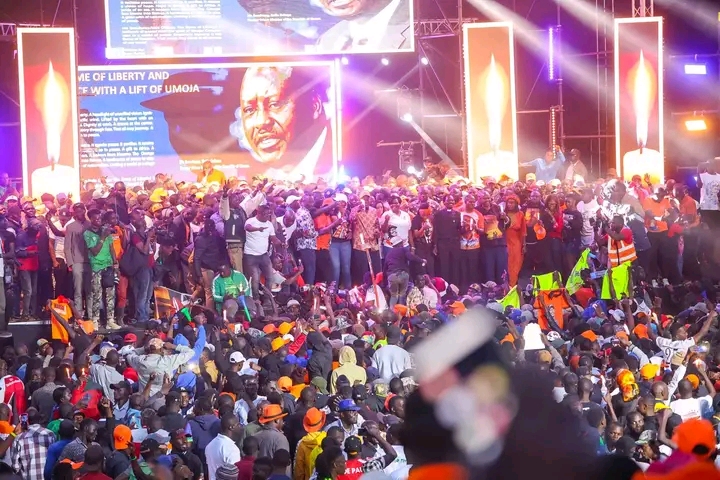
The gathering at Uhuru Park on October 2, 2026, became one of the major public events marking the first anniversary of Raila Odinga’s death. Thousands of people converged on the Nairobi park carrying candles, flowers, flags and portraits as they joined prayers, music, speeches and the nationwide candle-lighting ceremony. The event officially opened a month of commemorative activities under the “Mwezi wa Baba” programme, with additional memorial events planned across Kenya throughout October. For Raila’s supporters, the Uhuru Park gathering provided a public opportunity to mourn his death, celebrate his life and reflect on the political journey that made him one of Kenya’s most recognisable political figures.
Thousands of people gathered at Nairobi’s Uhuru Park on Friday, October 2, 2026, to remember the late former Prime Minister and ODM leader Raila Odinga during a candle-lighting memorial held in his honour. The gathering brought together ordinary Kenyans, ODM supporters, political leaders, public figures, artists and other members of the public who came to commemorate Raila’s life and reflect on his long political career.
The Uhuru Park event was part of a wider month-long programme dubbed “Mwezi wa Baba”, organised to commemorate Raila and mark one year since his death. Raila died on October 15, 2025, and the October 2026 activities are intended to give his supporters and members of the public an opportunity to remember his contribution to Kenya over several decades.
Large crowds arrive at Uhuru Park
People began arriving at Uhuru Park several hours before the main candle-lighting ceremony. According to reports from the event, activities at the park started at around 3pm, with music and entertainment taking place before the formal candle-lighting ceremony in the evening.
Those attending carried candles, flowers, flags, whistles and portraits of Raila Odinga. The items became prominent symbols of the evening as the crowd gathered to remember the politician popularly known by his supporters as “Baba.”
The atmosphere combined mourning and celebration. While the gathering was organised as a memorial, music and dance were also used to celebrate Raila’s life. Some of the songs played were associated with his political campaigns, including music remembered from his presidential campaigns in 2017 and 2022. Supporters sang and danced as they remembered the political figure who had remained influential in Kenya for decades.
Candle-lighting becomes the centre of the memorial
The main moment of the Uhuru Park gathering was the candle-lighting ceremony scheduled for 6pm. It formed part of a nationwide exercise in which Kenyans were encouraged to light candles simultaneously in honour of Raila.
The Nairobi event was among several memorial activities held in different parts of the country. Similar ceremonies were organised in places including Kisumu and Mombasa, while other locations were also included in the nationwide programme.
The candle was used as a symbol of remembrance, with participants reflecting on Raila's life and political journey. At Uhuru Park, the sight of numerous candles across the gathering created a significant visual feature of the memorial.
For many of those present, the gathering was not simply a political event but an opportunity to mourn a prominent Kenyan who had played a major role in the country's political history.
Political leaders attend the gathering
The memorial also attracted several political leaders. Reports from the event indicated that ODM Chairperson Gladys Wanga participated in the candle-lighting ceremony alongside other leaders associated with the broad-based political arrangement. Nairobi Governor Johnson Sakaja and other leaders were also present.
Homa Bay Governor Gladys Wanga, Nairobi Woman Representative Esther Passaris and Busia Woman Representative Catherine Omanyo were among leaders pictured during the ceremony.
The presence of leaders from different political backgrounds gave the gathering a wider political representation. The event was primarily about remembering Raila, although his political career naturally featured prominently in speeches and reflections about his life.
Raila spent several decades in Kenya’s political arena. He served as Prime Minister from 2008 to 2013 and was a central figure in opposition politics for many years. His supporters continue to associate him with campaigns for political reform, multiparty democracy and constitutional change.
Music, prayers and performances
The Uhuru Park programme was not limited to speeches and candle-lighting. Organisers included prayers and musical performances as part of the evening's activities.
Lang'ata MP Phelix Odiwuor, popularly known as Jalang’o, had announced that prayers would be led by Pastor Robert Burale. Gospel singer Solomon Mkubwa was also announced as one of the performers.
The entertainment programme helped create a mixture of solemn remembrance and celebration. Artists performed for the crowd while supporters sang along and remembered songs associated with Raila’s political journey.
This approach reflected the broader “Mwezi wa Baba” programme, which seeks not only to mourn Raila but also to celebrate aspects of his life and legacy.
Raila's political legacy remembered
Speakers and participants at the Uhuru Park memorial reflected on Raila’s contribution to Kenya. His supporters have long associated him with the country's struggle for political pluralism and constitutional reforms.
Raila was one of the most prominent figures in Kenyan politics from the late 20th century into the 21st century. His political career included periods in government as well as many years in opposition.
He was also a major participant in Kenya's 2007–2008 political crisis and the subsequent coalition government, serving as Prime Minister between 2008 and 2013. Later, he remained a major opposition figure and contested the presidency several times.
At the memorial, supporters remembered these different stages of his career and the political causes with which they associated him.
The memorial extends beyond Nairobi
The Uhuru Park gathering was only one part of a much larger programme. The organisers planned commemorative activities across different parts of Kenya throughout October.
A major memorial rally is scheduled for Kakamega on October 9, followed by family-led activities between October 10 and 15. The main anniversary events will take place around October 15, marking one year since Raila's death.
Further activities are planned in other regions, including Northern Kenya and the Coast. The programme is expected to culminate in Nairobi later in October with a national concert and legacy commemoration festival on October 31.
In Bondo, where Raila's family has strong roots, family-led commemorations are also expected to form an important part of the anniversary programme.
KICC projection adds to Nairobi tribute
Another notable feature of the Nairobi commemoration was the projection of Raila’s story and legacy onto the Kenyatta International Convention Centre tower.
The projection was scheduled from around 7pm, adding another public tribute to the candle-lighting ceremony taking place at Uhuru Park.
The use of one of Nairobi's most recognisable landmarks formed part of the wider effort to make the anniversary visible to residents and visitors in the capital.
A moment of remembrance for supporters
For the thousands who attended Uhuru Park, the gathering provided an opportunity to remember Raila away from the normal political campaign environment. Candles, flowers, photographs, music and speeches helped create an atmosphere centred on remembrance.
Many supporters came dressed in colours associated with ODM, while others carried portraits and other items connected with Raila. The crowd also included people who wanted to witness the historic memorial even without being active members of the party.
The scale of the gathering demonstrated the continuing public interest in Raila's life one year after his death. Similar crowds were reported in Kisumu, Kisii, Mombasa and other parts of the country, showing that the commemorations were taking place beyond Nairobi.
You Might Also Like
-
Ndindi Nyoro gives President William Ruto 14 days to make the Dangote Refinery agreement public, calling for greater transparency on the deal.
-
President William Ruto has handed over 20,189 title deeds to residents of Lamu County. The exercise is part of a wider programme to issue 300,000 title deeds across the Coast. Beneficiaries include residents from community lands and settlement schemes across Lamu. The initiative seeks to strength
-
Opposition leaders have graced the event, attracting a large gathering of supporters and wananchi. The leaders addressed key issues affecting Kenyans, including governance, development and the economy. The event also provided a platform for political engagement and interaction with the public. Lea
-
Rigathi Gachagua's latest engagements in the United States have focused heavily on Kenya's future and the role Kenyans abroad can play in shaping it. In Boston, he praised the achievements of the diaspora and said their skills, experience and financial contribution should receive greater recognition
-
Wicknell Chivayo’s family has announced that there will be no viewing of his body or that of his wife, Lucy Muteke, during their funeral ceremonies.
-
President William Ruto’s October 2, 2026 visit to Kilifi was largely centred on development and economic opportunities. The President launched and announced road projects, expanded electricity connectivity plans, invested in technical education, commissioned a modern market and outlined Government